

Local Economy
Bangladeshis are embracing digital finance without abandoning cash, revealing how convenience, trust and access still shape the way people choose to pay.

Illustrated By sk. yeahhia
18 August, 2026
A shopper can now find a product on Facebook, compare prices online, place the order through an app or Messenger, and track the parcel on a phone. Yet when the delivery rider finally arrives, there is a good chance the last part of the transaction will look much the same as it did years ago: the customer reaches for cash.
That says quite a lot about how Bangladeshis are actually using digital finance.
Digital payments have become part of everyday life. People send money through MFS, pay bills from their phones, recharge accounts and increasingly shop online. But that does not necessarily mean they want to leave cash behind. The same person who happily sends money through bKash in the morning may withdraw cash for groceries in the afternoon and choose cash on delivery for an online order at night.
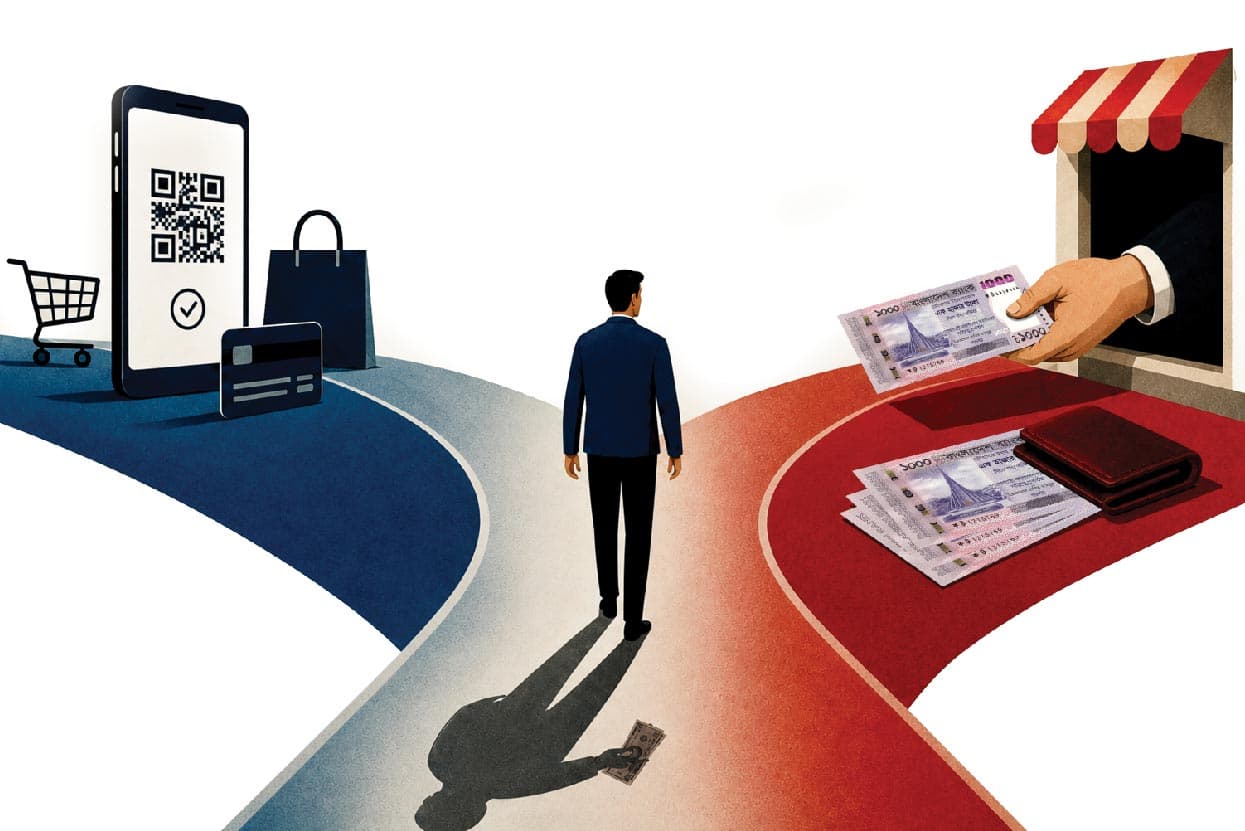
What is emerging, then, is not quite a cashless consumer, but a hybrid one. People are using digital payments where they find them useful, while holding on to cash where it still feels simpler, cheaper or safer.
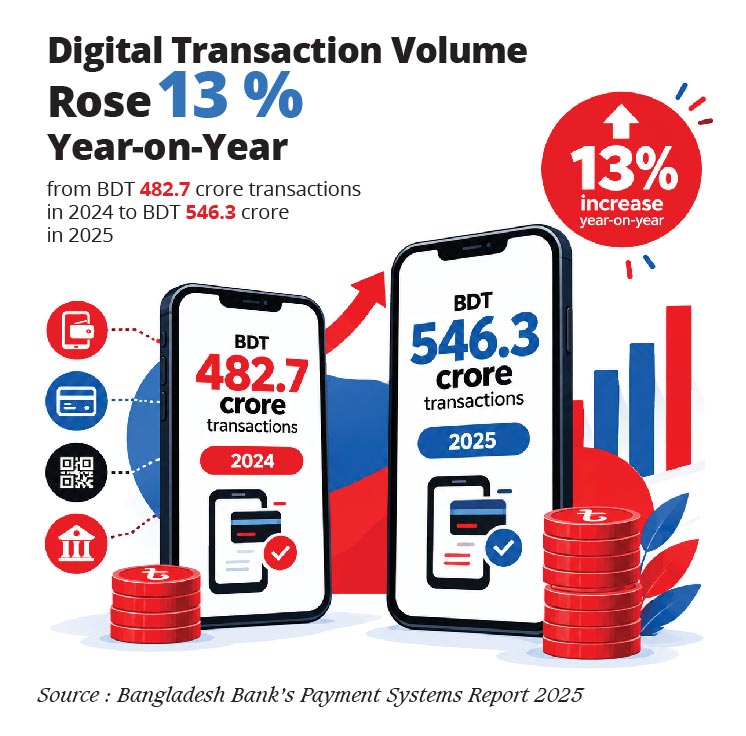
The numbers reflect that mixed behaviour. Bangladesh Bank’s Payment Systems Report 2025 shows digital transaction volume rose 13 % year-on-year, from BDT 482.7 crore transactions in 2024 to BDT 546.3 crore in 2025. Their value also increased 13%, from BDT 90.38 lakh crore to BDT 102.24 lakh crore. Yet digital channels accounted for only 32.8% of overall transaction value, while cash and other non-digital channels accounted for 67.2%, according to data from Bangladesh Bank's payment systems department.
That 67.2 % is not a direct measure of how much consumers spend in cash. Bangladesh Bank also counts deposits and withdrawals involving physical cash, including those through bank branches, ATMs and MFS agents. But it still points to something important: money can enter the digital system without staying there.
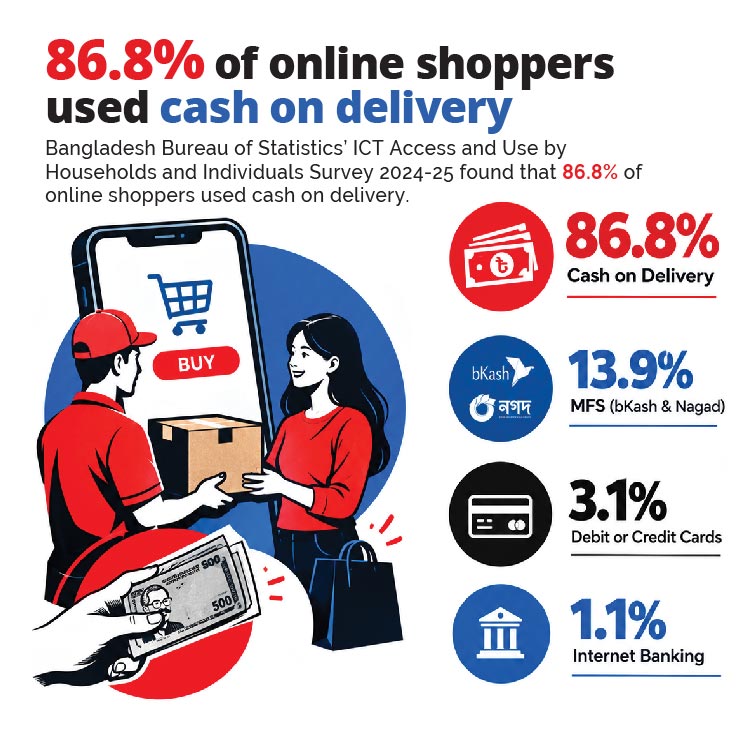
The consumer data makes the contradiction even clearer. The Bangladesh Bureau of Statistics’ ICT Access and Use by Households and Individuals Survey 2024-25 found that 86.8% of online shoppers used cash on delivery. MFS such as bKash and Nagad were used by 13.9%, debit or credit cards by 3.1%, and internet banking by only 1.1%.
So the question is no longer whether Bangladeshis are adopting digital finance. They clearly are. The more interesting question is why they use it in some moments but still return to cash in others — and what that tells us about convenience, financial inclusion and trust.
What is emerging, then, is not quite a cashless consumer, but a hybrid one. People are using digital payments where they find them useful, while holding on to cash where it still feels simpler, cheaper or safer.
Convenience decides more than technology
MFS has already transformed convenience. Sending money to family, paying utility bills, recharging phones and settling some merchant payments no longer require a bank branch or physical cash at the point of transfer. Bangladesh Bank says consumers are increasingly using digital channels not only for small payments but also for tuition fees, utility bills and higher-value e-commerce purchases.
The acceptance network is growing too. By the end of 2025, Bangla QR had reached nearly 9.63 lakh merchants, involving 46 banks, seven MFS providers and four payment service providers. More than BDT 2,700 crore in payments moved through the system during the year.
But availability is not the same as convenience
Cash is accepted almost everywhere. It does not require a particular app, sufficient account balance, internet connection or working QR code. At a neighbourhood shop, street market or small service point, the consumer usually knows before reaching the counter that cash will work.
Digital payments still contain small frictions. A merchant may not accept the customer’s preferred method. A network may fail. Fees can also influence the choice, particularly for businesses operating on thin margins. These frictions are significant enough that Bangladesh Bank changed the economics of Bangla QR this month. On 10 August 2026, the central bank set the interbank charge on Bangla QR transactions at zero and introduced incentives for institutions processing payments at small and marginal merchants. The new rules took effect on 1 October. The move itself says something: having the technology was not enough. The payment also had to become easier and cheaper on the merchant side.
Bangladesh’s MFS expansion has made financial transactions available to people who may never have relied heavily on conventional banking. But an MFS account does not automatically create a cashless consumer.
A worker can receive wages digitally and withdraw them from an agent. A family member can receive an MFS transfer and cash it out before going to the market. The transaction begins digitally, but consumption remains physical.
Included, but not necessarily cashless
The second question is financial inclusion.
Bangladesh’s MFS expansion has made financial transactions available to people who may never have relied heavily on conventional banking. But an MFS account does not automatically create a cashless consumer.
A worker can receive wages digitally and withdraw them from an agent. A family member can receive an MFS transfer and cash it out before going to the market. The transaction begins digitally, but consumption remains physical.
Bangladesh Bank’s own MFS data illustrates the difference. In February 2025, total MFS cash-out exceeded BDT 51,000 crore, while merchant payments were below BDT 7,000 crore. It is only a monthly snapshot, not a full-year comparison, but the gap shows why account ownership and digital spending cannot be treated as the same thing.
Nor does every consumer have equal ability to participate. BBS reported in April 2026 that 98.9%t of households had access to a mobile phone, but only 53.4% of individuals used the internet. Internet use was 75.7% in urban areas compared with 43.6% in rural areas.
So a cashless strategy that assumes universal connectivity, smartphone ownership and digital confidence risks confusing access with inclusion. Financial inclusion means more than getting money into an account. The service has to remain useful after the money arrives.
Cash can also be about trust
The strongest evidence of Bangladesh’s hybrid behaviour may be the 86.8% cash-on-delivery rate among online shoppers.
These consumers are already comfortable enough with technology to browse and order online. Yet most still prefer not to complete the payment digitally.
That suggests cash is not surviving simply because people resist technology. In some situations, it may be a way of managing risk.
For an online shopper, paying after delivery offers some control if a seller does not deliver, sends the wrong item or provides something different from what was advertised. This becomes particularly relevant in a market where formal e-commerce platforms operate alongside Facebook pages, smaller online shops and informal sellers.
Advance digital payment requires a different kind of confidence: not only that the transaction will work, but that a problem can be resolved afterwards.
That distinction matters. A secure payment system does not automatically create consumer trust. Trust also depends on dispute resolution, refunds, fraud protection and how easily consumers can recover from mistakes.
Bangladesh Bank’s latest analysis similarly identifies limited digital infrastructure, low financial literacy, cybersecurity concerns, high transaction costs, limited smartphone access and lack of trust in digital platforms among the barriers to wider cashless adoption.
The merchant matters too
Consumers cannot become cashless on their own. A payment has another side.
A small shopkeeper may accept digital payment but still need cash to buy stock, pay transporters or settle with suppliers. If the business chain behind the retailer remains cash-heavy, digital payment can create an additional step rather than remove one.
This is particularly relevant in Bangladesh’s large informal economy. Experts interviewed about Bangladesh Bank’s 2025 payment data identified informality, infrastructure limitations and digital literacy as reasons cash continues to dominate.
For businesses, however, the hybrid consumer also represents an opportunity. Digital payments can create transaction histories, reduce cash handling and generate information about purchasing patterns. For banks and MFS providers, the challenge moves beyond acquiring users towards keeping money inside the digital ecosystem.
Almost is the important word
Bangladesh’s payment transition is therefore not a simple journey from cash to digital. It looks more like money moving into digital channels when they solve a problem, then returning to cash when cash remains more convenient, accessible or trusted.
The direction is changing. Digital transaction value rose 13% in 2025, the digital share of overall transaction value increased from 28% to 32.8%, and Bangla QR continues to expand. But the overwhelming use of cash on delivery shows why infrastructure alone cannot tell us how consumers actually behave.
The next stage will depend less on convincing consumers that digital payments exist. They already know that. It will depend on removing the reasons they still return to cash.
When digital payment becomes as easy to accept, inexpensive to use and reassuring when something goes wrong as cash, behaviour may change with it.
Until then, Bangladesh’s new consumer is cashless only when it makes sense to be.


