

Local Economy
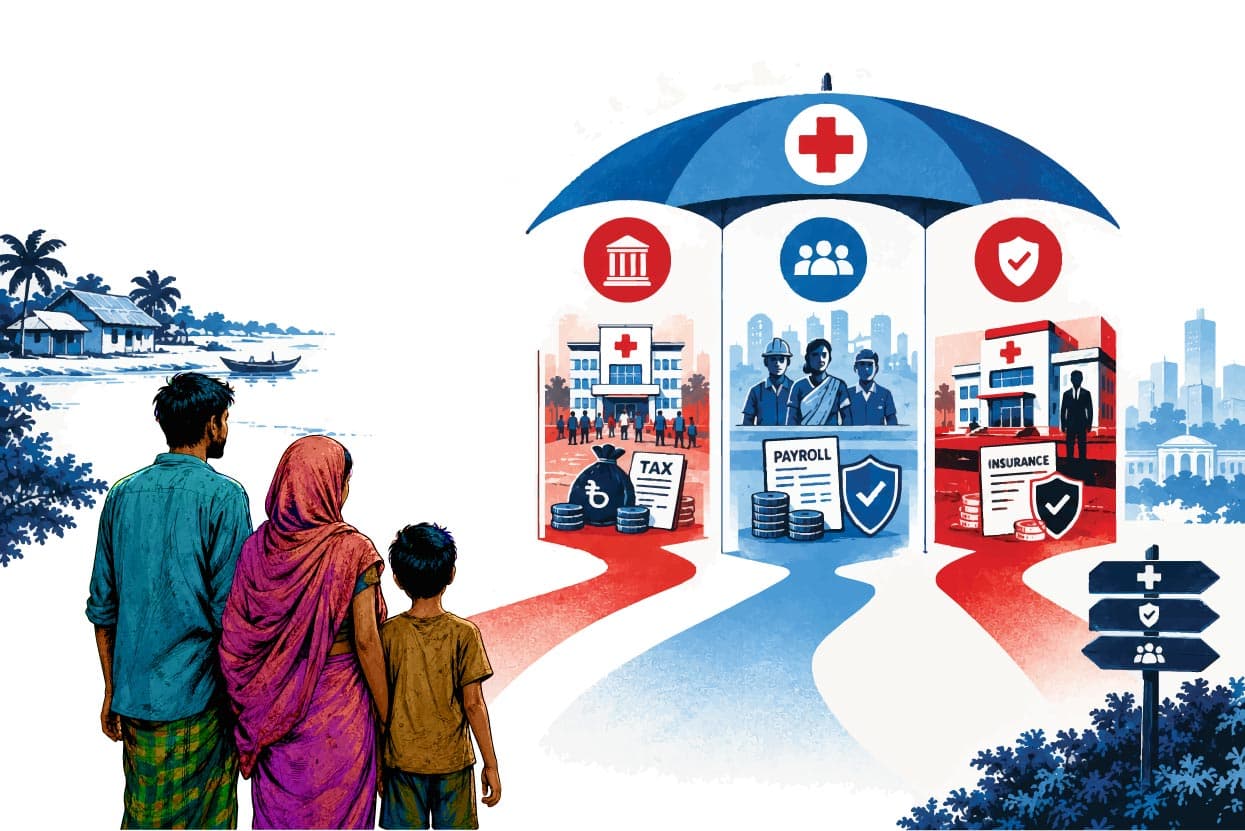
Bangladeshis pay most of their healthcare costs out of pocket, while only a fraction of the population has health insurance. Three international models offer possible paths forward — but weak tax revenues, a largely informal workforce, regulatory gaps and poor health data make each difficult to replicate.

Illustrated By sk. yeahhia
14 September, 2026
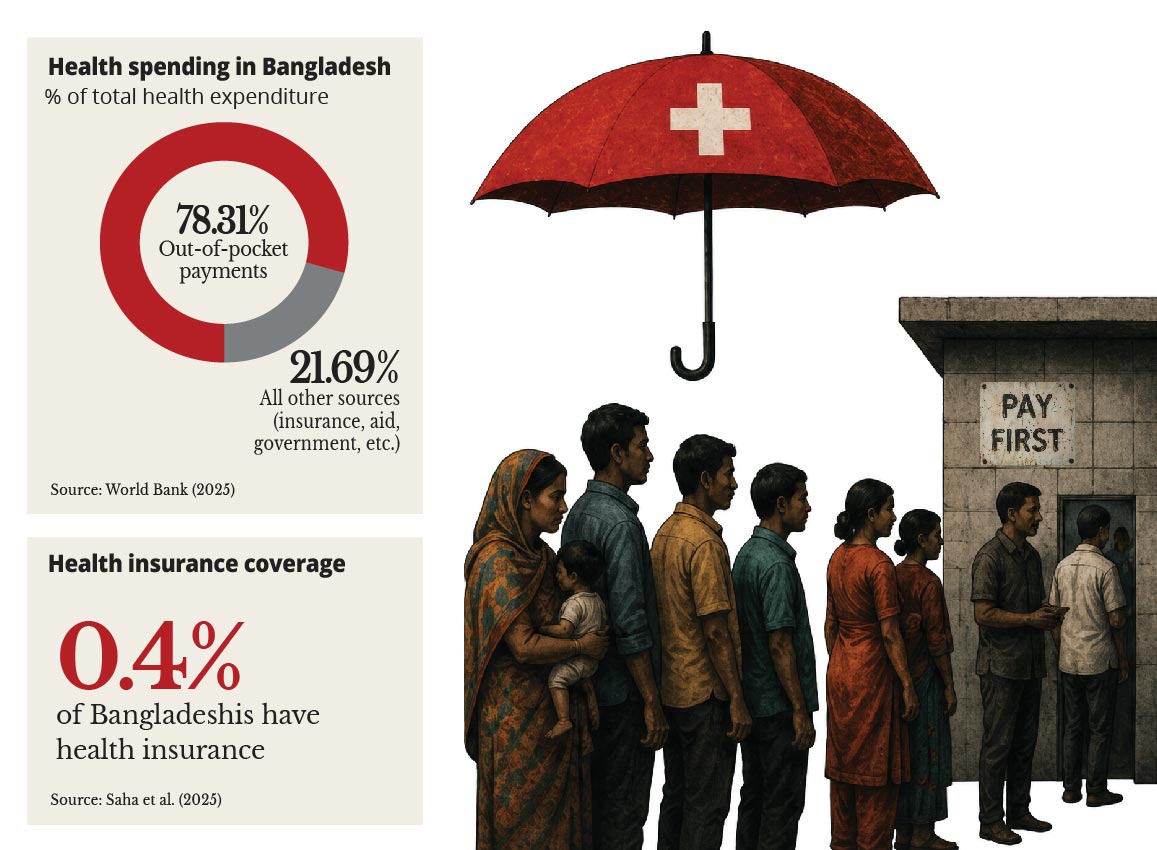
Bangladesh’s healthcare system is rife with problems. According to the World Bank, Bangladeshis bear 78.31% of their healthcare expenditure through out-of-pocket payments. BIDS recently published a study that showed that around 65% of Bangladeshis simply couldn’t access necessary healthcare due to the exorbitant costs. In such a backdrop, perhaps health insurance markets could be explored.
Health insurance is a system where an individual regularly pays a certain amount of money as a premium to an insurance company, which then pays for their medical expenses. Based on the agreement between you and the company, your insurance can cover doctor fees, surgery costs, diagnostic tests, etc. According to Saha et al. only 0.4% of Bangladeshis have health insurance, so let's assess the barriers through the lens of funding, pricing, trustworthiness, regulation, and scope of data collection.
A TAX-FUNDED MODEL FACES A FUNDING PROBLEM
Firstly, the National Health Insurance Model is where facilities are privatised, but expenses are borne through taxes. It is a monopoly where the prices of medical goods and services are fixed by the government. The amount of money paid by each person is based on their income and not medical history or age. According to Mala, Bangladesh’s tax revenue-to-GDP ratio is 6.78%, one of the lowest in the world so funding the NHI model would be difficult. Due to the absence of profit incentives, patients’ claim denials are almost zero, which makes the system trustworthy, but wait times are often high due to affordability.
Nevertheless, it’s important to note that the NHI functions in countries like Canada and Taiwan, both top-30 countries on the Corruption Perceptions Index, while Bangladesh lies in the bottom 15-20 countries annually, so the implementation of it here could lead to different outcomes. When the NHI model was implemented in Kenya, the fund was being drained by fraudulent bills and claims, which later led to higher patient claim denials by the government.
Furthermore, according to past precedent, the Bangladeshi government would find it difficult to set uniform prices in private facilities. Long ago, under Practice and Private Clinics Ordinance, private hospitals and clinics were instructed to price services according to government schedules, but the Ordinance is irrelevant, outdated, and holds no legislative teeth.
Legislation meant to replace this Ordinance has been sitting in Parliament for over decades due to repeated reviews and pressure from hospital associations. As for data collection, medical information would remain in a centralised database, but Transparency International frequently flags the Bangladeshi government agencies’ inability to protect citizens’ personal data from theft.
THE BISMARCK MODEL AND BANGLADESH’S INFORMAL WORKFORCE
Under the Bismarck Model, sickness funds function as non-profit insurance funds that gather people’s payroll contributions: fixed deductions from employers and employees that are determined by income and not by age or pre-existing conditions. The biggest hurdle for this model is that 85% of Bangladesh’s workforce is informally employed, so payroll contributions cannot be tracked and collected. In this model, when someone incurs a medical expense, they get reimbursed by said fund. The prices of the services are regulated and kept at uniform levels like the NHI model, so the legislative inadequacies apply here as well. Although this model is non-profit and has no incentive to deny patients’ medical claims, this model may also struggle with trust, as people may see their payroll contributions go to waste if they do not require frequent or critical visits to medical facilities. As for data collection, it would be fragmented between various sickness funds.
PRIVATE INSURANCE BRINGS COMPETITION AND NEW RISKS
Lastly, in a private insurance market, one enters a financial agreement with an insurance company and pays regular premiums. Insurance companies negotiate with different medical facilities to set prices for services, and premiums are determined not on income but on age, pre-existing conditions, and other risk-inducing factors, which means the most vulnerable people are less likely to opt in due to being charged higher premiums. Due to profit incentives, they’re also infamous for denying patient claims, fostering an environment of high distrust. The biggest regulatory hurdle would be that the Insurance Development and Regulatory Authority (IDRA) has no authority over hospital charges, and the Directorate General of Health Services has no authority over insurance reimbursements. Even if private health insurance happened to be a more popular choice in Bangladesh, there would be major bureaucratic bottlenecks in regulating the market. Additionally, data collection would be challenging as Bangladesh still does not have a central public database for medical records. Most records are paper-based and remain in the personal databases of private facilities, which means that insurance companies could find it nearly impossible to corroborate accurate information on patients’ medical conditions and histories on a mass scale.
Although this model is non-profit and has no incentive to deny patients’ medical claims, this model may also struggle with trust, as people may see their payroll contributions go to waste if they do not require frequent or critical visits to medical facilities.
THE CHALLENGE OF BUILDING A MARKET FROM SCRATCH
Setting up any comprehensive health insurance model in Bangladesh would be a Herculean task, for it would not only require setting up novel institutions from the ground up but would also require working through inefficiencies of existing institutions. Furthermore, it would also require the Legislature to update and perhaps create new Ordinances. Yet, private healthcare is inaccessible for the vast majority, and public healthcare is overextended and underfunded, so health insurance is an initiative that needs to receive more urgent consideration.


