

Local Economy
Bangladesh’s workers fuel global supply chains, yet much of the value flows beyond its borders

Illustrated By sk. yeahhia
15 May, 2026
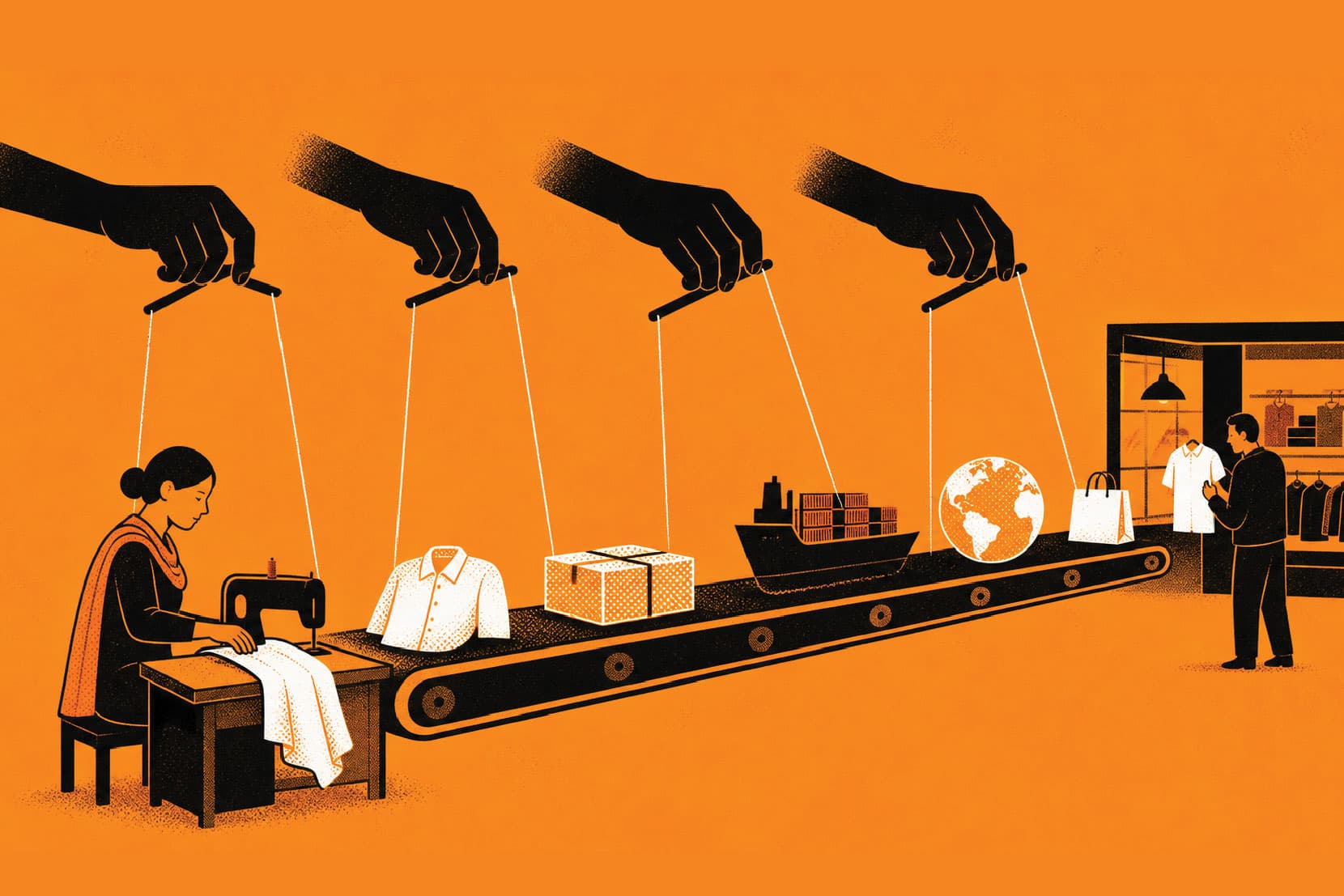
A shirt stitched in Narayanganj or Gazipur may travel farther than the worker who made it ever will. It may pass through freight handlers, customs systems, warehouses, brand showrooms, online platforms and discount campaigns before reaching a shopper in Berlin, London or New York. At every stage, its value changes. But the worker’s wage does not change with it. Nor does Bangladesh’s position in the chain change just because the country produces at scale.
That is the uncomfortable question behind Bangladesh’s people-powered economy. The country’s rise has been built on labour: factory workers, migrant workers, informal workers, women entering paid employment, and young people pushing into services and digital work. This human engine has delivered exports, remittances and resilience. But it has also placed Bangladesh in a structural position where the country supplies labour to global systems while much of the value created by that labour is priced, branded, financed and captured elsewhere.
This is not an argument that Bangladesh has failed. The opposite is true. Bangladesh has built one of the world’s most important labour-intensive growth stories. But the issue now is whether employment and export volume are enough. If Bangladesh remains primarily a supplier of low-cost labour, the economy may keep growing without gaining enough pricing power, technological control or value ownership.
The export machine others price
The readymade garment industry remains the clearest example of Bangladesh’s labour-powered success and its structural limitation. BGMEA data show RMG exports reached USD 39.35 billion in FY2024-25, accounting for 81.49% of Bangladesh’s total exports. On a calendar-year basis, apparel exports stood at USD 38.82 billion in 2025. These numbers confirm the sector’s scale, but also its concentration. One industry continues to carry the bulk of the country’s export structure.
Globally, Bangladesh has also retained its position as the world’s second-largest apparel exporter after China. WTO data reported in July 2025 showed Bangladesh exported USD 38.48 billion worth of apparel in 2024, representing 6.90% of the global apparel export market, down from 7.38% a year earlier. China, by contrast, held 29.64% of the market. Bangladesh is therefore essential to global fashion, but not dominant enough to set the rules of pricing.
That distinction matters. Bangladesh produces garments, but global brands and retailers control design, branding, retail margins, consumer data and final pricing. Local factories compete for orders inside a buyer-driven chain. When global demand weakens or competitors cut prices, Bangladeshi suppliers have limited room to resist. They can protect market share by producing more, faster and cheaper – but that reinforces the very structure that keeps value capture low.
Growth by volume, not by value
Recent market data make this imbalance visible. In the European Union, Bangladesh’s apparel exports rose to EUR 15.26 billion from January to September 2025, up from EUR 13.48 billion a year earlier. But that growth was driven by a 15.55% increase in volume, while Bangladesh’s unit price fell by 2.06%, according to data cited by The Business Standard. The wider EU apparel import market also expanded mainly through volume, while average prices declined.
The same pressure appeared more sharply at the start of 2026. Dhaka Tribune, citing Eurostat data, reported that Bangladesh’s apparel exports to the EU fell 25.25% year-on-year in January 2026 to EUR 1.43 billion. Export volume dropped 17.49%, while the average unit price fell 9.41%, from EUR 15.08 per kg in January 2025 to EUR 13.66 in January 2026. Analysts and industry stakeholders linked the decline to weaker European demand, cautious procurement by retailers and pressure for discounts.
This is where the “extraction” in the title becomes economic rather than rhetorical. Bangladesh’s labour creates tradable goods, but the system rewards scale more than upgrading. If export earnings rise because factories ship more units at lower prices, workers and producers carry more of the effort while buyers preserve cost advantage. The country gains orders, but not necessarily stronger margins.
Tariffs reveal who holds leverage
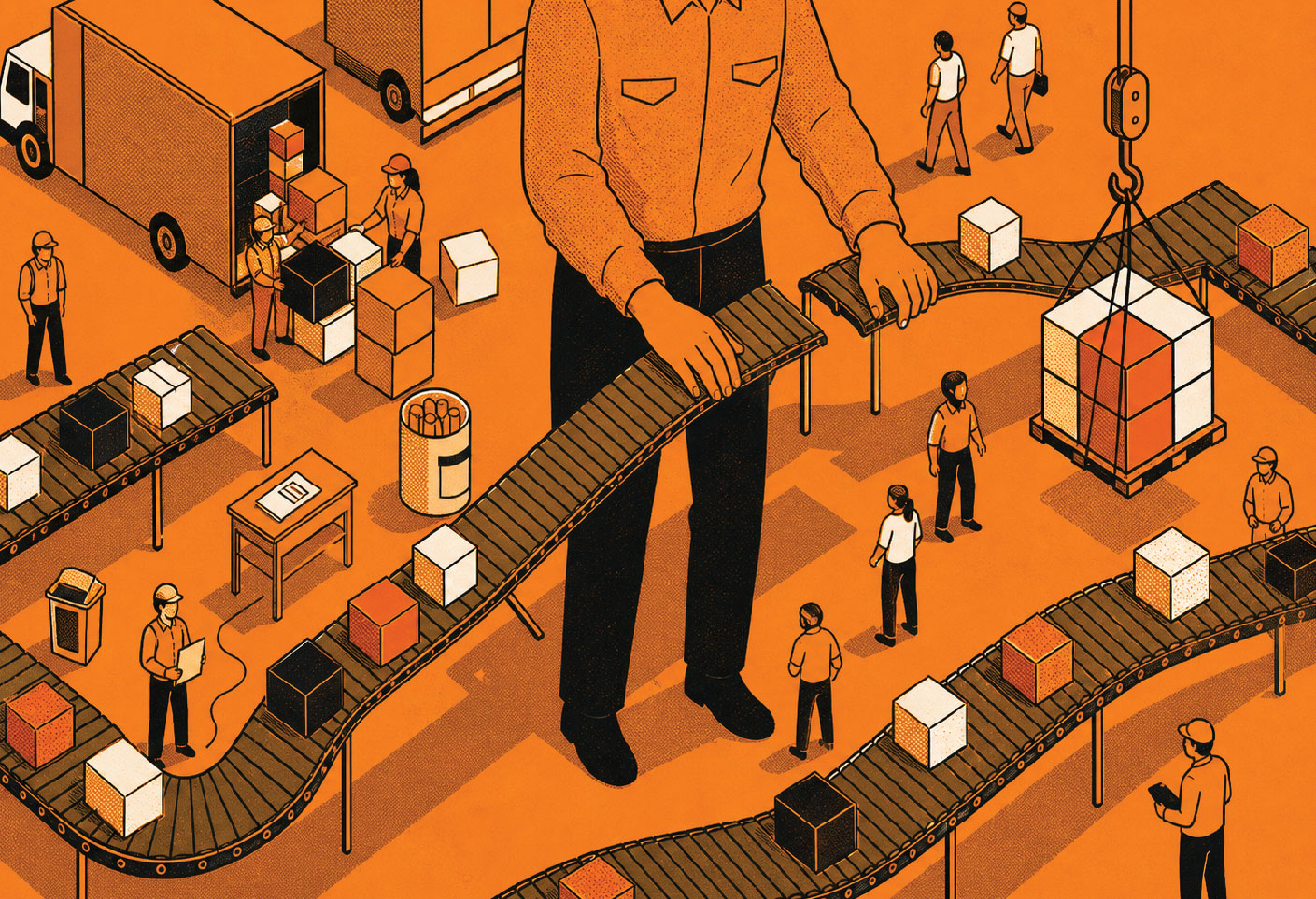
The recent US tariff episode further exposed Bangladesh’s dependence on external decisions. Reuters reported in February 2026 that Bangladesh’s garment sector had suffered six straight months of falling exports due to US tariffs, domestic political instability and labour unrest. The sector accounts for around 80% of exports, more than 10% of the economy, and employs nearly four million workers, mostly women.
Bangladesh later secured a reduced 19% US tariff under a trade agreement, with a mechanism for zero reciprocal tariffs on some textile and apparel goods made with US-produced cotton and man-made fibre. But the deal also required Bangladesh to open more access for US goods and included major commitments on energy, aircraft and agricultural purchases.
This is not simply a trade story. It shows how a labour-exporting production economy negotiates from a constrained position. Bangladesh needs market access to protect millions of jobs. Buyers and destination countries know this. As a result, market access can become tied to conditions that go well beyond garments. Labour sustains the economy, but trade rules are written elsewhere.
Migration repeats the pattern
The same structure appears in labour migration. Bangladesh earns crucial foreign exchange from workers abroad, but the productive activity takes place in other economies. BSS reported that remittances reached a record USD 30.33 billion in FY2024-25, the highest single-fiscal-year inflow in the country’s history. In March 2026 alone, remittances hit a record USD 3.75 billion, again underlining how central overseas workers are to Bangladesh’s external balance.
But remittance success also hides a structural weakness. Bangladesh is not exporting high-value services at scale; it is exporting people. More than 1,100,000 Bangladeshis went abroad for work in 2025, and over 750,000 went to Saudi Arabia alone, according to BMET officials cited in TBS. Saudi Arabia remained the top destination, taking more than two-thirds of Bangladesh’s outgoing workers that year.
The skill composition reinforces the problem. RMMRU data cited by TBS show around 70% of Bangladeshi migrant workers are unskilled or semi-skilled, while only around 4% are highly skilled or professionals. This limits wage potential and keeps Bangladesh dependent on low-value labour deployment instead of higher-value capability exports.
Bangladesh produces garments, but global brands and retailers control design, branding, retail margins, consumer data and final pricing. Local factories compete for orders inside a buyer-driven chain. When global demand weakens or competitors cut prices, Bangladeshi suppliers have limited room to resist.
The hidden cost of dependence
The vulnerability of this model is now clearer because both pillars, garments and migration, are exposed to external shocks. Fitch revised Bangladesh’s outlook to negative in May 2026, citing macroeconomic and external financing vulnerabilities linked to the Middle East conflict. Reuters reported that Fitch pointed to risks from higher energy import costs and possible disruption to remittances, with nearly half of Bangladesh’s remittance inflows coming from the Middle East.
That warning brings us to the core argument. Bangladesh’s people power global systems, but the country does not fully control those systems. Garment workers depend on Western consumer demand, brand sourcing strategies, tariffs and buyer pricing. Migrant workers depend on Gulf labour markets, oil-linked economies, visa regimes and geopolitical stability. Bangladesh receives the income, but not the command centre.
This does not mean labour-intensive growth has reached its end. It means Bangladesh must move beyond a model where volume substitutes for value. The next stage requires domestic brands, product upgrading, stronger design capacity, better logistics, skilled migration, technology adoption, and deeper movement into higher-value manufacturing and services.
Bangladesh’s workers have already proved they can power global industries. The question now is whether the country can capture more of the value they create – or remain an economy where people do the work, while systems elsewhere take the larger reward.


%20Square%20Ad%20-11.jpg&w=640&q=75)
%20Horizental%20AD-01.jpg&w=3840&q=75)
