

features
As Bangladesh’s healthcare market expands, families still shoulder most treatment costs, raising a harder question over who ultimately carries the financial risk of illness

Illustrated By sk. yeahhia
17 September, 2026
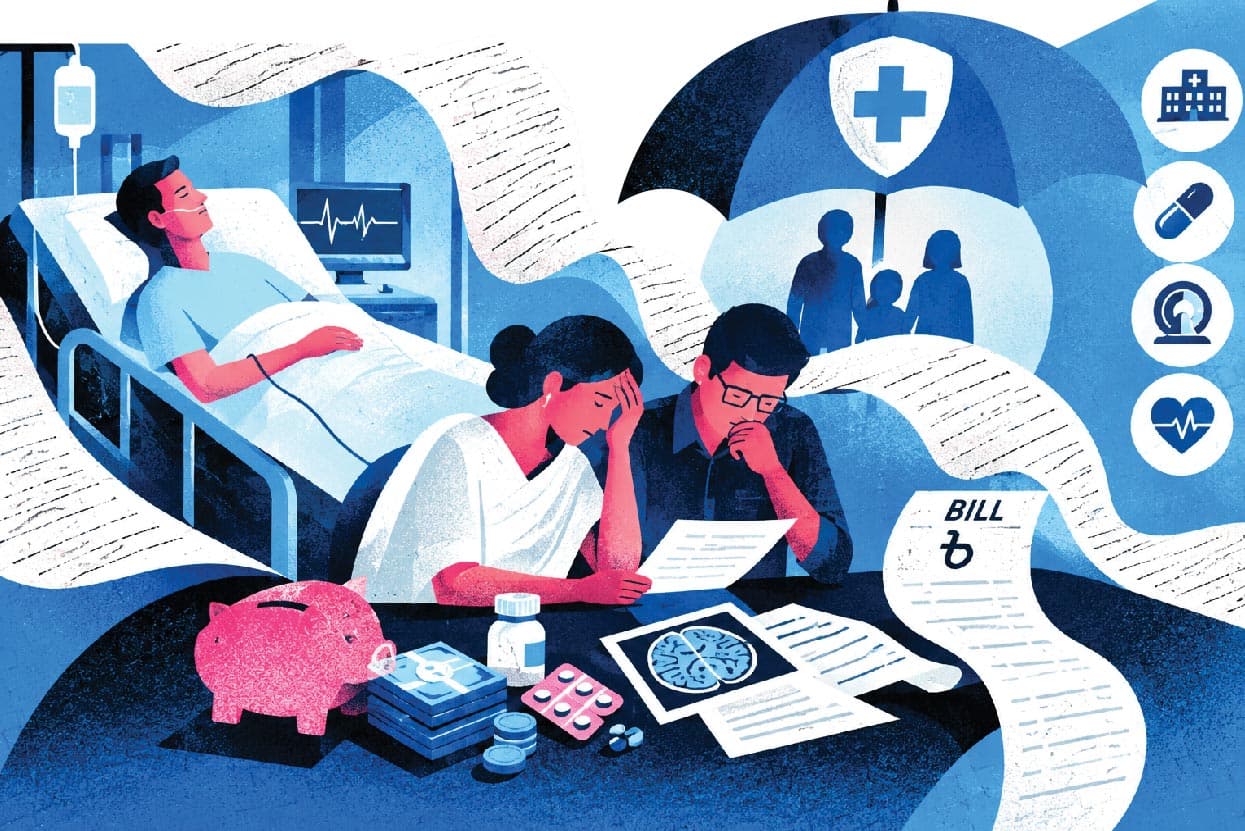
Imagine Kamal leaving home one morning expecting to return before lunch. He has been feeling a pressure in his chest for several days, and his wife finally convinces him to see a doctor. By evening, he is in a hospital bed. There are blood tests, scans, consultations and, soon, talk of a cardiac procedure.
At home, the conversation changes just as quickly. His wife checks the family’s savings. His brother offers to lend some money. The fixed deposit they had kept for their daughter’s university admission suddenly looks less like a future plan and more like the next hospital payment.
The family did not choose to make a major purchase. Illness made the decision for them.
That is what makes healthcare different from most other consumer markets. Bangladesh is building more places to seek treatment, more diagnostic capacity, more specialised services and a large pharmaceutical industry. Yet access to much of that expanding healthcare economy still begins with a very basic question for the patient: how much can you pay?
The latest internationally comparable WHO data put direct out-of-pocket payments at 79.3% of Bangladesh’s current health expenditure in 2023. In 2025, WHO estimated that around 70 million people, or 41.7% of the population, experienced financial hardship because of out-of-pocket health spending.
These numbers say more than that healthcare is expensive. They show where the financial risk of illness currently sits: overwhelmingly with the household that happens to become sick.
A BIGGER MARKET, BUT WHO FINANCES IT?
Bangladesh needs more healthcare infrastructure, not less. Growing incomes, an ageing population, chronic diseases and unmet demand mean the country will need hospitals, diagnostics, medical technology, pharmaceuticals and specialised treatment for years to come.
The industry is already moving in that direction. At a DCCI seminar in December 2025, United Hospital Managing Director Malik Talha Ismail Bari estimated Bangladesh’s healthcare market at around $14 billion, with projections suggesting it could reach USD 23 billion by 2033. This is an industry estimate rather than an official forecast, but it gives a sense of where the sector believes demand is heading.
There is nothing inherently troubling about that growth. More treatment capacity can fill genuine gaps.
The harder issue is who finances access to it.
If the healthcare market keeps expanding while patients remain its principal direct purchasers, Bangladesh can become better at delivering treatment without becoming equally better at protecting people from the cost of treatment.
A larger healthcare industry, in other words, does not automatically create greater health security.
WHEN THE PATIENT CARRIES THE RISK
The weakness of paying directly becomes clearest when illness is serious.
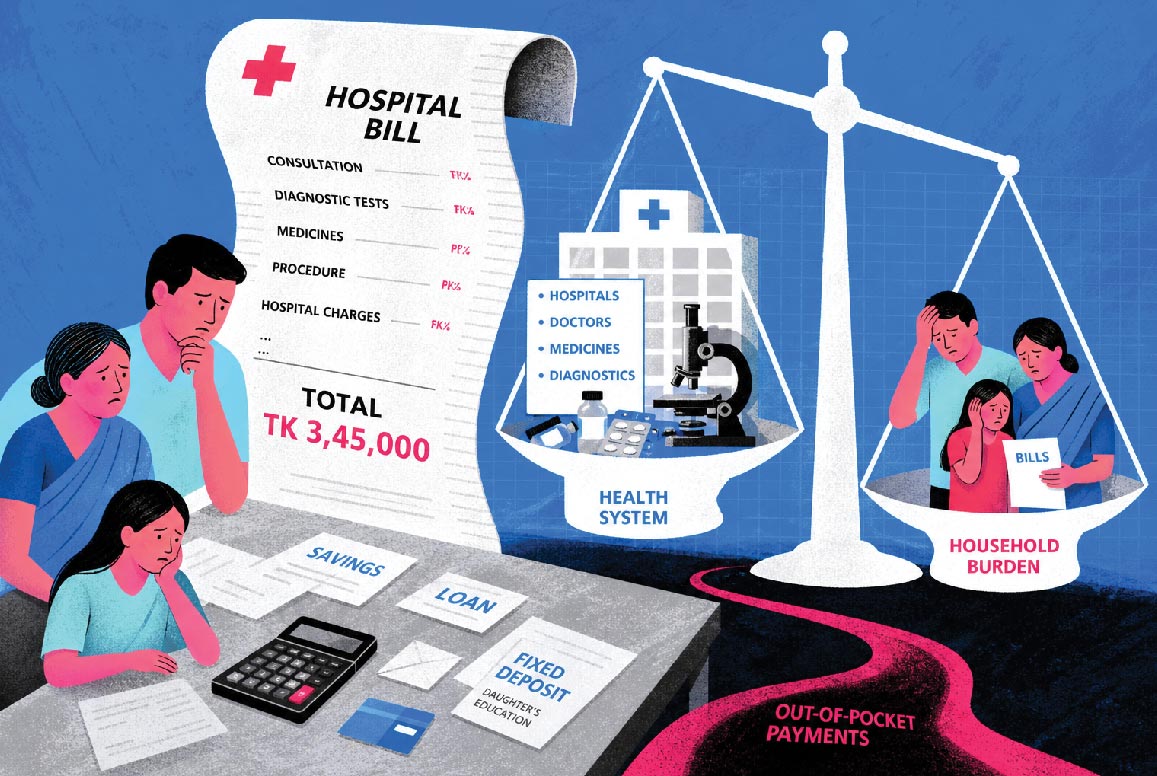
A household cannot know whether a medical problem will require a few thousand taka in tests and medicines or months of treatment costing several lakh. Yet under an out-of-pocket system, much of that uncertainty remains with the family.
A 2025 study based on the nationally representative HIES 2022 found that around 61% of hospitalised patients experienced distress financing. Savings were the largest source of payment, followed by borrowing, help from relatives and friends, and selling assets. Regular income accounted for only a small share.
That changes the nature of the problem.
The question is not simply whether a hospital bill is high. It is whether a family has to absorb an unpredictable financial shock precisely when it is least able to avoid the expense.
In a system with meaningful risk pooling, that uncertainty is spread before illness occurs — through taxes, social insurance, employer contributions or another form of prepayment. Bangladesh still leaves much of it to be settled after the diagnosis.
THE BILL BEGINS BEFORE THE HOSPITAL BED
It is also easy to imagine that the main problem is expensive surgery or private hospital charges.
Household spending tells a different story.
A BIDS analysis of HIES 2022 found that 54.4% of out-of-pocket healthcare expenditure went on medicines and 27.52% on diagnostics. Together, those two categories accounted for more than four-fifths of the spending identified in the analysis.
This means Bangladesh cannot solve the problem simply by making hospital admission cheaper.
If patients leave public facilities to buy medicines themselves, if diagnostics have to be purchased outside, or if chronic illnesses require repeated tests and prescriptions month after month, the household remains a buyer throughout the healthcare journey.
The financing problem is therefore also a delivery problem. What the public system does not reliably provide eventually appears on somebody’s private bill.
Bangladesh needs more healthcare infrastructure, not less. Growing incomes, an ageing population, chronic diseases and unmet demand mean the country will need hospitals, diagnostics, medical technology, pharmaceuticals and specialised treatment for years to come.
MORE GOVERNMENT MONEY, BUT LESS HOUSEHOLD MONEY?
The FY2026-27 budget offers a chance to test that relationship.
Bangladesh has allocated BDT 69,409 crore to health-related spending, equivalent to 1.01% of GDP, taking the figure above 1% for the first time. The revised allocation for FY2025-26 was BDT 35,477 crore.
More public spending is necessary. But allocation by itself does not tell us whether Kamal’s family will have to spend less.
In FY2025-26, the health ministry used only 32.86% of its revised development allocation, according to IMED figures, even as public facilities continued to face shortages of basic medicines, functioning equipment and manpower.
That suggests a more useful way of looking at the health budget.
The real measure should not only be how much money government puts into healthcare. It should also be how much spending that money takes away from households.
If public expenditure rises but patients still buy medicines, tests and essential treatment themselves, public and private spending can rise together without fundamentally changing financial protection.
BANGLADESH HAS PROVIDERS. WHERE IS THE PAYER?
Private healthcare has become an essential part of this picture.
DGHS figures cited in 2025 showed 126,353 beds in registered private hospitals and clinics, compared with 71,100 in public hospitals. Private capacity has expanded partly because the public system alone has not been able to meet demand.
Private healthcare, then, is not simply the villain in a story about expensive treatment.
Private providers can answer one question: where can the patient get care?
They cannot, on their own, answer another: who should carry the financial risk of needing that care?
That is where Bangladesh’s healthcare economy still looks underdeveloped. It has created providers much faster than it has created a strong payer between the patient and provider.
Health insurance has barely filled that space. The Health Economics Unit says insurance contributes less than 1% of healthcare financing, with coverage concentrated largely among parts of the formal urban workforce.
For the lower-middle or middle-income household, this gap can be particularly dangerous. Such families may not qualify for poverty-targeted protection, yet may be nowhere near wealthy enough to absorb cancer treatment, dialysis or major cardiac care without damaging years of savings.
Healthcare financing is therefore not only about protecting people who are already poor. It is also about preventing illness from reversing economic progress.
Its draft Universal Health Coverage Roadmap 2026–2035 proposes gradual universal coverage built around a single pooled fund, a comprehensive benefit package and stronger governance and accountability.
THE ANSWER BANGLADESH IS NOW CONSIDERING
Bangladesh is not unaware of this problem.
Its draft Universal Health Coverage Roadmap 2026–2035 proposes gradual universal coverage built around a single pooled fund, a comprehensive benefit package and stronger governance and accountability. The basic shift is important: instead of relying mainly on money found after illness occurs, more financial risk would be pooled beforehand and care purchased when people need it.
There is reason to believe pooling can make a difference. An evaluation of Bangladesh’s existing Shasthyo Surokhsha Karmasuchi for poorer households found sharply lower out-of-pocket and catastrophic health expenditure among members who used covered inpatient services.
But moving from a targeted programme to a national system is where the difficult questions begin.
If medicines and diagnostics create much of the household bill, will the promised benefit package cover them sufficiently? If private hospitals are already central to healthcare delivery, will the pooled fund purchase care from them, and who will determine prices and prevent additional billing? If much of Bangladesh’s workforce is informal, how much of the system can realistically be financed through contributions and how much must come from taxation?
And coverage on paper will mean little if the doctor, medicine or diagnostic service is not available when the patient arrives.
There is also history to contend with. Bangladesh’s Health Care Financing Strategy 2012–2032 already set out to increase financing, improve equity and reduce the impoverishment caused by catastrophic healthcare expenditure.
Yet more than a decade later, households still carry most of the burden. And as of WHO’s May 2026 monitoring update, finalising the new UHC roadmap, developing its implementation plan and establishing its monitoring and coordination mechanism remained ongoing work.
That makes the next phase less about discovering the right principle and more about whether Bangladesh can finally make it work.
For Kamal’s family, the test would be much simpler. When the diagnosis arrives, does the first serious conversation at home still have to be about savings, loans and what can be sold?
Bangladesh may build a much larger and more sophisticated healthcare industry over the coming decade. But hospitals, diagnostics and new treatments represent only one side of a modern healthcare system.
The other is whether the financial risk of needing them is shared before a family falls sick.
When that next serious illness comes, how much of the cost will the health system carry before the household has to?


