

features
Bangladesh has proved it can build world-class green factories. The harder question is why the same logic has not reshaped the buildings where people live, work, study and seek healthcare.

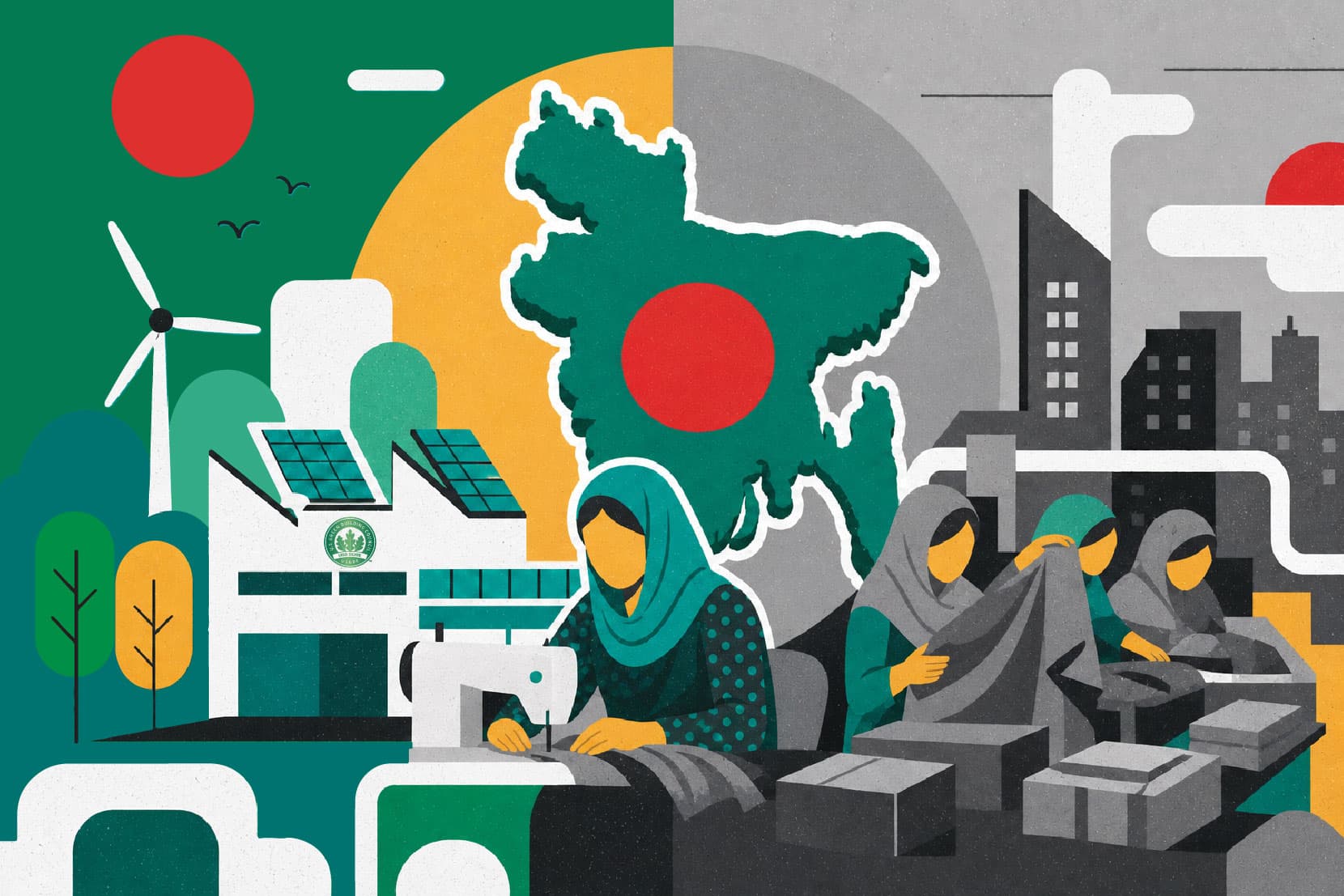
Illustrated By sk. yeahhia
23 June, 2026
Bangladesh’s green-building success story begins inside the garment industry.
By May 2026, the country had 287 LEED-certified RMG factories, including 124 Platinum and 144 Gold-rated facilities, according to certification data reported by Bonik Barta. Bangladesh also had 53 of the world’s top 100 highest-rated LEED factories, giving the country a rare global leadership position in sustainable apparel manufacturing.
A few weeks earlier, BSS had reported that Bangladesh had 284 LEED-certified RMG factories, including 121 Platinum and 144 Gold units, and noted that the country’s green factory growth reflected investments in energy-efficient machinery, water conservation, waste management and improved workplace environments.
It is a remarkable achievement for a country still widely discussed through the language of climate vulnerability. In one part of the economy, Bangladesh has shown that green design, resource efficiency and global certification are not distant ambitions. They are already built, audited and functioning.
But the achievement also exposes a wider failure.
Outside the export-facing factory compound, Bangladesh’s cities are still expanding through concrete-heavy, heat-trapping and energy-hungry construction. Dhaka’s skyline is rising, but much of its built environment continues to depend on air-conditioning rather than passive cooling, hard surfaces rather than shade, and maximum floor space rather than climate-sensitive design. The country knows how to build green when export markets reward it. It has been far less successful in making green buildings part of everyday urban life
The export sector found the incentive
Green factories did not appear by accident. They emerged from a particular business environment. Garment manufacturers faced growing pressure from international buyers to reduce water use, improve energy efficiency, manage waste, protect workers and prove environmental compliance. LEED certification gave factory owners a recognised way to show that progress. It also helped position Bangladesh as a more responsible sourcing destination at a time when global apparel buyers were under pressure to clean up supply chains.
The US Green Building Council describes LEED as the world’s most widely recognised green building rating system, covering energy and water use, material selection, waste management and indoor environmental quality. It applies not only to new buildings, but also to existing buildings, residential projects, neighbourhoods and cities.
That last point matters. LEED is not designed only for factories. The framework can be applied to commercial buildings, homes, hospitals, schools and city-scale development. Yet in Bangladesh, the green-building story has been overwhelmingly associated with RMG.
The reason is not technical capacity; it is incentive.
Export factories had a clear business case. Certification could protect buyer relationships, improve reputation, reduce operating costs and support market access. In an industry where compliance can determine orders, green investment became part of competitiveness.
The same market signal is weaker in ordinary real estate. A buyer of an apartment in Dhaka may care about location, square footage, parking, price and handover date. Energy performance, ventilation, heat exposure, water systems and future cooling costs often come later, if at all. For developers, the short-term commercial logic is to maximise saleable space. For buyers, the long-term operating cost is dispersed over years.
That split has shaped the city.
Poorly designed buildings push households and offices toward more cooling. More cooling increases electricity demand. Higher demand raises pressure on the grid, fuel imports and household bills. Heat also reduces labour productivity, worsens health risks and makes already crowded cities more unequal, because those who cannot afford cooling suffer most.
The city absorbed the heat
Buildings are not passive victims of climate change. They can either reduce heat exposure or intensify it. In Bangladesh’s urban centres, especially Dhaka, the cost of poor design is becoming harder to ignore. Narrow setbacks, glass-heavy façades, limited tree cover, poor ventilation, rooftop heat absorption and shrinking water bodies all add to the same problem: cities hold heat long after the sun goes down.
The World Bank warned in September 2025 that Bangladesh ranks second globally in exposure to elevated temperatures. Since 1980, the country’s maximum temperature has risen by 1.1°C, while the “feels like” temperature has surged by 4.5°C. Dhaka’s heat index has increased about 65% higher than the national average, according to the same report.
The economic toll is already visible. In 2024, heat-related physical and mental health conditions led to the loss of 250 million workdays, costing the economy up to USD 1.78 billion, or around 0.4% of GDP, the World Bank said.
That is no longer just a public health warning. It is a productivity warning, an energy warning and a building-sector warning.
Poorly designed buildings push households and offices toward more cooling. More cooling increases electricity demand. Higher demand raises pressure on the grid, fuel imports and household bills. Heat also reduces labour productivity, worsens health risks and makes already crowded cities more unequal, because those who cannot afford cooling suffer most.
The green factory, in this context, is not only a symbol of environmental progress. It is also evidence that better building choices can reduce operating pressure. The question is why those choices remain concentrated in spaces tied to export earnings.
Why the model stopped at the factory gate
Bangladesh already has a national building code with an energy-efficiency component. The International Energy Agency notes that the Bangladesh National Building Code was updated in 2020 and that its Chapter 4 on energy efficiency and sustainability seeks to improve efficiency through passive and low-energy architectural features and better resource management.
But a code on paper does not automatically change a skyline.
The factory sector has buyers, audits and certification pressure. Urban housing has fragmented buyers, uneven enforcement and developers competing on visible features. Public buildings often face cost-first procurement. Hospitals and schools may be built to meet space needs, not lifetime energy or heat-resilience performance. Many commercial projects still treat green features as premium branding rather than basic climate infrastructure.
The result is a divided building economy.
One side uses certification, audits and efficiency investments to serve global markets. The other side builds much of the city through a short-term real estate logic that passes future cooling, health and resilience costs to residents, tenants, businesses and the state.
This is not unique to Bangladesh. But Bangladesh’s case stands out because the country has already demonstrated green-building capability at scale. The gap is not between knowledge and ignorance; it is between export incentives and domestic incentives.
The economics of greener buildings
Green buildings are often presented as expensive. That framing, however, is incomplete.
The US Green Building Council says green buildings reduce carbon emissions, energy use, water use and waste, while improving health and lowering exposure to toxins. It also cites evidence that LEED buildings have reported almost 20 per cent lower maintenance costs than typical commercial buildings, while green retrofits can reduce operating costs by almost 10 per cent in one year.
Those figures are not Bangladesh-specific, and they should not be applied mechanically. But the underlying principle is relevant: building costs do not end when construction ends. In a hotter country, the real price of a building includes cooling bills, health impacts, lost work hours, water stress, maintenance and flood exposure.
A building that is cheap to construct but expensive to live in is not truly affordable. A school that overheats during summer affects learning. A hospital that depends heavily on cooling during heatwaves becomes more expensive to operate. An office that traps heat can reduce productivity. An apartment that needs continuous air-conditioning shifts climate cost from developer to household.
Bangladesh’s green factories show that better building performance can be planned, measured and marketed. The same discipline is now needed beyond the apparel industry.
For developers, green construction should not remain a luxury label. For banks, mortgages and project finance could begin to price energy performance and resilience. For city authorities, planning approval could be linked more seriously to heat, drainage, open space and ventilation.
From trophy to infrastructure
The next phase of Bangladesh’s green-building economy cannot be limited to more LEED factories. The larger opportunity lies in bringing climate-sensitive design into mainstream construction.
That would mean stronger enforcement of building codes, incentives for passive cooling, more shaded streets, better ventilation standards, reflective and insulated roofs, rainwater harvesting, rooftop solar, efficient cooling systems, permeable surfaces, restored water bodies and low-carbon construction materials. It would also mean applying lifecycle cost thinking to public buildings so schools, hospitals and government offices are not judged only by construction cost but by long-term energy, maintenance and resilience performance.
For developers, green construction should not remain a luxury label. For banks, mortgages and project finance could begin to price energy performance and resilience. For city authorities, planning approval could be linked more seriously to heat, drainage, open space and ventilation. For buyers, building quality should include future utility costs and liveability, not only tiles, lifts and location.
Bangladesh’s climate economy will not be built only through renewable power plants or export factories. It will also be built through the walls, roofs, windows and streets that determine how much heat people absorb and how much energy they need to survive it.
The unfinished transition
The country’s green factories deserve recognition. They have helped Bangladesh improve its global apparel image and prove that sustainable construction is possible even in a cost-sensitive manufacturing economy.
But they also raise an uncomfortable question. If Bangladesh can build some of the world’s highest-rated green garment factories, why are its cities still being built in ways that deepen heat stress, raise energy demand and pass climate costs to ordinary people?
The answer is not that Bangladesh lacks architects, engineers, technology or examples. The answer lies in incentives. The export sector changed because the market demanded it. The city has not changed because the market, regulation and finance have not demanded it strongly enough. A climate economy would turn green buildings from export trophies into everyday infrastructure. It would treat heat-resilient, energy-efficient construction not as a premium feature, but as economic protection.
The factory went green because business required it. The next test is whether Bangladesh can make the city follow.


%20Square%20Ad%20-11.jpg&w=640&q=75)
%20Horizental%20AD-01.jpg&w=3840&q=75)
