

in focus
As AI and automation reshape global work, Bangladesh must turn its labour advantage into a productivity advantage

Illustrated By sk. yeahhia
2 May, 2026
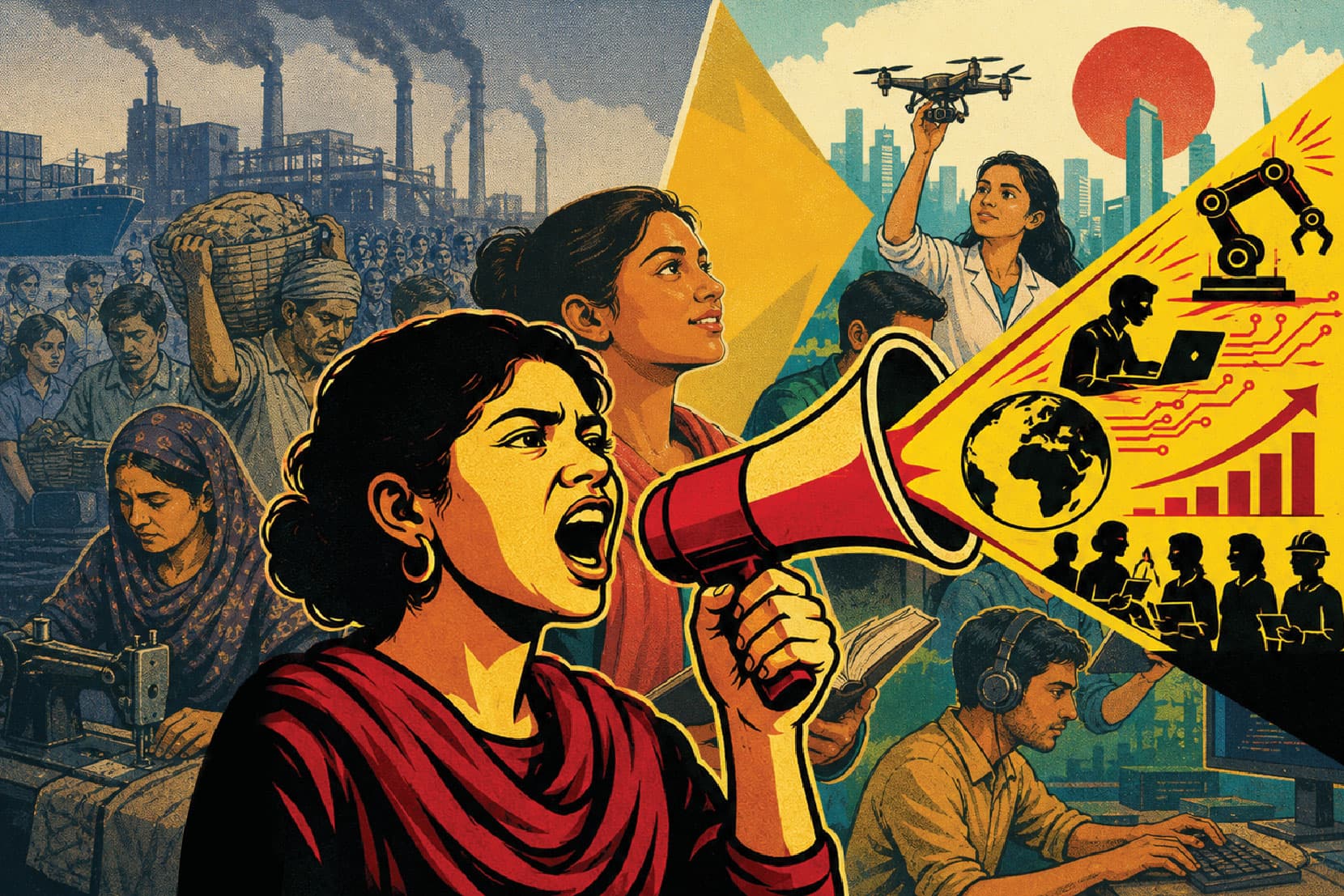
Bangladesh has never been short of workers. That has been the country’s economic advantage for decades: garment workers filling global orders, migrants financing households from abroad, farmers, traders, small entrepreneurs and young freelancers keeping the economy moving through sheer adaptability. But the global economy is changing the terms of work. The question is no longer only how many people Bangladesh can put to work. It is what kind of work the world will still pay for – and whether Bangladesh’s workforce is ready for that shift.
For years, the country’s people-powered model relied on scale. More workers meant more output, more exports, more remittances and more household income. That model delivered real gains. But artificial intelligence, automation, digital platforms and shifting global demand are now changing labour markets across manufacturing, services, offices, logistics, outsourcing and migration. Low-cost labour is no longer enough if machines and software can do routine work faster, and if higher wages increasingly go to workers who can use technology rather than compete with it.
So Bangladesh’s problem is not that it has too many people, rather the risk is that it has too many people trapped in low-productivity work, while the global economy moves towards higher-skilled, AI-enabled employment. The solution is not to abandon the people-powered model, but to upgrade it – from labour abundance to labour productivity.
A dividend that must be earned
The urgency is already visible in the macro numbers. The World Bank’s April 2026 Bangladesh Development Update projected growth to slow to 3.9% in FY26, citing slowing growth, persistent inflation, weak private investment and external shocks. It also said wages of low-income workers had not kept up with prices, while the national poverty rate rose to 21.4% in 2025, from 18.7% in 2022.
These figures matter because Bangladesh’s demographic dividend is often treated as automatic. It is not. A large working-age population becomes an advantage only when the economy can absorb people into productive, decent and better-paid work. Otherwise, the same labour force becomes a source of underemployment, wage pressure and social frustration.
This is especially important because Bangladesh must create jobs for nearly two million young people entering the labour market every year, according to the World Bank. In 2025, Bangladesh and the World Bank signed an USD 850 million financing package aimed at boosting trade capacity, job creation and social protection, including skills training, microcredit and entrepreneurship mentoring for vulnerable groups. That investment points to the right priority: Bangladesh does not only need growth; it needs growth that creates better jobs.
AI changes the meaning of employability
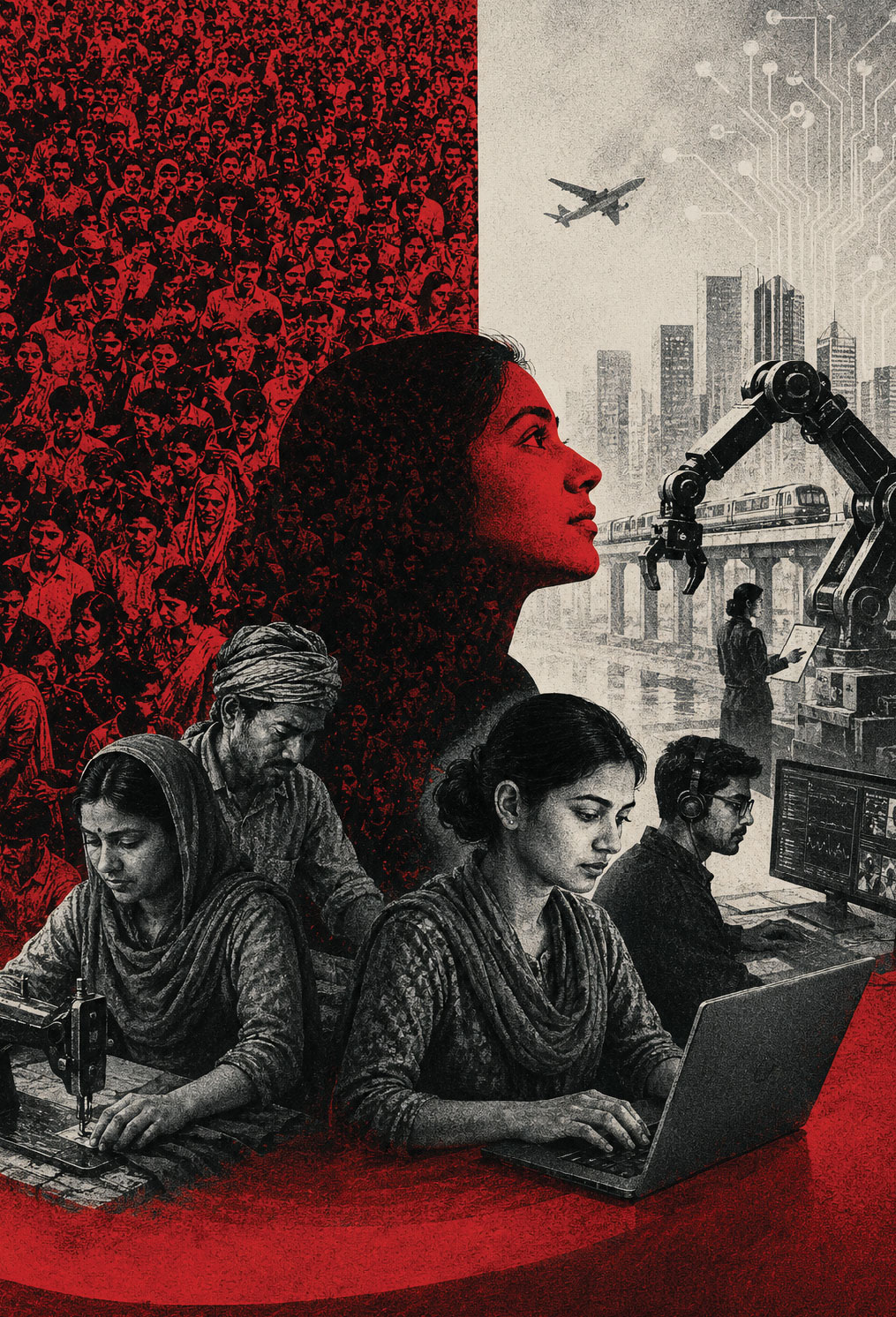
The automation debate is often reduced to machines replacing factory workers. That is too narrow. The bigger shift is that AI is changing the meaning of employability across sectors. Basic coding, data entry, call centres, administrative support, content processing, accounting support and routine office tasks are all vulnerable to some form of AI-assisted disruption.
The World Bank’s October 2025 South Asia Development Update offers a more nuanced picture. It found that only 7% of South Asia’s jobs are at risk of AI automation, while 15% of workers are in jobs that may benefit from productivity gains. It also found that AI-related job postings have grown 75% faster than other postings since 2023, and that AI skills carry a wage premium of nearly 30% compared with other white-collar jobs.
That means the future is not simply job loss. It is job polarisation. Workers with AI and digital skills may earn more and become more productive. Workers doing routine, entry-level and easily substitutable tasks may find the ladder into formal employment narrowing. The World Bank also found that postings for the most substitutable white-collar jobs fell by around 20% after the introduction of ChatGPT, with business services jobs particularly exposed.
For Bangladesh, this is both a warning and an opportunity. The country has a young workforce, a growing digital economy and an expanding pool of educated jobseekers. But if they remain trained for yesterday’s clerical, outsourcing or low-end service tasks, AI could shrink opportunities before they fully mature.
The readiness gap is the real risk
Bangladesh has begun recognising the AI challenge, but readiness remains weak. The 2025 Bangladesh Artificial Intelligence Readiness Assessment Report, published by UNDP and UNESCO, says Bangladesh does not have a comprehensive strategy to address AI’s impact on labour markets, and that upskilling and reskilling strategies for workers do not yet exist. It also cites an a2i estimate that around 40% of Bangladesh’s workforce could be at risk of losing jobs due to automation.
The same report highlights structural weaknesses: Bangladesh’s AI ecosystem is still emerging, private AI investment data are unavailable, and the country has only a 0.2% share of global high-tech exports, according to the 2023 Global Innovation Index. It also notes that internet usage reached 44.50% in 2023 and that fixed broadband penetration remained low at 7.51 subscriptions per 100 inhabitants.
This is why digital literacy must be treated as basic economic infrastructure. CPD’s 2025 policy brief on technology and digital literacy argues that digital literacy has become nearly as essential as traditional literacy, while technology adoption can create opportunities but also displace some jobs and require new skills. It recommends better ICT coordination, wider broadband access in rural and underserved areas, and removal of barriers for digital start-ups.
Migration must move up the skills ladder
Bangladesh’s people-powered model is not confined within its borders. Migration remains one of its strongest economic pillars. But here too, the model is too dependent on low-skilled labour export.
Recent TBS reporting, citing RMMRU data, found that around 70% of Bangladeshi migrant workers are unskilled or semi-skilled, while only about 4% are highly skilled or professionals. The same report quoted concerns that government training centres are operating at less than one-third of capacity due to shortages of modern equipment and trainers.
This is not only a welfare problem; it is an earnings problem. Low-skilled migration means lower wages, higher vulnerability and weaker bargaining power. As destination economies adopt new technologies, demand will increasingly favour certified technicians, care workers, drivers, electricians, HVAC specialists, health-support workers and digital service providers.
The risk of relying on external labour markets is already visible. In May 2026, TBS reported that Middle East conflict and uncertainty had reduced outgoing worker flow by nearly 50% in March compared with the same month a year earlier, citing BMET data presented by RMMRU. Around 5,000,000 Bangladeshis work in the Middle East and contributed more than USD 15 billion in remittances last year, accounting for over 46% of Bangladesh’s remittance inflow.
The solution is not simply sending more workers abroad. Bangladesh needs destination-specific skills, internationally recognised certification, language training, contract literacy, crisis monitoring and reintegration support. Migration should become a skills strategy, not just a manpower pipeline.
Build systems, not slogans
Bangladesh’s skills debate often stops at training. But training is not enough if it is disconnected from real jobs. The country needs a labour-market system that links education, employers, industry demand, migration opportunities and technology adoption.
A March 2025 RAPID-IGC policy brief warned that high informality, stagnant labour productivity, underemployment and skills mismatches have weakened the economy’s ability to absorb its growing workforce. It said automation and capital-deepening processes have weakened the traditional link between output growth and job creation, especially in manufacturing.
The same brief recommended formalising the informal economy, investing in market-relevant skills, building a national internship framework, expanding labour-intensive sectors such as healthcare, education and care work, and supporting skills recognition partnerships for migration.
That is the right direction. Bangladesh needs employer-led curricula, apprenticeships, graduate internships, outcome-based training finance and a national skills database. Training centres should be judged not by how many certificates they issue, but by how many trainees find decent work.
The people-powered model needs a second act
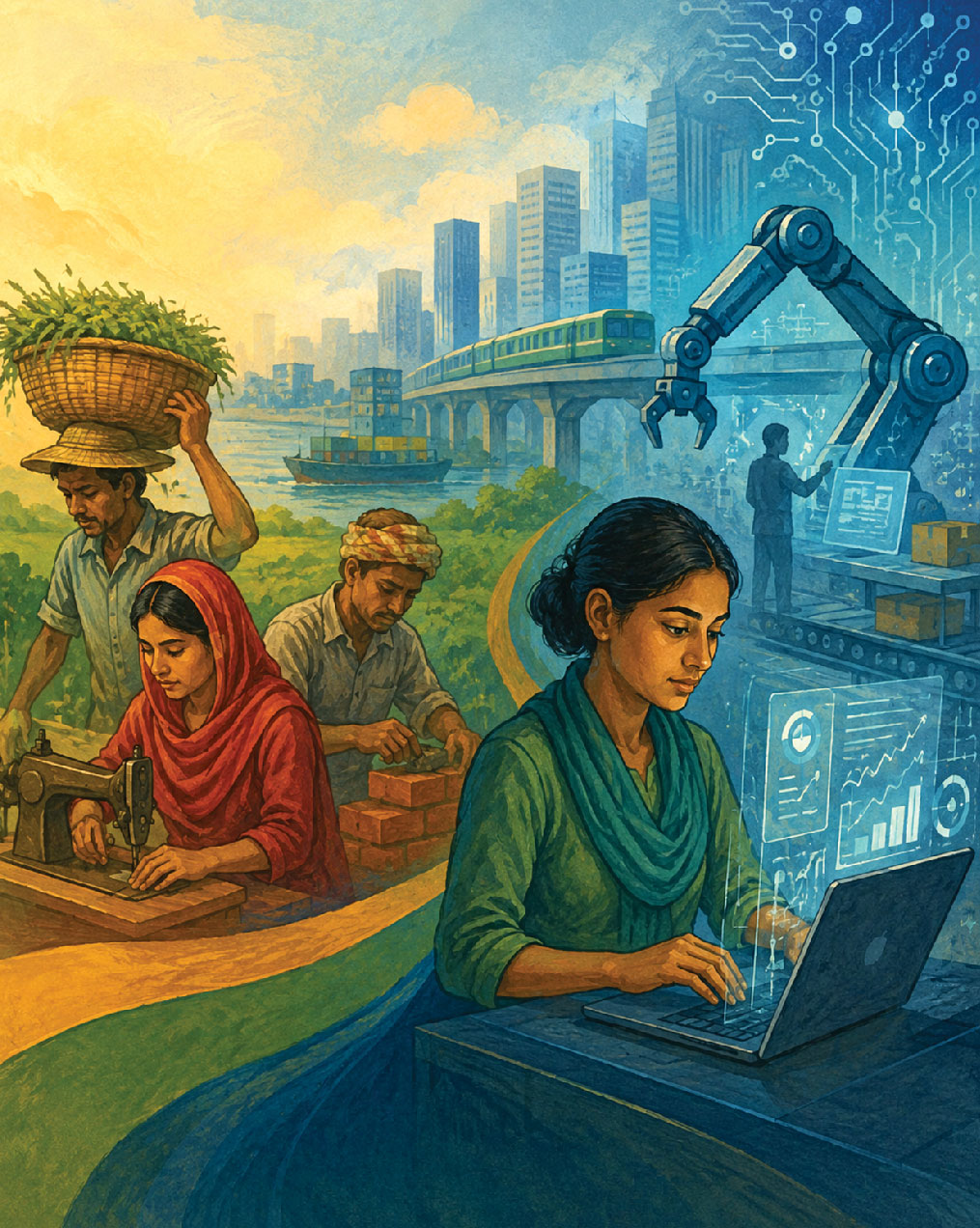
Bangladesh’s next advantage will not come from cheap labour alone. It will come from workers who can use AI tools, operate smart production systems, provide digitally enabled services, move into skilled migration and raise productivity in informal enterprises.
The UNDP-Unesco AI readiness report recommends investing in reskilling and upskilling for a future-ready workforce, including technical AI skills, ethical and legal understanding, public-private training partnerships and a national digital marketplace for certified workers. It also identifies data annotation and labelling as a possible entry point into the global AI services economy, if backed by fair labour standards.
That is where Bangladesh can turn risk into strategy. AI does not have to replace the people-powered model. It can strengthen it – if workers are trained to complement technology rather than compete against it.
Bangladesh has already bet on its people. The next question is whether it will invest in them with the urgency the bet demands.


%20Square%20Ad%20-11.jpg&w=640&q=75)
%20Horizental%20AD-01.jpg&w=3840&q=75)
