in focus
No home, no pension, no access; is Bangladesh allowing its elders to be abandoned?

Illustrated By sk. yeahhia
5 September, 2025
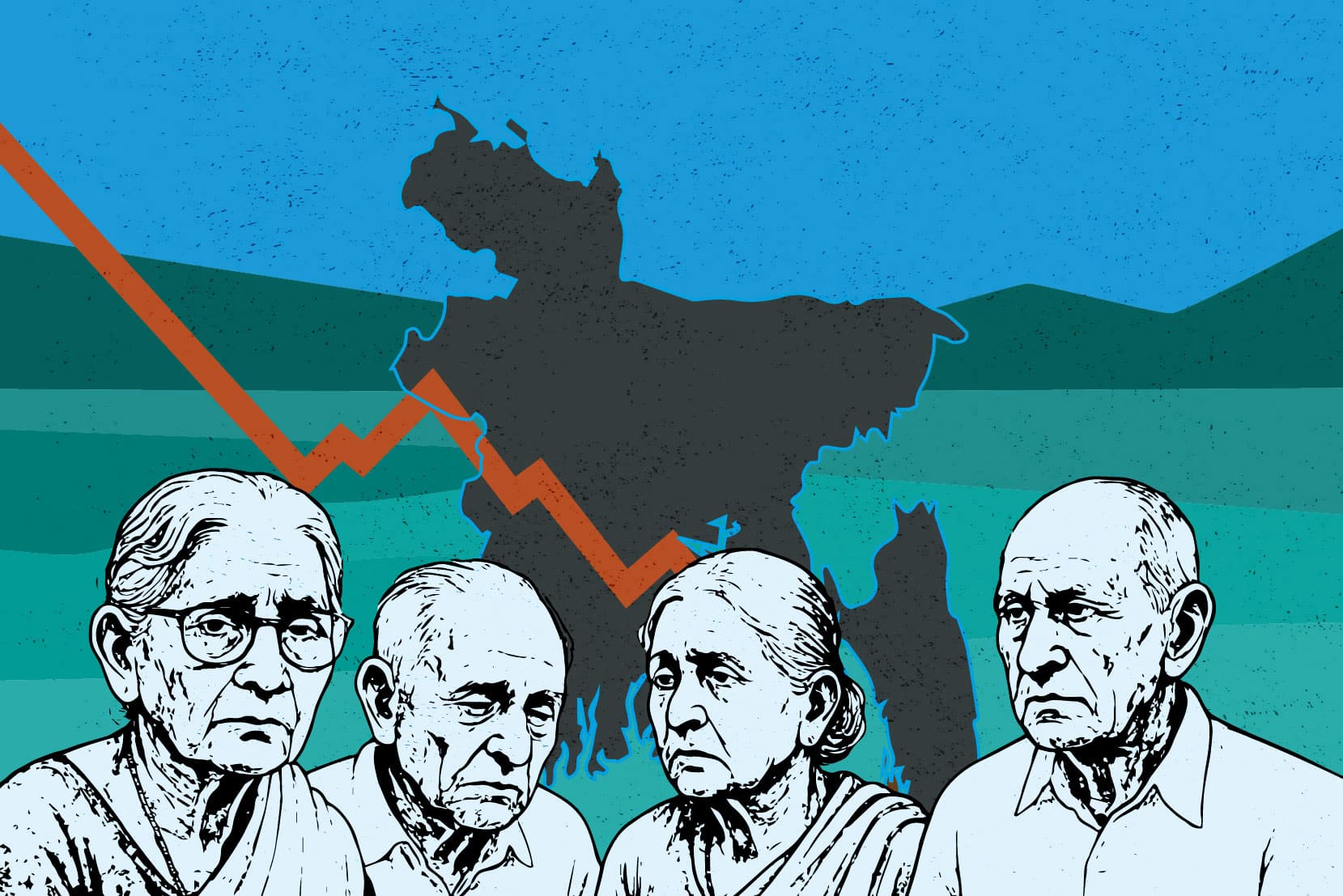
We’ve seen them before - quiet figures in documentaries, sitting on worn cots or plastic chairs, eyes hollow with waiting. They are the generation that raised us, built livelihoods from scratch, and sacrificed their prime for others. Now, they are being left behind. In the dusk of life, many wait days for meals, months for medical care, years for the warmth of a familiar face. As Bangladesh races ahead with highways and high-rises, it quietly abandons the generation that laid its foundation.
By 2050, one in six citizens will be a senior citizen, according to the Bangladesh Bureau of Statistics (BBS). With life expectancy now 74 for men and 77 for women, according to the UNFPA’s 2025 State of World Population report, Bangladesh is entering a longevity revolution. Yet, elder care is missing from public policy and private investment. The myth of the joint family is fading; urbanisation and migration have eroded the traditional safety net. Many seniors now live in isolation - without care, company, or dignity.
Infrastructure reflects this neglect. Public transport is barely accessible. Footpaths are broken. Hospitals lack geriatric wards. Bangladesh has no integrated elder care framework, dedicated ministry, cohesive policy, or regulatory oversight. The cost of inaction will be a social crisis, a public health emergency, and an economic liability.
Bangladesh’s main public support for elders is a BDT 650 monthly allowance for 6.1 million beneficiaries - a modest rise from BDT 600 in April 2025 - covering little more than basic food. Pensions are limited to civil servants.
THE NUMBERS BEHIND THE CRISIS
Bangladesh’s ageing is no longer a forecast - it is here. The 2022 Population and Housing Census counted 15.78 million citizens aged 60 and above (9.28% of the population), projected to hit 10.09% by 2025 and nearly 17% by 2050. The World Bank warns that one in five will be over 60 by mid-century. Yet this strains a fragile support system. In 2022, 77% of seniors lacked enough income to meet basic needs, while 71% relied on relatives. The old-age dependency ratio, older people compared to working-age adults, will increase to 23.5 by 2050. These figures signal a rise in frailty, chronic disease, and social isolation.
THE NEAR-ABSENCE OF GERIATRIC CARE
Despite this demographic surge, the health system remains youth-focused. A Dhaka Tribune investigation found geriatric care almost nonexistent in public hospitals - no dedicated wards, only informal ‘elderly corners’. The Probin Hospital in Dhaka, run by the Bangladesh Association for the Aged and Institute of Geriatric Medicine (BAAIGM), treats about 3,700 older patients every three months, relying on voluntary doctors and lacking full-time specialists.
One private facility, Senior Citizen Hospital Ltd., markets itself as the country’s first geriatric-focused hospital, offering neurology, geriatrics, cardiology, and physiotherapy. Yet no independent data exists on affordability or outcomes. Outside Dhaka, there are no geriatric departments in district hospitals or community clinics. A 2023 Tangail study found primary clinics lacked elder-friendly infrastructure, trained staff, or accessible toilets; many older patients bypassed them for distant hospitals or costly private care.
OLD-AGE HOMES: A FRAGILE SAFETY NET
The joint family once provided primary elder care, but migration and shrinking households are pushing more seniors into institutions. The Ministry of Social Welfare runs six government old-age homes with a capacity for about 300 residents. Nationwide, there are roughly 32 homes, mostly run by charities or private groups, all unregulated, with no monitoring body or quality standards.
Conditions vary - some offer lodging but no medical care. Others provide meals but no psychosocial support. Residents report loneliness and stigma, as institutional care is still seen as abandonment. The National Policy on Older Persons (2013) and Parents’ Maintenance Act (2013) recognise elders’ rights and obligate children to provide care, yet enforcement is minimal, and no dedicated agency implements them.
SOCIAL SAFETY NETS: MODEST BUT INADEQUATE
Bangladesh’s main public support for elders is a BDT 650 monthly allowance for 6.1 million beneficiaries - a modest rise from BDT 600 in April 2025 - covering little more than basic food. Pensions are limited to civil servants.
The Universal Pension Scheme, launched in 2023, aims to include 100 million citizens aged 18 to 50 by 2040, anticipating the 65+ share will rise from 7% to 25% by 2050. Contributions are required, with subsidies for low-income participants, but many current elders - especially in the informal sector - cannot afford to join.
ELDER-UNFRIENDLY CITIES
Dhaka and other cities are hostile to older bodies. Unsafe roads, blocked footpaths, and inaccessible public transport isolate seniors. A 2021 transport survey described older residents feeling ‘feverish’ before travel due to unsafe last-mile connections, potholes, lack of ramps and seating, and bus conductors unwilling to stop long enough for boarding.
Overcrowded buses, high rickshaw fares, and harassment discourage older women from using public transport. A Daily Star report estimated 60% of Dhaka’s footpaths are occupied by hawkers, forcing pedestrians, including elders, onto roads. Elevators are rare in multistorey buildings, and there are almost no age-friendly public spaces.
PRIVATE SECTOR AND HOME CARE
As family-based care weakens and government facilities remain scarce, a small but growing home-care sector is emerging. Startups like Olwel, Doctors Home Care, and SAJIDA Foundation offer elder-care packages with health checkups, home visits, and daily assistance. However, these remain urban-centric and costly, leaving rural and low-income elders out. The sector is also unregulated, with no licensing or quality control, raising concerns over safety and training.
INCREMENTAL POLICY MOVES, NO COHESIVE STRATEGY
The National Social Welfare Policy (2005), National Policy on Older Persons (2013), and Parents’ Maintenance Act (2013) address elder rights and health access. Yet implementation is weak, with no enforcement mechanisms. Plans to build ‘Shanti Nibash’ homes in all eight divisions remain on paper.
Budget allocations for older adults are minimal. While allowances increased slightly in 2025, they barely cover essentials. The Universal Pension Scheme excludes most informal workers, who make up the majority of the labour force. Bangladesh lacks a comprehensive elder care strategy integrating health, housing, social protection, and infrastructure.
GLOBAL COMPARISONS: LESSONS FOR BANGLADESH
Countries facing rapid population ageing have developed diverse strategies to care for seniors-from rights-based systems and social insurance to community-driven models.
India launched the National Programme for Health Care of the Elderly (NPHCE) in 2010-11, establishing National Centres for Ageing (200-bed hospitals with training and research), Regional Geriatric Centres, geriatric units at district hospitals, twice-weekly clinics and rehabilitation units at community health centres, weekly clinics at primary health centres, and domiciliary visits by sub-centres. The programme trains geriatric specialists and integrates non-communicable disease screening. Social pensions through the Indira Gandhi National Old Age Pension Scheme pay INR 200 per month at ages 60-79 and INR 500 at 80+, with 2.85 crore beneficiaries in 2020.
Japan operates Long-Term Care Insurance (LTCI), launched in 2000, funded 50% by premiums (from age 40) and 50% by taxes, with only a 10% co-payment. Services include facility, in-home, and community care. Local governments integrate preventive, medical, welfare, and housing services at the neighbourhood level, reducing hospital admissions and supporting ageing in place.
Australia offers a government-subsidised aged care system to help seniors live independently at home before transitioning to residential care. The Commonwealth Home Support Programme (CHSP) provides entry-level assistance such as cleaning, transport, and personal care, while Home Care Packages (HCP) deliver tailored higher-level support. From late 2025, these will merge into the Support at Home Program, offering streamlined assessments, tiered funding, and fully subsidised clinical care.
WHAT BANGLADESH CAN LEARN
From India’s Regional Geriatric Centres to Australia’s rights-based reforms, global experiences show that ageing can be addressed with foresight, financing, and integrated services. For Bangladesh, where elder care remains fragmented and underfunded, these lessons offer a roadmap for turning a looming crisis into an opportunity for social and economic renewal.
This begins by making ageing a strategic priority, integrating elder care into national plans with clear budgets and targets, as seen in India, Japan, and Australia. It also requires building an age-friendly health system by establishing geriatric units, training specialists and community health workers, and embedding elder services at district and upazila levels, following India’s NPHCE. At the same time, pensions and insurance must be expanded by adapting Japan’s LTCI and subsidising universal pension contributions for informal workers, since BDT 650 per month is inadequate. Regulating home care is equally important, which means setting training, wage, and safety standards, using consumer ratings like Australia’s, and supporting providers with tax breaks, loans, and PPPs. Cities, too, must be designed to be elder-friendly, ensuring barrier-free access, reserved transit seating, and safe footpaths, while also including accessible housing and parks in urban plans. Addressing loneliness and mental health is another pressing need, through funding community centres, counselling, and digital literacy programmes, and by allocating more than the current 0.44% of health budgets to mental health. Finally, existing laws must be enforced by activating the National Policy on Older Persons and the Parents’ Maintenance Act, and by creating a regulatory body to audit care homes and prosecute abuse.
Bangladesh’s demographic dividend is ending, and an age wave is rising. Yet healthcare, social protection, and urban design remain ill-prepared. Most seniors depend on family, minimal pensions, or a few charity homes; mental health and geriatric services are scarce.
Global models - from Australia’s rights-based reform to Japan’s social insurance and India’s tiered care - prove solutions exist. The barrier is political will. Investing now in elder-friendly health systems, infrastructure, pensions, regulated home care, and mental health can ensure seniors live not just longer but with dignity.