

features
The Pink Bus may create a safer corner within Bangladesh’s transport system, but meaningful progress will depend on what happens when women step onto buses that are not pink.

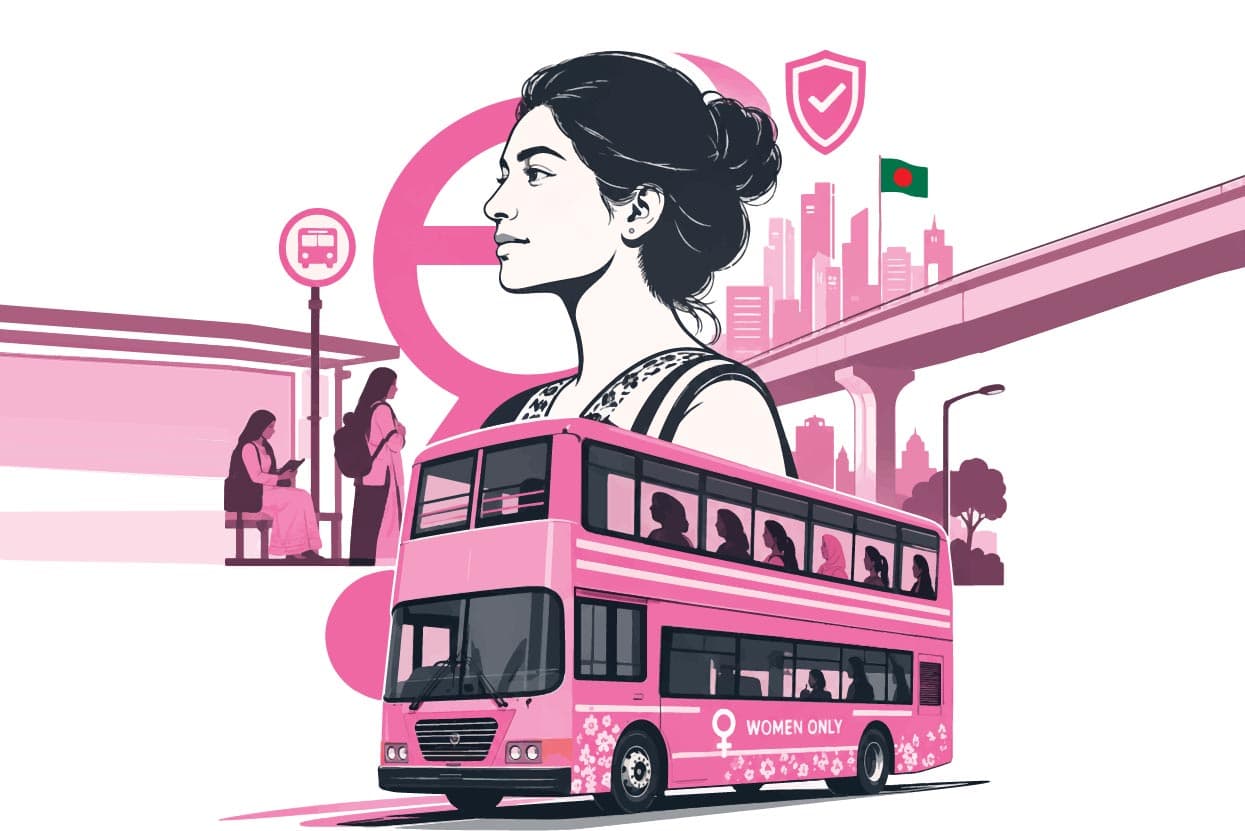
Illustrated By sk. yeahhia
19 August, 2026
There is something almost ironic about the way Bangladesh has begun discussing the Pink Bus. A service introduced to make public transport safer and more comfortable for women quickly became the subject of jokes, memes and arguments about whether men should also have reserved seats. One particularly popular line of discussion was revealing: if women have 9 reserved seats on ordinary buses, should men have 9 seats on the Pink Bus? The joke may seem harmless. Beneath it, however, lies a question worth taking seriously. Why does a policy created in response to women’s insecurity so quickly become a debate about what men are supposedly losing?
What the Pink Bus Promises
On 18 August, the Bangladesh Road Transport Corporation (BRTC) launched 14 women-only ‘Pink Buses’ across Dhaka, Chattogram and Bogura. Operated by women drivers and attendants, the buses were introduced to provide women with a safer and more comfortable transport option, with plans to expand the service further.
The initiative itself is difficult to object to. Women deserve safe transport. But the Pink Bus raises another, far more uncomfortable question: what happens when the bus is not pink?
Fourteen buses cannot serve every woman who depends on public transport. That is not necessarily a failure of the initiative. Operating a large fleet of women-only buses at short intervals across an entire city would be expensive and operationally difficult. Nevertheless, there remains a considerable gap between what is safer and what is readily available.
A university student cannot necessarily wait for a Pink Bus. Neither can an employee who must clock in at 9 a.m., or a woman travelling to an examination, an interview, a hospital appointment or simply home after a long day. The next ordinary bus may be her only practical option. So she takes it.
And that is where the real problem begins: when rights become confrontations.
When Everyday Travel Becomes a Calculation
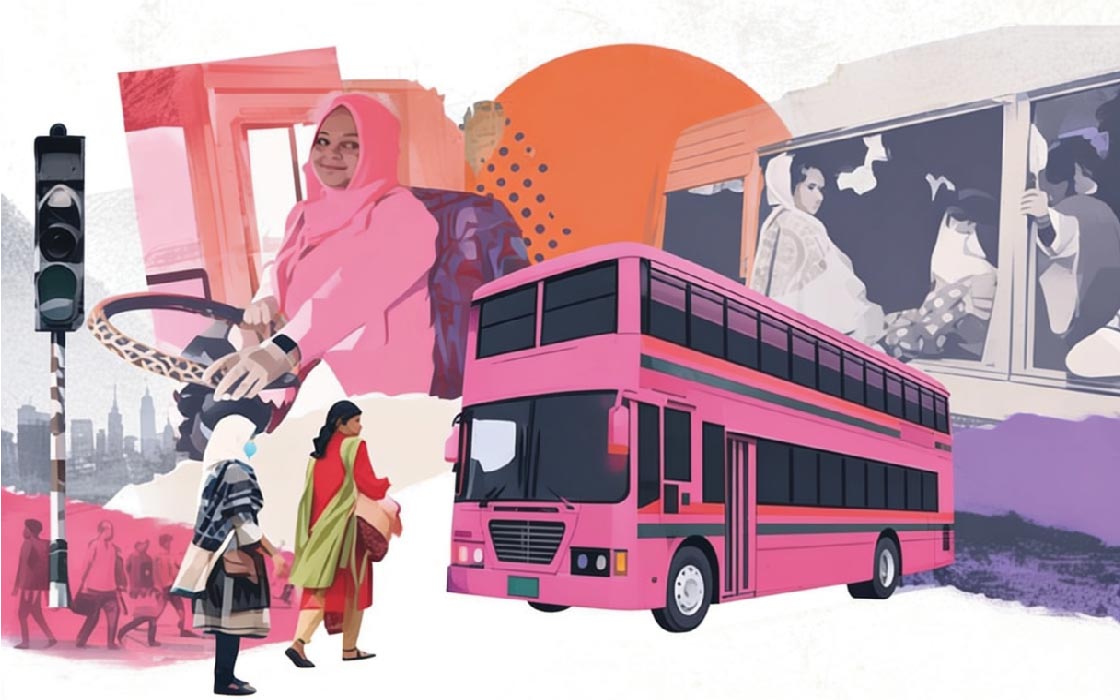
Much of what women say about ordinary buses emerges through everyday accounts rather than formal statistics. Women who regularly use public transport describe overcrowding, unwanted physical contact and the constant discomfort of travelling in close proximity to strangers. These accounts are not presented here as the findings of a formal survey. They are experiences shared by women commuters— experiences I have also encountered and witnessed first-hand while travelling on public buses.
There is the familiar sensation of an arm brushing against you. A body pressed unnecessarily close in an already crowded bus. The uncertainty over whether the contact was accidental.
Then there are the reserved seats.
Seats at the front of ordinary buses are designated for women and other priority passengers. Yet women commuters describe situations in which men occupy those seats regardless. When a woman asks them to move, the interaction can become hostile. Since the launch of the Pink Bus, some women have encountered a new line of argument:
‘This is not your bus anymore.’
‘These are not your seats.’
‘You chose to ride this bus.’
‘Then sit somewhere else.’
The words vary. The message does not: if you wanted comfort, you should have taken the Pink Bus. But what if there was no Pink Bus to take?
According to BRTC, route-tracking facilities have been introduced on the Pink Buses. CCTV cameras have initially been installed on three buses, with plans to extend surveillance to the rest of the fleet.
A Right Reduced to an Argument
This is why the discussion surrounding reserved seats — and women’s safety on public transport more broadly — has become even more important. A reserved seat is a matter of transport policy. It should not become a personal negotiation between a woman and a stranger.
If a seat is reserved for women, a woman should not have to argue with another passenger to justify her right to use it. She should not have to risk mockery or hostility, or decide whether enforcing the rule is worth the confrontation. That responsibility belongs to the transport system.
The conductor should be able to say, ‘This seat is reserved. Please move.’
That should be the end of the conversation.
Women’s transport problems cannot be solved by expecting them to negotiate their safety personally with every passenger they encounter. A functioning policy is one that does not require the person it is designed to protect to enforce it herself.
An Addition, Not a Substitute
It is important to make this distinction: the Pink Bus is not the problem. It responds to a very real need. The problem arises if it is treated as a substitute for making ordinary public transport safer.
At the launch, the Road Transport Minister emphasised that women’s safety must be ensured not only after they board a bus, but also while they are waiting and when they get off. That principle should apply to the entire transport system—not only to buses reserved exclusively for women.
There is an understandable appeal in separating women from men when the existing system is unsafe. But separation does not correct the behaviour that made it necessary. It may create a safer option for some women without addressing the conditions experienced by the majority.
The better solution is to pursue both objectives: give women the option of women-only transport while also making ordinary transport safer. The Pink Bus should provide an additional layer of protection, not an alternative to systemic reform.
Making Safety the System’s Responsibility
Achieving that reform requires something less visible than a new fleet of pink buses: accountability.
Drivers and conductors should receive training in gender-sensitive transport practices. Reserved seats should be clearly marked, and conductors should be responsible for enforcing the policy. Passengers should have a simple and accessible way to report violations, while transport operators should face consequences when complaints are repeatedly ignored.
Technology can also help. According to BRTC, route-tracking facilities have been introduced on the Pink Buses. CCTV cameras have initially been installed on three buses, with plans to extend surveillance to the rest of the fleet. The more important question is whether similar accountability mechanisms can gradually be introduced across ordinary public transport.
Technology alone, however, will not make women safe. Cameras are of little value if footage is not reviewed, complaints are not investigated and violations carry no consequences. Tracking systems are useful only if authorities use the information to monitor routes, schedules and driver conduct. Every technological intervention must therefore be supported by a clear process of enforcement.
The responsibilities of transport workers must also be made explicit. A woman facing harassment should not have to rely on the goodwill of an individual conductor. Staff should be required to intervene, and they should know what steps to take when a passenger behaves abusively. Safety must become an operational standard rather than a matter of personal discretion.
Does a woman feel safer boarding an ordinary bus six months from now? Does a conductor enforce the reserved-seat policy without being asked? Can a woman report harassment and reasonably expect action to follow?
Mobility Is Economic Freedom
A woman who cannot move safely through her city does not enjoy the same economic freedom as one who can. Safe public transport is therefore not simply a matter of comfort. It is infrastructure for women’s education, employment and economic participation.
When commuting is unsafe or unpredictable, women may turn down jobs, avoid evening classes, restrict their working hours or spend more on private transport. These decisions carry consequences not only for individual women and their families, but also for the wider economy. A transport system that limits women’s mobility also limits their access to opportunity.
This is why the success of the Pink Bus cannot be measured solely by the number of passengers it carries. Its larger value should lie in whether it helps raise expectations across the entire transport network.
Does a woman feel safer boarding an ordinary bus six months from now? Does a conductor enforce the reserved-seat policy without being asked? Can a woman report harassment and reasonably expect action to follow?
If the answer remains no, then we have created a safer corner within public transport without making public transport itself safer. That is not enough.
The Real Destination
Most women will still have to travel on buses that are not pink. When they do, they should not be told that they chose the wrong bus. They should not have to fight with another passenger to occupy a seat already reserved for them. Nor should they have to defend their right to feel safe.
Women should not have to secure their rights one passenger at a time. Policy should do that work for them.
The Pink Bus may be a good beginning. But the real destination should be a city in which women do not need a pink bus to feel safe.


