

in focus
Bangladesh’s garment scraps could cut import bills, create green jobs and strengthen export competitiveness — but only if jhut moves from opaque scrap trade to traceable industrial feedstock

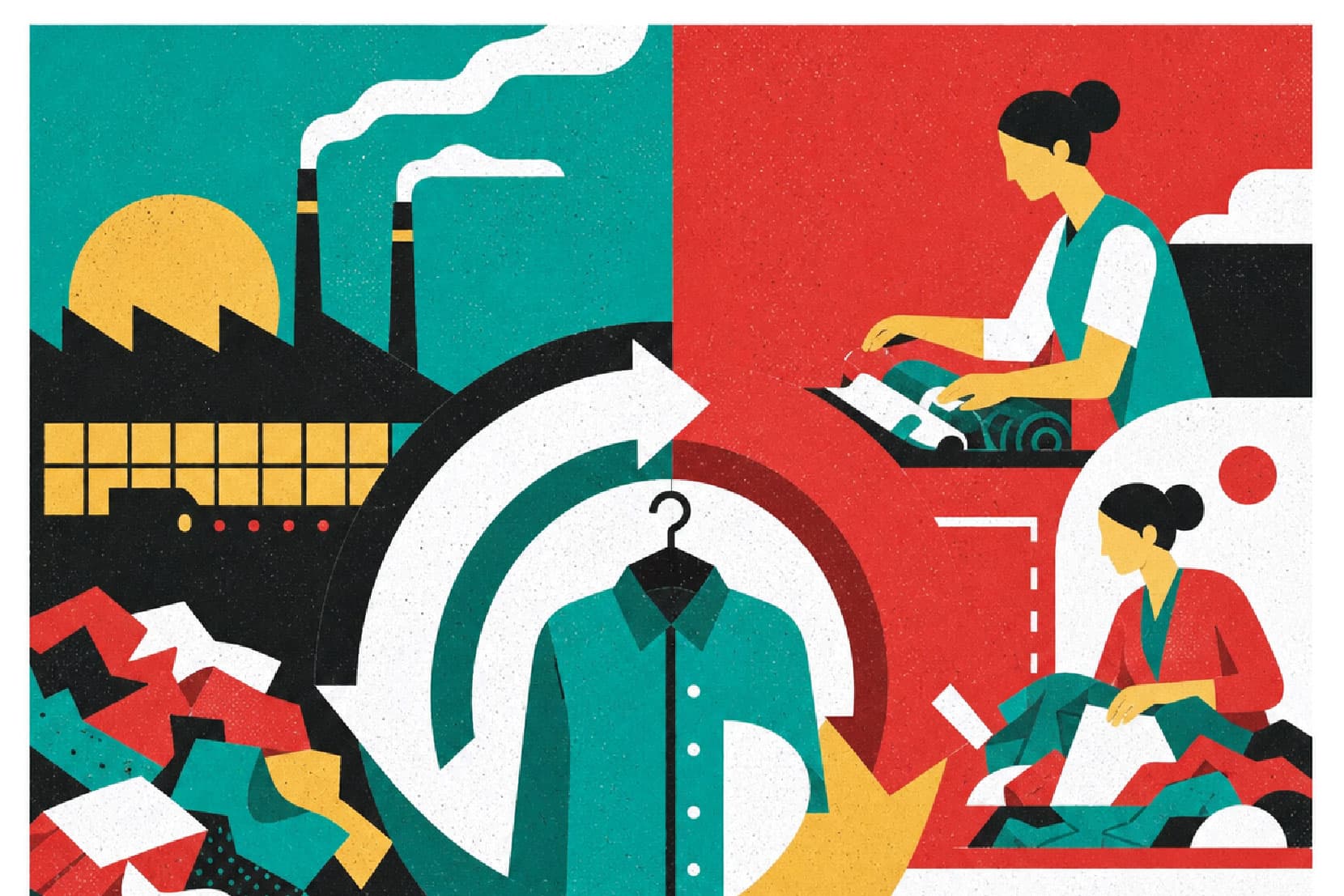
Illustrated By sk. yeahhia
22 June, 2026
Bangladesh’s garment industry leaves behind a second economy every day. It begins at cutting tables, where leftover fabric falls away from export-bound shirts, trousers, jackets and knitwear. Locally known as jhut, this material moves through factory gates into the hands of brokers, traders, transporters, sorters, godown owners, recyclers and small manufacturers. Some become filling for mattresses and cushions. Some is recycled locally. Some are exported. Some disappear into low-value, poorly documented channels.
Yet the numbers suggest this is not a marginal scrap trade.
In the first 11 months of FY2025-26, Bangladesh exported USD 35.31 billion worth of RMG products, down 3.41% year-on-year. Knitwear shipments fell 4.26% to USD 18.78 billion, while woven exports declined 2.42% to USD 16.53 billion, according to BGMEA data. During the same period, garment exports to the EU fell 4.88% to USD 17.36 billion, while exports to the US remained almost flat at USD 7.03 billion.
Every year, the industry is estimated to generate up to 577,000 tonnes of textile waste. Much of it is shipped abroad or left to pollute locally, while what remains in Bangladesh is often downcycled into low-value products. More local recycling could save the country about USD 700 million a year in imports, according to estimates cited by Reuters/Context. At a time when export growth is weakening, that waste stream looks less like an afterthought and more like unfinished industrial business.
The import burden behind the scraps
The pressure is sharper because Bangladesh still imports heavily for the same industry that produces this waste. Prothom Alo reported, citing NBR data, that Bangladesh imported 1.889 million tonnes of cotton last year at BDT 453.74 billion, alongside 1.2 million tonnes of yarn worth BDT 457.13 billion.
The import pressure has become more visible in the current yarn debate.
The Business Standard reported in October 2025 that more than 50 textile mills had closed, while Indian export incentives gave imported yarn an estimated USD 0.30 per kilogram price edge over Bangladeshi producers.
Against that import bill and price pressure, jhut is not only disposal fabric. Properly sorted cotton waste can become recycled fibre, higher-quality post-industrial scraps can feed mechanical recycling and cleaner, better-documented material can enter textile-to-textile recycling systems. What is missing is not the material, but the system to move it reliably back into production.

That matters because the informal jhut chain is often dismissed as disorderly or inefficient. In reality, it already performs a circular function. It collects, sorts and redirects material that would otherwise have little value. The weakness is not that the chain does nothing; it is that too much of its work remains outside formal records, quality standards, labour protections and buyer visibility.
A circular economy that already exists
Bangladesh does not have to invent the jhut economy. It already exists. A 2025 BRAC University research brief describes jhut as a garment and textile factory waste processing industry that includes recycling, reuse and disposal. Sorting is concentrated in hubs such as Gazipur, Mirpur, Narayanganj and Pabna, with Gazipur described as a major centre that receives jhut from other clusters. The brief also cautions against a simple landfill narrative, noting that jhut clusters already support domestic and export uses of waste.
That matters because the informal jhut chain is often dismissed as disorderly or inefficient. In reality, it already performs a circular function. It collects, sorts and redirects material that would otherwise have little value. The weakness is not that the chain does nothing; it is that too much of its work remains outside formal records, quality standards, labour protections and buyer visibility.
Reuters/Context reported that thousands of informal workshops sort and bundle jhut, while the processed material that stays in Bangladesh is commonly downcycled into products such as mattresses, pillows and cushions. The report also cited concerns that politically connected and influential actors can control access to factory scraps and pricing, limiting visibility for brands and suppliers. That opacity becomes costly when buyers begin asking not only whether recycled content exists, but where it came from, what fibre it contains, who handled it and whether the claim can be verified.
When scraps need paperwork
Textile Exchange’s 2025 Materials Market Report says global fibre production reached 132 million tonnes in 2024 and could reach 169 million tonnes by 2030 if business continues as usual. Recycled fibres made up only 7.6% of global fibre production in 2024, and less than 1% of the global fibre market came from pre and post-consumer recycled textiles.
This is where Bangladesh’s factory waste could matter. Compared with post-consumer waste, post-industrial textile scraps are easier to collect, cleaner, and more predictable. But the advantage disappears if they are mixed, poorly sorted, undocumented or sold through channels that brands cannot audit.
The EU’s Strategy for Sustainable and Circular Textiles sets a 2030 vision in which textile products placed on the EU market are durable, repairable, recyclable and, to a great extent, made of recycled fibres. The strategy also includes actions to introduce a Digital Product Passport, mandatory extended producer responsibility rules for textiles, and restrictions on textile waste exports.
In the EU’s own policy language, product information is part of the circular transition. The European Commission’s textile strategy says a Digital Product Passport for textiles would be based on mandatory information requirements on circularity and other environmental aspects, including data that can help actors across the value chain understand fibre composition, repairability and substances of concern.
Once a garment needs proof of circularity, the value of jhut changes. Untraceable scraps remain cheap. Sorted and traceable scraps become inputs, data and compliance tools.

7 participating manufacturers reported direct financial benefits from selling segregated textile waste at higher market value, while the pilot generated an estimated EUR 1.07 million in economic value across actors.
The pilot that tested the system
Recent work in Bangladesh shows how much value can be unlocked when the system is organised. The BESTSELLER-SWITCH2CE pilot, led by Unido and supported by Global Fashion Agenda, BGMEA and Reverse Resources, was designed to scale traceable textile recycling among BESTSELLER’s suppliers in Bangladesh and strengthen domestic recycling capacity. At the outset, participating suppliers were generating recyclable cotton waste, but no factory was segregating textile waste at scale, classifications were broad, and fibre composition was rarely recorded.
As the pilot progressed, supplier engagement grew from 7 to 20 manufacturing facilities. Waste handler and recycler participation increased from 2 to 27 handlers and 26 recyclers. The volume of segregated material rose from just over 129 tonnes at baseline to more than 16,000 tonnes by November 2025. 14 of 16 participating manufacturers introduced dedicated waste segregation zones, and suppliers began recording up to 20 material composition categories.
Those changes also produced commercial returns. 7 participating manufacturers reported direct financial benefits from selling segregated textile waste at higher market value, while the pilot generated an estimated EUR 1.07 million in economic value across actors.
The limits were just as important. Recycled fibres remained more expensive than virgin alternatives, waste quality outside the pilot was inconsistent, and domestic recycling capacity was not yet enough to absorb rising volumes of segregated material. Only about 10% of material could be fully channelled into textile-to-textile recycling at present.
The pilot did not show that Bangladesh has solved the jhut problem. It showed that better segregation, data and coordination can turn scraps into higher-value material — and that the existing system is still too fragmented to do this at national scale.
The people inside the waste chain
The move from scrap trade to circular industry also carries a labour risk.
The jhut economy is not only a flow of material; it is a source of livelihood. A 2026 SWITCH2CE employment study estimated that Bangladesh’s jhut value chain supports the livelihoods of around 195,000 to 214,000 informal workers. The same study notes that circular textile activities in Bangladesh stretch across formal and informal arrangements, with many workers outside the scope of labour protection.
Reuters/Context reported that tens of thousands of workers, around 70% of them women, sort remnants for 10 to 12 hours a day in workshops where workers described low wages and limited basic protections such as drinking water, paid sick leave or safeguards against harassment.
This is the part of circularity that can easily be hidden. A more formal recycling system may help brands meet sustainability targets and factories earn more from sorted waste. But if the workers who already collect, sort and process jhut remain invisible, Bangladesh could build a greener value chain on the same old labour precarity.
The SWITCH2CE employment study recommends that the upcoming circular textile strategy embed decent work as a core objective rather than assume it will automatically follow from circularity. It also calls for informal jhut workers to be recognised within labour protections and for basic standards such as regulated working hours, predictable wage payments, weekly rest, paid sick leave, healthcare access, water and toilets.
A climate economy that improves material efficiency but leaves workers unprotected would be only half a transition.

If Bangladesh can build that bridge, jhut can become more than leftover fabric. It can reduce part of the import burden, create recycling businesses, support lower-carbon apparel, prepare exporters for buyer scrutiny and bring informal workers into a better-regulated value chain.
The policy window
Bangladesh is now trying to put a framework around the transition. The Ministry of Commerce has reaffirmed its commitment to finalising the National Strategy on Circular Economy for the Textile and RMG sector by the end of 2026. The announcement came after a national stakeholder consultation in Dhaka on 23 April 2026, aimed at shifting the country’s largest export sector toward a climate-neutral and sustainable manufacturing model.
That strategy will matter only if it treats jhut as industrial policy, not as a narrow waste-management issue. Disposal, collection and small recycling schemes may reduce pollution. But a real waste economy would need more than that: factory-level segregation, digital traceability, transparent pricing, quality standards for recycled input, domestic mechanical and chemical recycling capacity, buyer purchase commitments, tax incentives, green finance and worker protection.
Experts quoted by TBS also flagged economic viability, policy inconsistency and investment limitations as major recycling challenges. Those are not side issues. They decide whether jhut remains a fragmented informal trade or becomes part of Bangladesh’s next industrial upgrade.
From leftovers to leverage
For decades, Bangladesh’s garment success has rested on converting imported and locally sourced textile inputs into exportable apparel. The next stage may require something more complex: recovering value from what production leaves behind. The raw material is already there. The export pressure is already visible. The global rules are moving toward recycled content, traceability and circular design. Early pilots show that factories can earn more when waste is segregated and documented. Workers already keep the material moving, even if the formal economy barely recognises them.
What is missing is the bridge between these pieces.
If Bangladesh can build that bridge, jhut can become more than leftover fabric. It can reduce part of the import burden, create recycling businesses, support lower-carbon apparel, prepare exporters for buyer scrutiny and bring informal workers into a better-regulated value chain. If it cannot, the pattern will be familiar: Bangladesh will continue producing garments at scale, while others capture more of the value from the materials, data and technologies around them.
The factory floor is already producing the next input. The question is whether Bangladesh can keep the value before it leaves the gate.


%20Square%20Ad%20-11.jpg&w=640&q=75)
%20Horizental%20AD-01.jpg&w=3840&q=75)
