

Global Economy
The winners, losers, and the unwritten rules of Donald Trump’s tariff game.

Illustrated By sk. yeahhia
20 August, 2025
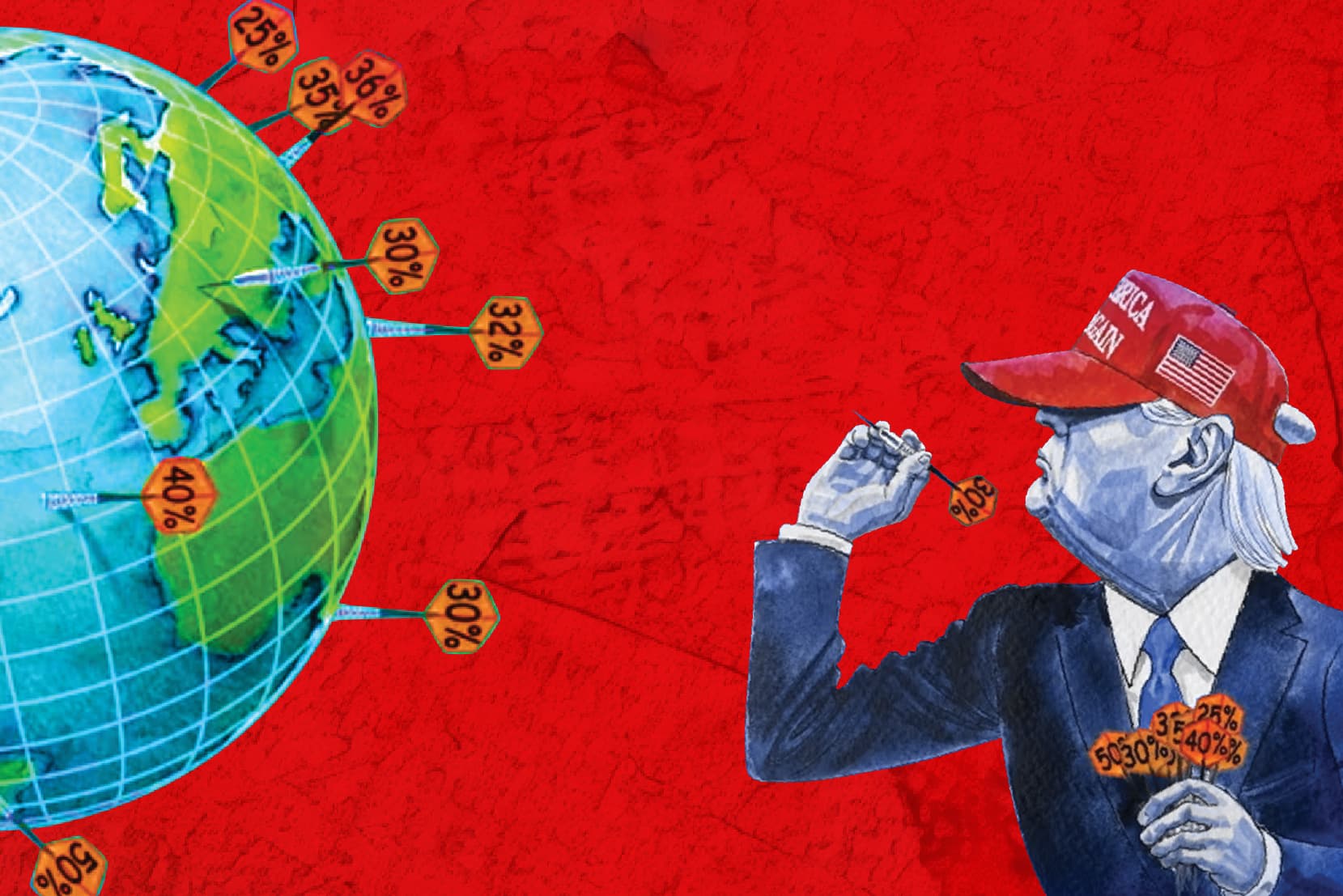
On 1 August 2025, US President Donald Trump formalised his proposed tariff rates on global trading partners, following weeks of talks, negotiations, and discussions, albeit largely one-sided, where nations were essentially hoping to secure the lowest possible tariff by keeping Trump as pleased as possible. While this list is being called the President’s finalised set of tariffs, Trump has long been known for his impulsive decisions and his tendency to alter outcomes on the fly. As such, it remains difficult to predict the true winners and losers of these tariffs, which seem to hinge on the ever-shifting mood of the POTUS.
A Confusing Prequel
In April, when President Trump made it clear that the tariffs were inevitable, he claimed his motivation was to protect the US market, boost domestic manufacturing, and generate jobs for American workers. However, analysts were quick to point out that research has repeatedly shown that the increased cost of goods caused by tariffs is typically borne by consumers, not by companies operating manufacturing plants overseas. Canada and South Africa, thus, expressed grave concern over Trump’s executive order, warning that the global trade system, which had been functioning under pre-Trump tariff rates, would be severely disrupted. The resulting ripple effect could cause job losses around the world and, ironically, impose a higher cost of living on Americans themselves.
Some nations simply chose not to risk entering a trade war with the US. When Trump threatened that he would impose tariffs on countries unless they agreed to come to the table with a great offer that benefits the US, countries like the UK, Vietnam, Indonesia, the Philippines, Japan, the European Union nations, and South Korea scrambled to negotiate agreements. Their goal was to keep Trump appeased, whether through investment promises or massive shipment orders, in the hopes of securing the lowest possible tariff rates. Meanwhile, analysts were left scratching their heads over decisions like Trump’s 10% levy on the Heard and McDonald Islands territories, populated exclusively by penguins, or his move to slap a colossal 50% rate on the impoverished southern African nation of Lesotho.
Still up in the air are the final tariff rates between the US and China, the world’s two largest economies. The two nations remain locked in a cycle of tit-for-tat levies, neither side backing down nor showing any real interest in compromise.
Hardest-Hit Nations
The harshest import taxes were reserved for Syria, at 41%, and for Laos and Myanmar at 40% each. These are three relatively poor nations with only modest trading relationships with the US. Iraq and Serbia were hit with 35%, while Algeria received a 30% tariff, again, inexplicably high in a landscape where few expected to be winners or losers.
How exactly these tariffs help protect US jobs remains an open question, but it is increasingly clear this isn’t just about economics. For instance, Brazil received a separate 50% tariff as punishment for what Trump described as a “witch hunt” against its former president and his right-wing ally, Jair Bolsonaro, who stands accused of plotting a coup. So, it’s not just about protecting American jobs, it’s also about protecting America’s political interests.
Lesotho, threatened with a 50% tariff, ultimately saw that figure reduced to 15%. However, Trump’s initial threat had already prompted American buyers to freeze orders, causing thousands in Lesotho to lose their jobs. In response, Lesotho’s government declared that Trump had brought on a national disaster in an already deeply impoverished country.
In trying to make sense of Trump’s decisions, analysts have struggled to identify any consistent logic behind the rates - why some countries were hit so hard, while others were spared. One possibility is that the steepest tariffs have been aimed at countries with the biggest trade surpluses. During his announcement, Trump claimed that these surpluses constitute “an unusual and extraordinary threat” to the national security and economic stability of the United States.
Tariffs on Major Trading Partners
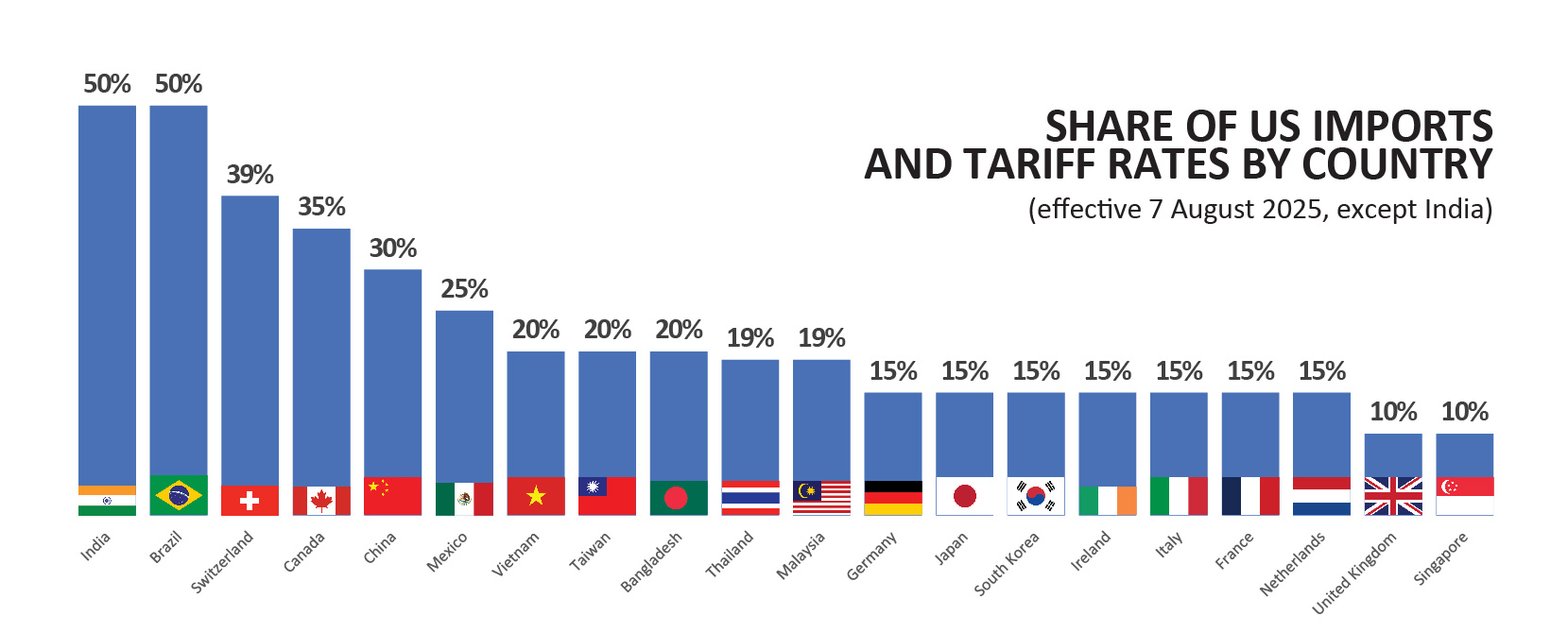
Switzerland was hit hard by Trump’s tariffs. At 39%, the Swiss government expressed great regret over the decision. Switzerland, one of the wealthiest nations in terms of GDP per capita, is a major manufacturer of luxury goods, from Swiss chocolates to premium watches, and the US remains its largest market for these products. Following the announcement, shares of Watches of Switzerland Group PLC tumbled by 8.5%.
The case of India remains a developing story. India was struck with an unexpectedly high 25% tariff - surprising, given the recent display of amicability between the two countries. India quickly dismissed any suggestion of a diplomatic rift. A spokesperson for the Ministry of Commerce expressed confidence in the continued strength of India-US relations. However, by the end of the week, Trump had already threatened to raise the rate to 50% if India continued purchasing Russian oil. This secondary tariff threat is widely seen as a tactic in Trump's broader strategy to pressure nations into supporting a ceasefire between Russia and Ukraine. Whether this steeper tariff will actually materialise remains to be seen, but analysts argue that such unpredictable threats on the global stage can sour diplomatic relations and erode trust between allies.
In Southeast Asia, where exports to the US have been steadily growing due to a production shift away from China, the general sentiment was one of relief. Given a tariff rate of 19%, Thailand called the situation a “win-win,” Cambodia described it as “great news,” and Malaysia declared it a “positive outcome.” Cambodia, in particular, was pleased, having previously been threatened with a staggering 49% tariff. Indonesia and the Philippines also received 19%, while Vietnam was hit with 20%. For these nations, the rates are considered favourable, helping to create what they see as a more level playing field.
Taiwan, initially threatened with a 32% tariff, saw the rate lowered to 20%. While this reduction brought some relief, Taiwan still faces higher tariffs than Japan, South Korea, and the European Union, all of whom managed to negotiate their rates down to 15%. President Lai Ching-te described Taiwan’s current 20% tariff as temporary, expressing optimism that continued negotiations would result in a lower rate.
Still up in the air are the final tariff rates between the US and China, the world’s two largest economies. The two nations remain locked in a cycle of tit-for-tat levies, neither side backing down nor showing any real interest in compromise. Whether China represents a major threat to the US depends on the chosen lens of analysis - trade and economics, technology and military competition, or human rights and freedom of expression. Analysts come to different conclusions depending on the framing.
While the United States is China’s largest trading partner, it is certainly not an ally. Notably, China is also the biggest buyer of Russian oil, which raises the question: why has Trump been so vocal in penalising India, while remaining largely silent on China? Though Trump has managed to pressure and placate most nations, China appears unwilling to yield. A spokesperson for China’s foreign ministry reiterated the country’s long-standing position that there are no real winners in trade wars or tariff wars.
No Clear Winners
It’s difficult to say who has won or lost, because there are no clear rules to this game. Lesotho’s 15% tariff instead of the threatened 50% could be seen as a win, but Lesotho had no agency in that outcome, and Trump’s initial threats had already inflicted damage. Looking solely at the European Union, Trump may appear to be the clear winner, having extracted major investments and purchase orders through negotiations. But US consumers are, undeniably, the losers. They will soon find themselves paying higher prices for European goods. At the same time, not all EU member states are happy with President Ursula von der Leyen’s agreement to the 15% rate. That handshake has already caused tensions within the bloc, meaning European solidarity is another casualty. In the days to come, the most important task will be to step back and observe the bigger picture.
Analysts are convinced that, chaotic as it seems, Trump is executing a plan. The problem is, no one actually knows what that plan is. What is almost certain, however, is that the United States will not suddenly become a manufacturing hub again, as it was in the 1950s. The world of 2025 operates under vastly different geopolitical dynamics. Globalisation has turned manufacturing into a complex game of logistical strategy, and tariffs alone cannot reverse that.
It is highly probable that Trump's tariff play is part of a long game, one aimed at reclaiming something less tangible - control. Perhaps it’s the voice and authority the United States once commanded on the global stage. And in that sense, there are no definitive winners or losers here, because this is a game where the rules seem to change depending on who’s playing.


%20Square%20Ad%20-11.jpg&w=640&q=75)
%20Horizental%20AD-01.jpg&w=3840&q=75)
