

in focus
Bangladesh has expanded NCD screening and treatment, but the harder test is whether it can stop manageable disease from progressing into tomorrow’s strokes, kidney failure and cancer wards


Illustrated By sk. yeahhia
10 September, 2026
A stroke happens in minutes. The hypertension that helped cause it may have been developing for years. Dialysis begins on a particular day. Kidney damage does not. A patient may enter a cancer hospital only after a diagnosis, but whether the disease is found early or late can depend on opportunities missed months or years before.
This situation is what makes Bangladesh’s growing burden of noncommunicable diseases different from an ordinary shortage of medical treatment. Hospitals see the crisis at its most visible point. Much of the trajectory that determines who eventually reaches those hospitals begins far earlier.
Noncommunicable diseases, including cardiovascular diseases, diabetes, cancer, chronic respiratory illnesses and kidney disease, now account for around seven in every 10 deaths in Bangladesh. More than half of those deaths occur prematurely, according to the World Health Organization (WHO). In June 2026, WHO made another observation that is closer to the structural problem: although public investment in health has increased, spending remains weighted towards curative services, primary healthcare is not yet fully equipped to provide the continuous long-term care that chronic illness requires, and preventive action remains insufficient.
That appears to fit a familiar story: Bangladesh is treating illness after it occurs rather than preventing it. The evidence, however, suggests something more complicated. Bangladesh does have screening programmes, NCD corners, treatment protocols, digital patient registration, community clinics and disease-prevention initiatives. Some have produced substantial improvements. The problem is therefore not simply the absence of prevention. It is whether the system can reach enough people early, keep them in care for years, maintain medicine and diagnostic supplies, and turn a diagnosis into actual disease control.
That distinction matters because screening someone for hypertension does not prevent a stroke. Controlling that hypertension over the following years might.
WHERE THE PIPELINE NARROWS
Hypertension offers perhaps the clearest way of seeing where Bangladesh currently stands.
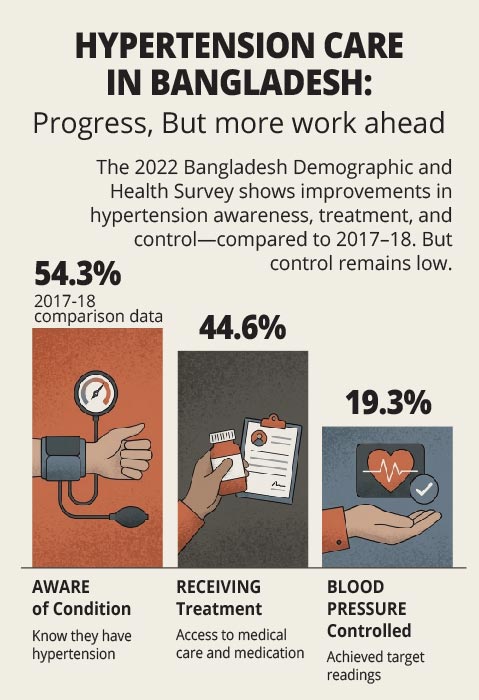
A newly published analysis of the nationally representative 2022 Bangladesh Demographic and Health Survey found that among people with hypertension, 54.3% were aware of their condition and 44.6% were receiving treatment. But only 19.3% had their blood pressure controlled. There has been progress. In the 2017-18 survey, awareness was 42.4%, treatment 37% and control just 12.5%. The researchers caution against interpreting apparent changes in hypertension prevalence between the two surveys because of methodological differences, but the improvement in the care cascade is clearer. Yet, the shape of the cascade matters as much as its improvement. For every 100 people living with hypertension in 2022, roughly 54 knew they had it, 45 were being treated, and only 19 had it under control.
Diabetes paints a starker picture: a 2025 study using BDHS 2022 data identified 2,403 people with type 2 diabetes. Only 33.5% had been diagnosed, 24.6% were receiving treatment and just 9.6% had achieved glycaemic control. The most alarming statistic, however, was the fact that almost two-thirds of people with diabetes did not know they had it.
For someone who already has diabetes, preventing it is no longer possible. But sustained control can still delay or prevent kidney disease, cardiovascular complications, vision loss, and other consequences. A person with hypertension has already moved from primary prevention to chronic disease, but their stroke or heart attack is not therefore inevitable.The missing space between having disease and developing severe disease is where a large part of Bangladesh’s NCD battle will be decided. And that space belongs largely to primary care.
Noncommunicable diseases, including cardiovascular diseases, diabetes, cancer, chronic respiratory illnesses and kidney disease, now account for around seven in every 10 deaths in Bangladesh. More than half of those deaths occur prematurely, according to the World Health Organization (WHO).
THE PATIENTS HOSPITALS HAVE NOT SEEN YET
It is tempting to measure an NCD crisis through hospital demand: more cardiac patients, more people requiring dialysis, more oncology services, more medicines and diagnostics.
The hypertension and diabetes cascades reveal part of what may be coming towards that end. Large numbers of people are either undiagnosed, untreated or treated without achieving control. Not every future complication among them can be prevented, and it would be wrong to treat every stroke, heart attack or case of renal failure as evidence of health-system failure. But at the population level, uncontrolled blood pressure and glucose create an avoidable component of future specialist demand. That means today’s primary-care performance partly determines tomorrow's tertiary-care burden.
This is also why it is difficult to answer the brief's investment question with one neat budget percentage. Bangladesh’s latest National Health Accounts currently published by the Health Economics Unit cover expenditure through 2020, and functional spending categories do not cleanly separate “NCD prevention” from “NCD treatment”. A precise contemporary ratio would therefore imply more certainty than the published accounts allow. What can be said more confidently is what WHO said in June this year: current spending remains weighted towards curative care.
But expenditure is only one test. The stronger test is whether the upstream system is actually changing disease trajectories.
A SYSTEM OF VISITS, OR A SYSTEM OF CONTINUITY?
Bangladesh's health system has decades of experience delivering interventions that occur at identifiable moments: vaccination, antenatal care, childbirth, treatment for an infection.
Chronic disease asks something different from a health system. A patient diagnosed with hypertension at 43 may require management into their seventies. Diabetes requires repeated testing, medicine adjustment and monitoring. Cancer screening needs a mechanism to ensure that someone with an abnormal result actually reaches confirmation and treatment.
In other words, NCD care is not primarily a sequence of isolated medical encounters. It is a relationship with the health system measured in years.
A 2022 qualitative assessment of Bangladesh’s NCD-control programme illustrates why this distinction matters. Researchers found that in several programme-only NCD corners, patients were receiving medicines for just 10 to 15 days despite a protocol calling for one month's supply. Record-keeping often counted patients attending rather than whether their hypertension or diabetes had actually been controlled. Counselling was limited, while manual records became difficult to maintain under heavy workloads. Development-partner-supported facilities with electronic databases, additional support and more organised medicine distribution generally functioned better.
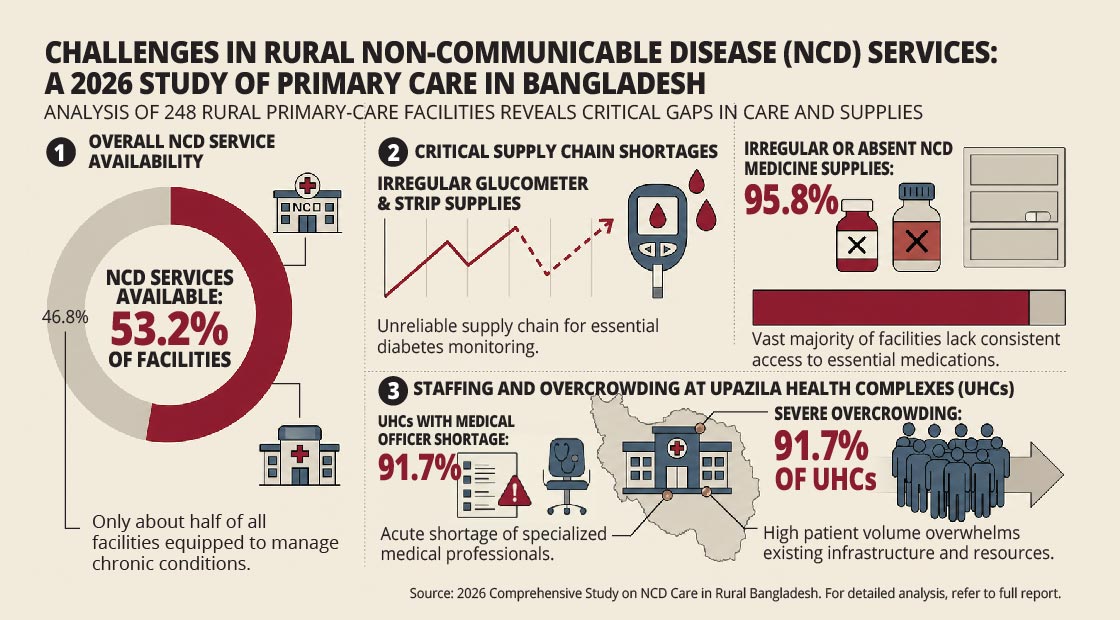
Four years later, some of the same problems remain visible. A 2026 mixed-methods study examining 248 primary-care facilities in rural Bangladesh found NCD services at only 53.2% of the facilities assessed. Almost all community clinics and union-level facilities surveyed reported irregular glucometer-strip supplies, while 95.8% reported irregular or absent NCD medicine supplies. At the upazila health complexes, 91.7% reported shortages of designated medical officers, and the same proportion reported overcrowding.
The patient interviews are even more revealing. Among 467 patients who had not remained in care, 56.7% cited receiving medicines for only a short period, 48.8% cited unavailable or irregular medicine supplies, 41.1% inadequate attention from doctors, and 33.8% long queues. Some 14.8% said they went to hospital when their condition became worse.
WHAT BANGLADESH HAS ALREADY BUILT
Yet describing Bangladesh’s NCD response as simply inadequate would miss an important part of the evidence.
The country has built a sizeable dedicated system for hypertension and diabetes management. As of March 2026, Directorate General of Health Services figures reported by The Daily Star showed NCD corners operating at 416 upazila health complexes and 30 district hospitals. Around 9.18 lakh hypertension patients and 7.31 lakh diabetes patients were registered. Among actively enrolled patients, 58% of those with hypertension and 28% of those with diabetes had their conditions under control.
Those percentages should not be directly compared with the 19.3% national hypertension-control estimate or 9.6% diabetes-control estimate from the BDHS. The populations, dates and denominators are different: one measures nationally identified disease, while the NCD-corner figures describe patients who have already entered and remained active in a treatment programme.
But precisely because of that difference, they reveal something useful; people who reach structured care and remain inside it can do considerably better. More rigorous evidence points in the same direction. A quasi-experimental trial involving 3,935 patients with uncontrolled hypertension at 14 rural upazila health complexes compared seven facilities implementing the WHO HEARTS package with seven providing usual care. After six months, blood-pressure control reached 62% in the HEARTS facilities, compared with 49.7% under usual care. The difference in missed clinic visits was even larger: 8.8% in HEARTS facilities against 39.3% in usual care. The intervention combined a standardised treatment approach with other improvements in hypertension management.
That changes the diagnosis of the problem. Bangladesh does not lack proof that stronger primary-care NCD management can work. The challenge is turning effective pockets of care into the normal experience of millions of patients.
WHEN SOMETHING THAT WORKS BECOMES FRAGILE
In May 2026, NCD corners were facing medicine shortages following a funding disruption. DGHS told The Daily Star that at least 26 upazila facilities were unable to provide a full month's medicine supply. The directorate had sought BDT 100 crore in emergency funding after warning stocks could run out; some facilities were rationing medicines for five or 10 days.
This is more than a procurement problem. For acute treatment, a temporary supply disruption is serious. For chronic disease, recurring disruption attacks the operating principle of the programme itself. A hypertension-control system works because the medicine is there next month. And the month after that. A digital registry works because the patient continues to be followed. A successful pilot produces population health gains only if the institutional machinery survives beyond the pilot, project or funding cycle.
The irony is striking: Bangladesh has evidence that continuous primary-care treatment improves hypertension control, while some of the strongest barriers identified by patients are precisely the things that interrupt continuity.
THE URBAN GAP
Much of Bangladesh's successful NCD-primary-care model has developed around the rural public-health structure. Urban primary care is considerably more fragmented.
A study published in 2026 assessed all 19 government urban dispensaries and 32 NGO clinics included in its Dhaka sample against Bangladesh’s national protocol for hypertension and diabetes management.
Preparedness for hypertension management was 46.8% in government urban dispensaries and 32.5% in NGO clinics. For diabetes, it was 31.6% and 34.9%, respectively. Neither type had digital patient records or designated data-management personnel. The researchers concluded that both were insufficiently prepared to manage hypertension and diabetes according to the national protocol.
This matters in a rapidly urbanising country. If longitudinal NCD care is easier to organise through an upazila-based network than through fragmented urban providers, Bangladesh could find itself strengthening chronic-care architecture in one part of the country while some of its fastest-growing populations remain dependent on a more episodic mix of providers. The future NCD system therefore cannot simply mean “more NCD corners”. It has to answer where a city resident's long-term primary-care home actually is.
SCREENING IS ONLY THE BEGINNING
Bangladesh's national cervical cancer screening programme has established a large service network and an electronic case-based registry. Between January 2018 and May 2023, more than 1.56 million women were enrolled, and about 1.56 million received visual inspection with acetic acid, or VIA, according to a study of the national DHIS2 registry.
That demonstrates significant screening capacity. But only 20,954 of the 51,913 women who tested VIA-positive — 40.4% — subsequently attended colposcopy. Nearly six in 10 did not complete that next diagnostic step. The registry data covered only around 5.3% of the estimated target female population over that period, although the researchers note higher cumulative coverage when aggregated data over a longer period are considered.
This is why “number screened” can be a misleading prevention metric. The health benefit is not generated when an abnormality is recorded, it is generated when the chain from screening to confirmation to treatment is completed. A programme can therefore be expanding and leaking at the same time.
BANGLADESH CAN DO PREVENTION AT SCALE
There are also examples showing what happens when the delivery chain is strong. Bangladesh’s nationwide HPV vaccination campaign reached 5.6 million girls aged 10 to 14 by the end of 2024, equivalent to 93% of the target group, according to UNICEF. The vaccine was subsequently incorporated into routine immunisation from 2025.
That is genuine upstream prevention. The intervention occurs long before a cancer diagnosis and reduces the probability that the disease develops at all. Its success also suggests something broader — Bangladesh is not institutionally incapable of large-scale prevention. It has repeatedly demonstrated strong capacity when interventions have clear target populations, established delivery platforms, reliable commodities and measurable coverage. Chronic NCD management is harder because the intervention never really ends.
PREVENTION ALSO BEGINS OUTSIDE THE CLINIC
Even perfect primary care, however, would enter the story after many NCD risks have already formed.
Bangladesh’s last full national WHO STEPS risk-factor survey, conducted in 2018, found that 26.2% of adults had at least three major NCD risk factors. Average salt intake was around 9 grams per day – almost twice WHO’s recommended limit of less than 5 grams. The survey also documented substantial tobacco use, unhealthy diets, overweight and obesity, hypertension and diabetes.
This is where a hospital-centred response reaches its natural limit. Doctors can advise people to eat differently, exercise and stop smoking. But clinicians do not determine tobacco taxation, the salt content of packaged food, whether neighbourhoods are walkable, what children encounter in food marketing, or how urban transport shapes physical activity.
WHO’s June 2026 assessment therefore argues that NCD outcomes are also shaped by taxation, food systems, urban planning, transport, education and trade. Bangladesh adopted a multisectoral NCD action plan in 2018, but WHO says implementation has often remained fragmented and underfunded. In August 2025, 35 ministries and government entities signed a joint declaration intended to strengthen whole-of-government action.
Whether that changes the NCD trajectory will depend less on the declaration itself than on measurable changes in the risks it is supposed to reduce.
WHAT WOULD CHANGE THE TRAJECTORY?
The encouraging part of the evidence is that Bangladesh does not have to invent an NCD system from scratch. Several components already exist, and some have been tested locally. The hypertension evidence points towards standardised treatment protocols, reliable medicines, patient registration, simple monitoring and regular follow-up. The HEARTS trial suggests that organised care can improve control and drastically reduce missed visits.
The next step is not merely opening more screening points. It is making control and retention core performance measures. A facility should know not simply how many people had their blood pressure checked, but how many registered hypertensive patients are controlled and which patients have disappeared from follow-up.
A second priority is uninterrupted essential medicines and diagnostics. Chronic disease cannot be managed through intermittent procurement. If a programme's effectiveness depends on continuous treatment, then continuity of supply is itself a preventive intervention.
Third, stable patients do not necessarily need every routine interaction to occur with a doctor at an upazila hospital. A proof-of-concept study in Parbatipur shifted routine monitoring and medicine refills for hypertension and diabetes towards village-level community clinics, supported by non-physician health workers and a digital care platform. The proportion with uncontrolled blood pressure fell from 60% at baseline to 26% at the third month, while uncontrolled blood glucose fell from 74% to 43%. Attrition remained substantial, at 36.2%, and the authors appropriately caution that the short, single-site study requires further evaluation. But it shows the potential of taking chronic care closer to where patients live.
Fourth, screening programmes need to be designed around completion, not detection. The cervical-cancer registry already creates the possibility of tracking screen-positive women. The performance question should therefore move downstream: how many complete colposcopy, diagnosis and necessary treatment?
Fifth, Bangladesh needs a stronger urban answer. The rural primary-care model cannot simply be assumed to exist in Dhaka and other cities where authority and provision are divided among government bodies, NGOs and private providers.
And finally, primary prevention has to move outside the Ministry of Health. Tobacco, diet, salt, physical activity and other NCD risks cannot be reduced by clinical counselling alone. The 35-ministry approach matters only if ministries outside health begin treating NCD reduction as part of their own measurable responsibilities.
If more people with hypertension and diabetes are diagnosed early, remain in care and achieve control; if abnormal cancer screening results reliably lead to diagnosis and treatment; and if population risk factors begin to fall, then Bangladesh's growing treatment capacity will be serving a health system that is also reducing avoidable illness.
THE REAL TEST IS WHETHER THE PIPELINE GETS SMALLER
Bangladesh will need more cancer care, cardiac treatment, kidney services, diagnostics, medicines and specialist capacity. Prevention is not an alternative to treating people who are already ill. Nor does the evidence support a simple story in which Bangladesh has ignored prevention.
Hypertension awareness and control have improved. NCD corners now reach large numbers of patients. Structured hypertension management has demonstrated measurable success. HPV vaccination shows that primary prevention can be delivered nationwide. Digital registries are beginning to make longitudinal follow-up possible. But the gaps between those successes remain large. Nationally, most people with hypertension still did not have their condition controlled in the latest survey. Most people with diabetes were undiagnosed, and fewer than one in 10 had achieved glycaemic control. Rural facilities report medicine, staffing and follow-up problems. Urban primary care is poorly prepared for chronic disease. And even when cervical abnormalities are detected, large numbers of women are lost before the next diagnostic step.
This is where treatment can outrun prevention without prevention being entirely absent. Bangladesh may build an increasingly capable system for rescuing patients at the end of the disease pathway while still allowing too many people to travel too far along that pathway before the system successfully intervenes. The better measure of progress, therefore, is not whether treatment capacity stops expanding. It should expand. The test is whether the upstream numbers begin to change with it. If more people with hypertension and diabetes are diagnosed early, remain in care and achieve control; if abnormal cancer screening results reliably lead to diagnosis and treatment; and if population risk factors begin to fall, then Bangladesh's growing treatment capacity will be serving a health system that is also reducing avoidable illness.
If those numbers do not improve, hospitals will continue becoming better at treating a burden that the rest of the system keeps replenishing. Bangladesh does not need to choose between prevention and treatment. It needs to make sure that its health architecture can intervene long before the emergency room — by establishing genuine primary prevention, reliable screening, uninterrupted long-term control of chronic illnesses like hypertension and diabetes, and comprehensive risk mitigation — ensuring that managed conditions do not turn into tomorrow's end-stage crises.


