

in focus
Digital access, remittances and retail expansion are reshaping demand beyond the capital, creating new consumer markets that businesses can no longer afford to treat as one.

Illustrated By sk. yeahhia
22 August, 2026
For years, Bangladesh’s consumer market was easiest to read through Dhaka. New brands arrived there first, premium retail grew there first, and businesses often treated district towns as markets to enter later. That model is beginning to change.
Consumer demand is spreading beyond the capital as smartphones, e-commerce, remittance income and organised retail reach deeper into district towns and secondary cities. But the more important change is not simply that people outside Dhaka are spending more. It is that new consumer markets are emerging in different parts of the country for different reasons.
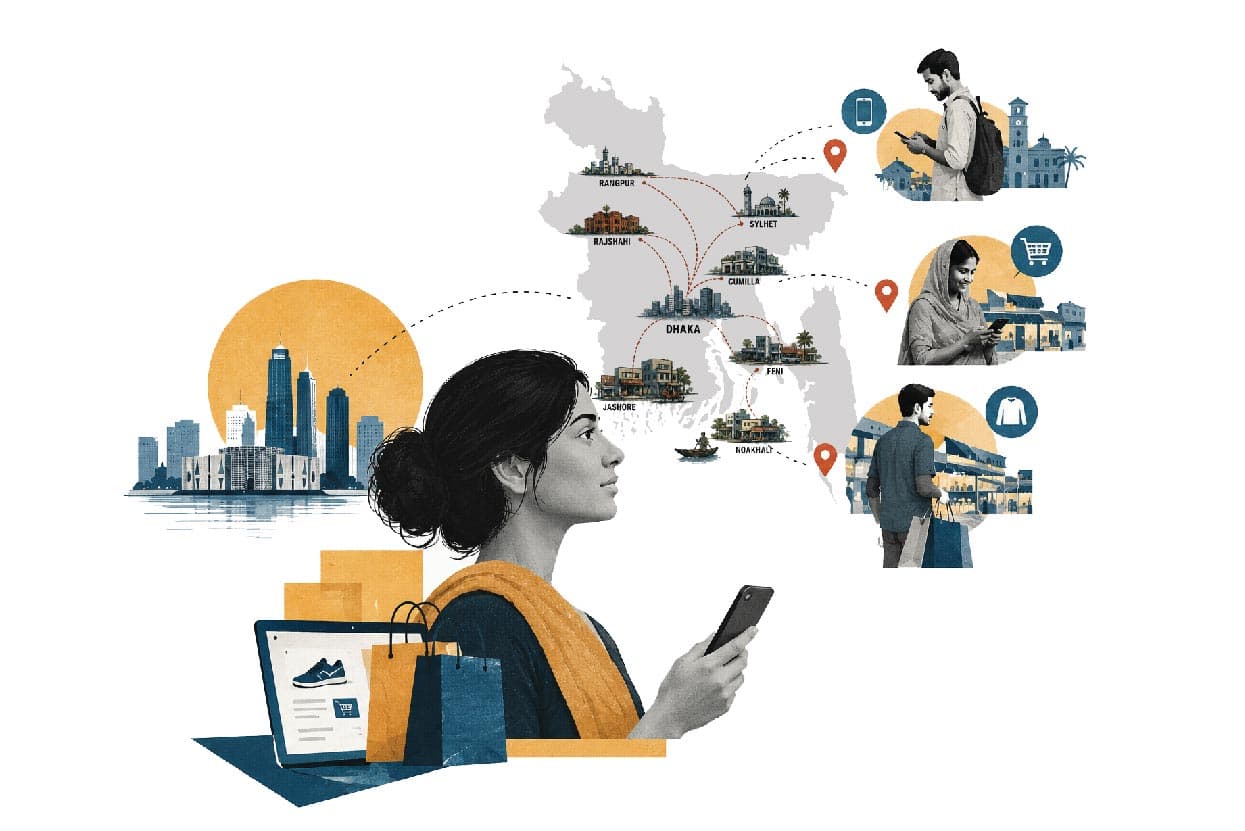
A family in Feni may be connected to overseas income through remittances. A shopper in Cumilla can now compare products and prices online before entering a store. In Noakhali, organised retailers are testing markets that once sat well outside their traditional urban focus. The consumer outside Dhaka is becoming more connected, more exposed to national brands and, in some places, more commercially important.
Yet that does not make Bangladesh one uniform consumer market.
The same product, price or retail format that works in Dhaka may not work in Rajshahi, Cumilla, Sylhet or Jashore in the same way. Income sources differ. Remittance exposure differs. Local economies differ. So do price sensitivity, aspirations and spending priorities.
This is where the opportunity — and the risk — lies for businesses. Bangladesh’s consumer map is becoming less Dhaka-centric, but understanding the markets beyond Dhaka requires much more than simply taking a Dhaka strategy outside the capital.
The latest data are beginning to show just how much that map is shifting.
The same product, price or retail format that works in Dhaka may not work in Rajshahi, Cumilla, Sylhet or Jashore in the same way. Income sources differ. Remittance exposure differs. Local economies differ. So do price sensitivity, aspirations and spending priorities.
The consumer map is changing
One of the clearest signals comes from the Bangladesh Bureau of Statistics (BBS). Its ICT Access and Use by Households and Individuals Survey 2024-25, published in April 2026, produced district-level ICT data for the first time. Feni ranked first in household smartphone access. The top 10 also included Cumilla, Chattogram, Noakhali, Brahmanbaria, Gazipur, Narayanganj, Dhaka, Chandpur and Shariatpur.
The finding is interesting not because Feni has suddenly overtaken Dhaka as a consumer market, but because it shows how access to the basic tool of digital consumption is spreading in ways that do not always follow the old hierarchy of cities.
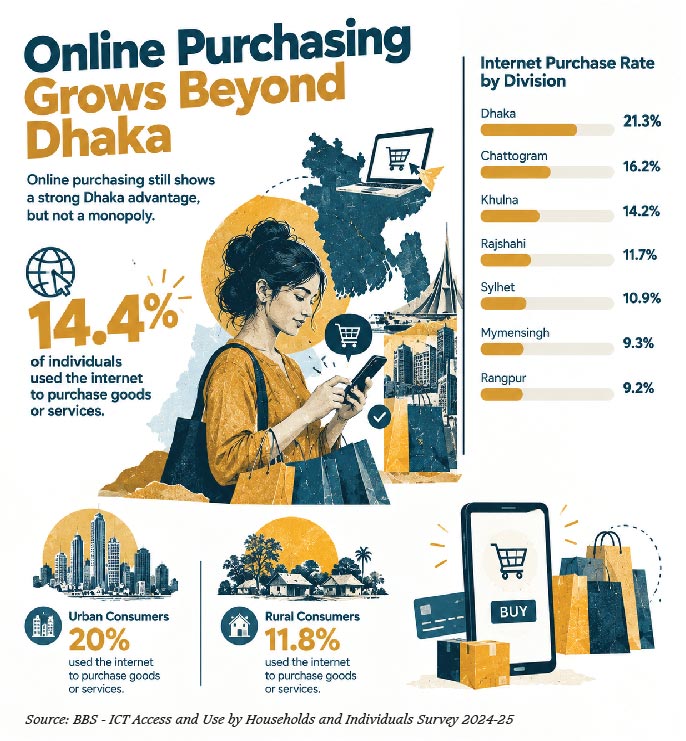
Online purchasing still shows a strong Dhaka advantage, but not a monopoly. The same BBS survey found that 14.4% of individuals used the internet to purchase goods or services. The rate was 21.3% in Dhaka division, followed by 16.2% in Chattogram and 14.2% in Khulna. Rajshahi stood at 11.7%, Sylhet at 10.9%, Mymensingh at 9.3% and Rangpur at 9.2%. Urban consumers were more active at 20%, but even among rural residents the rate was 11.8%.
That changes what distance means for a business. A company no longer needs a showroom in every district before a consumer there can discover its product, compare prices or decide whether the brand fits the life they want. Digital access can create the aspiration before physical retail arrives.
Money is moving too
Connectivity matters only if consumers have money to spend. Here, remittance adds another layer to the map.
Bangladesh received about USD 35.5 billion in remittances in FY2025-26, up more than 17% from the previous year, according to Bangladesh Bank. The national figure matters, but where some of that money lands matters to consumer businesses as well.
In the first quarter of FY2025-26 alone, Bangladesh Bank’s district-wise data show Cumilla received USD 378.6 million in remittances, Noakhali USD 225.7 million, Feni USD 200.5 million and Brahmanbaria USD 185.2 million. Chattogram district received USD 571.5 million over the same three months.
These are not measures of household consumption, and remittance is not automatically disposable income. Families use it for food, housing, education, healthcare, savings, debt and investment. But such flows can create purchasing capacity in places that a Dhaka-centred view of income may underestimate.
There is also an interesting overlap. Several districts appearing near the top of BBS’s smartphone-access ranking — Feni, Cumilla, Noakhali and Brahmanbaria — are also significant remittance destinations. That does not prove remittance is driving digital consumption, but it points to markets where connectivity and external income are meeting.
For businesses, that combination matters. A consumer does not have to migrate to Dhaka to become part of a national market anymore.
Retail follows demand
Organised retailers appear to be responding.
The number of supermarket-chain outlets in Bangladesh more than doubled to over 1,500 in 2025 from more than 750 a year earlier, according to USDA Exporter Guide reports. Small modern retail stores also increased from about 1,000 to 1,500, while the sector’s estimated annual turnover rose from USD 600 million to USD 800 million.
The expansion is not confined to the capital. Shwapno said in August 2026 that its nationwide network had crossed 1,000 outlets. Meena Bazar, meanwhile, opened an outlet in Maijdee, Noakhali, in July and said it planned to consider further expansion in the area depending on local response. Both figures come from company announcements, so they are better read as evidence of corporate expansion strategy than as independent measures of demand.
A company no longer needs a showroom in every district before a consumer there can discover its product, compare prices or decide whether the brand fits the life they want. Digital access can create the aspiration before physical retail arrives.
This does not mean the traditional bazar is disappearing. Organised retail remains only a small part of Bangladesh’s huge retail economy. Rather, its spread is evidence that companies see enough demand outside their original urban core to keep testing different formats and locations.
The attraction is not only about buying more. The USDA’s assessment of Bangladesh’s modern retail market points to growing consumer preference for convenience, appearance, ambience, comfort and access to a wider range of products. Those are changes in expectation as much as changes in income.
The same pattern is appearing in consumer durables. Electro Mart Group said in March 2026 that nearly 45% of its sales came from district and semi-urban markets, while describing expansion into district towns as an important source of growth. That is one company’s experience, not a national market share. Still, it offers a useful clue: products once strongly associated with metropolitan middle-class consumption are finding substantial buyers elsewhere.
Aspiration travels faster
This may be the most important part of the change.
Digital media has weakened Dhaka’s old role as the main window into new products and lifestyles. Consumers in district towns can now see the same product launches, influencer content, restaurant trends and brand campaigns at roughly the same time as consumers in the capital.
But seeing the same thing does not mean buying it in the same way.
Income, housing, household size, remittance exposure, local employment and living costs vary from one place to another. A consumer may want the same smartphone or air conditioner but be more price-sensitive, buy through instalments, wait for an Eid offer, or place greater value on durability than premium features.
That difference is important. Aspiration can spread faster than purchasing power.
And this is where “Beyond Dhaka” can itself become misleading if businesses begin using it as a single consumer category. The country does not suddenly become one homogeneous market once the Dhaka city boundary disappears.
Chattogram has the scale of a major metropolitan and commercial centre. Gazipur and Narayanganj sit within large industrial economies. Some eastern districts combine unusually high smartphone access with substantial remittance inflows. Other regional centres draw consumers from surrounding districts. The forces creating demand are different, so there is little reason to assume buying behaviour will be identical.
The next market is not one market
For businesses, the opportunity outside Dhaka is therefore real, but it is not as simple as taking a Dhaka store, Dhaka price point and Dhaka marketing campaign and reproducing them across the rest of the country.
The recent data instead suggest that Bangladesh is developing several consumer markets at once. Some are helped by remittances. Some are linked to industrial employment or regional commerce. Digital access is connecting all of them more closely to national brands, while organised retailers are making modern shopping formats increasingly visible.
There are limits to the shift too. BBS still finds a substantial digital divide: internet use in FY2024-25 stood at 75.7% among urban residents against 43.6% among rural residents. The same survey that reveals growing online consumption outside Dhaka therefore also warns against assuming that connectivity has already levelled the consumer landscape.
Dhaka will remain at the centre of Bangladesh’s consumption economy for the foreseeable future. But it may become less useful as the default model for understanding everyone else.
The question for businesses is no longer simply whether there is demand beyond Dhaka. Smartphone access, online purchasing, remittance flows and retail expansion increasingly show that there is.
The harder question is whether companies know what kind of consumer they will find when they get there.


