

features
Aarong’s BYOB initiative as a case study in loss aversion and habit change

Illustrated By sk. yeahhia
16 June, 2026
To most shoppers, a paper bag is a minor, routine part of the checkout experience. It is also a cost item that retailers typically absorb as part of doing business. At Aarong, however, the decision to introduce a nominal charge for paper bags under its “Bring Your Own Bag” (BYOB) initiative reframed this everyday object into a point of behavioural and environmental intervention.
Rather than treating packaging as a fixed operational cost, the initiative positioned it as something that could influence consumer behaviour. The result was not only a change in checkout practice, but also a measurable reduction in paper bag consumption across stores.
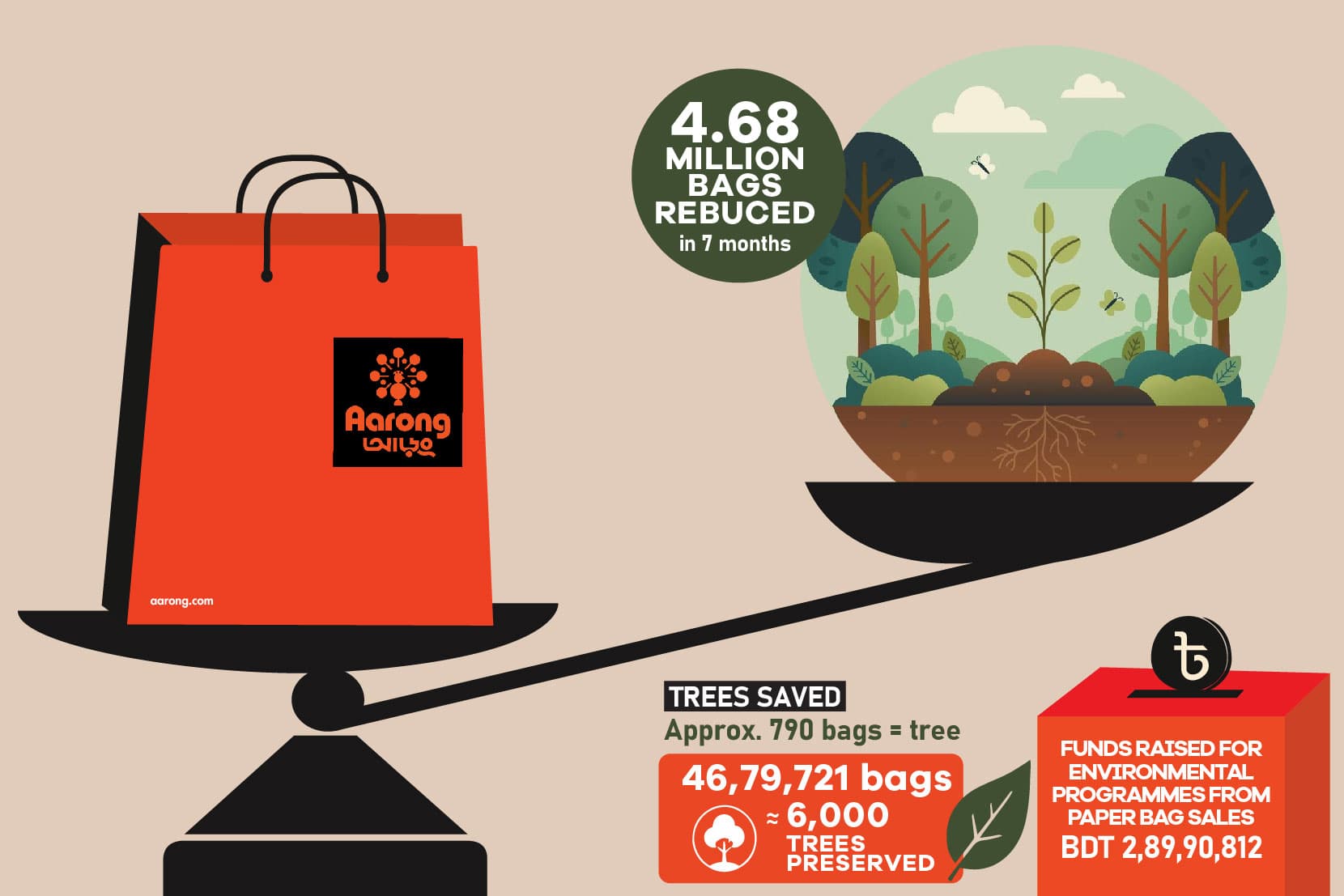
Over a seven-month period (September 2025 to March 2026), the initiative recorded a reduction of 4.68 million paper bags and generated approximately BDT 2.9 crore in bag-related revenue, which was allocated to environmental programmes implemented through partner organisations.
While the idea appears simple in principle, its execution required adjustments across pricing systems, staff training, customer communication, and post-transaction fund allocation.
FROM PACKAGING COST TO BEHAVIOURAL LEVER
In most retail environments, packaging is treated as a fixed operational necessity. Customers expect it, and its cost is embedded in product pricing or absorbed by the retailer. Aarong’s approach shifted this assumption by separating the paper bag from the purchase itself and assigning it a visible, explicit price.
This change introduced a small but deliberate decision point at checkout: customers could either purchase a bag or bring their own. From a behavioural perspective, this altered the default experience without restricting choice. The intent was not to eliminate convenience but to make the consumption of packaging more intentional. In practice, this required aligning point-of-sale systems, updating billing logic, and ensuring consistency across outlets so that the charge was applied uniformly.
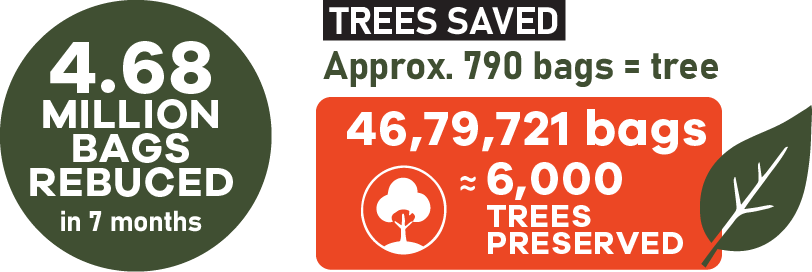
To help interpret the environmental implications of the change, Aarong also translated aggregate bag reduction data into equivalent ecological outputs. One commonly used internal conversion estimated that approximately 790 paper bags correspond to the material output of a mature plantation tree, based on paper yield assumptions from standard kraft production inputs.
Using this framework, the avoided consumption of 4.68 million bags was presented as equivalent to preserving roughly 6,000 plantation trees. While such conversions are inherently simplified, they were used as a communication tool to make large numerical reductions more tangible to non-technical audiences.
REVENUE SEPARATION AND ALLOCATION STRUCTURE
A key point of scrutiny in any pricing-based sustainability initiative is whether it functions as a revenue-generating mechanism or a cost-neutral environmental fund.
To address this, Aarong structured the bag charge as a segregated revenue stream. Over the seven-month period, approximately BDT. 2.9 crore was collected from paper bag fees. According to the programme design, these funds were ring-fenced and allocated entirely to environmental and reforestation activities through BRAC-affiliated programmes.
This separation required an internal accounting mechanism to ensure that bag revenue was not treated as general operating income. Instead, it was tracked independently and transferred to designated programme partners for implementation.
From an operational standpoint, this created an additional layer of financial governance: the initiative was not simply about changing consumer behaviour at checkout, but also about building a parallel flow of funds linked directly to environmental outcomes.

This separation required an internal accounting mechanism to ensure that bag revenue was not treated as general operating income. Instead, it was tracked independently and transferred to designated programme partners for implementation.
MANAGING IMPLEMENTATION AT THE POINT OF SALE
Because the paper bag charge was applied at the checkout stage, the most immediate operational impact occurred at the retail interface. The change required adjustments to both system processes and frontline workflows across all outlets.
At the systems level, point-of-sale configurations were updated to ensure paper bags were treated as a separate billable item. This required standardisation across stores to avoid inconsistencies in billing and customer communication.
At the store level, staff were required to communicate the change during transactions. This introduced an additional step in the checkout process, particularly during peak hours when transaction speed is a key operational metric.
To support implementation, internal guidelines were introduced covering:
1. how the charge should be explained to customers
2. how reusable bag usage could be integrated into the transaction flow
3. how to handle customer queries or objections at checkout
Because frontline staff included a significant proportion of part-time employees, training materials were simplified and standardised to reduce variation in delivery across outlets. The primary operational constraint during implementation was maintaining transaction efficiency while introducing an additional decision point into the checkout process.
PUBLIC RESPONSE AND DEMAND ADJUSTMENT
Following implementation, the initiative generated visible customer response at store level and on digital platforms. The reaction was concentrated in the initial phase of rollout and reflected adjustment to the removal of a previously standard service element.
At the point of sale, staff reported increased customer queries regarding the rationale for the charge and occasional delays during checkout while customers adapted to the new process.
Over time, the frequency of these interactions decreased as customers adjusted their behaviour, particularly through increased use of reusable bags.
On digital platforms, the policy was widely discussed, with attention focused on pricing, convenience, and sustainability considerations. This phase reflected a typical response pattern observed in behavioural pricing interventions, where initial resistance is followed by stabilisation as the new norm becomes familiar.
No structural changes to the programme were introduced during this period, but internal monitoring continued to track customer feedback and transaction flow.
REVENUE HANDLING AND FINANCIAL SEGREGATION
The paper bag charge generated a distinct revenue stream that was recorded separately from product sales.
Over the seven-month period, approximately BDT 2.9 crore was collected through paper bag transactions. This revenue was not incorporated into general operating income. Instead, it was ring-fenced under a dedicated allocation framework.
The financial structure involved:
1. separate tracking of bag-related transactions in retail systems
2. consolidation of funds into a designated account
3. transfer of allocated funds to implementing partner organisations
This separation was intended to ensure traceability between customer payments at checkout and downstream programme expenditure. From an accounting perspective, the structure created a direct linkage between a behavioural charge and external funding allocation, while maintaining separation from core retail revenue.
COMMUNICATION OF ENVIRONMENTAL IMPACT
To contextualise the scale of reduced paper bag usage, the programme translated aggregate consumption data into an equivalent environmental metric.
Using internal assumptions based on paper yield from plantation timber, approximately 790 paper bags were treated as equivalent to the material output of one mature plantation tree.
On this basis, the reduction of 4.68 million paper bags over the reporting period was presented as equivalent to approximately 6,000 plantation trees.
This conversion was used as a communication tool to translate high-volume consumption data into a more interpretable reference point. It does not represent a direct ecological substitution model but rather a simplified equivalence framework for reporting purposes.
OPERATIONAL BOUNDARIES AND STAFF-LEVEL IMPACT
Because the intervention was implemented at checkout, frontline employees became the primary interface for customer interaction related to the policy. This introduced an additional communication responsibility into roles primarily designed for transactional efficiency. In some cases, this affected perceived workload during peak retail hours.
Given that a portion of the workforce consists of part-time employees, including students, operational guidance emphasised standardisation of communication and escalation procedures for customer disputes.
Internal adjustments included:
1. clarification of staff responsibilities in relation to policy explanation
2. reinforcement that pricing structure decisions were not determined at store level
3. introduction of escalation pathways for unresolved customer concerns
The objective of these measures was to ensure that policy-related customer feedback was directed to formal channels rather than managed informally at the checkout counter.
FEEDBACK CHANNELS AND DATA CONSOLIDATION
To manage customer feedback generated by the initiative, existing communication channels were consolidated and reinforced.
Feedback was collected through:
1. in-store managers and outlet-level reporting systems
2. customer service helplines
3. digital communication channels including email and social media platforms
Inputs from these channels were categorised into operational issues (e.g., billing clarity, checkout flow) and policy-related feedback (e.g., pricing concerns, environmental rationale). This separation allowed internal teams to distinguish between implementation issues and broader consumer response to the policy itself.
LINKING CHECKOUT DESIGN TO ENVIRONMENTAL OUTCOMES
The BYOB initiative demonstrates how a small change in retail checkout structure can produce measurable shifts in packaging consumption when applied consistently across a large store network.
At an operational level, the intervention was primarily a pricing and systems adjustment. Paper bags were removed from the set of implicitly provided services and repositioned as a separately priced item within the transaction flow. This required changes to point-of-sale systems, staff processes, and customer communication at the store level.
At the consumption level, the introduction of a visible charge altered the default behaviour associated with packaging use. Over the reporting period, this corresponded with a reduction of 4.68 million paper bags.
At the financial level, the policy generated a distinct revenue stream of approximately BDT. 2.9 crore. The funds were segregated from general retail income and allocated to externally implemented environmental and livelihood programmes. This structure created a direct, traceable link between consumer transactions and programme funding.
The initiative also introduced operational considerations that extended beyond environmental outcomes. These included the need to standardise frontline communication, manage variability in customer response during early implementation, and maintain transaction efficiency while introducing an additional decision point at checkout.
From a systems perspective, the case highlights three interdependent components: pricing design at the point of sale, behavioural response at the consumer level, and structured allocation of resulting funds through partner organisations.
The overall model illustrates how retail environments can function as sites for behavioural intervention, where small changes in transaction design can influence consumption patterns and generate funding mechanisms for downstream environmental programmes.


%20Square%20Ad%20-11.jpg&w=640&q=75)
%20Horizental%20AD-01.jpg&w=3840&q=75)
