

features
The hours lost between appointments, admissions, tests, bills and discharge rarely come from one failing department. They reveal a larger problem: how difficult it is to keep a hospital's people, information and resources moving together — and what managers can do about it.

Illustrated By sk. yeahhia
12 September, 2026
THE FIRST DELAY HAPPENS ON PAPER
At 10:40 a.m., a patient with a 10:00 appointment is still outside the doctor's chamber, the same serial slip folded between her fingers. An urgent case has gone in. The receptionist cannot say when the schedule will recover.
That morning did not necessarily begin badly. The schedule may simply have left no room for the unpredictability of clinical work. One consultation runs longer, a physician is called to an emergency, or an admitted patient needs review during clinic hours. By midday, the timetable is chasing the day rather than organising it.
The pressure is harder to absorb when clinical capacity is already tight. According to the World Health Organisation, Bangladesh had around 13 doctors, nurses and midwives per 10,000 people in 2022, compared with a global median of 49.
The practical response is better scheduling, not just fuller scheduling. Hospitals can use historical consultation times to set realistic appointment blocks, leave buffer capacity in high-variation clinics and triage cases before they reach the consulting room. The measure of a good schedule is not how completely it is booked; it is how reliably patients move through it.
Hospitals can use historical consultation times to set realistic appointment blocks, leave buffer capacity in high-variation clinics and triage cases before they reach the consulting room. The measure of a good schedule is not how completely it is booked; it is how reliably patients move through it.
A BED CAN BE EMPTY AND STILL UNAVAILABLE
The same logic applies to beds. A patient waiting for admission may be only a few doors away from an occupied bed whose patient has already been cleared to leave. The bags are packed, but the bed is tied up while a discharge summary is completed, medicines are prepared, transport is arranged or the final bill is closed.
Hospitals can get more from existing capacity by treating discharge as part of bed management rather than an event at the end of a patient's stay. Daily reviews can identify likely discharges early, while a live bed-status system can distinguish between occupied, being cleaned and genuinely ready beds.
A blocked bed can hold back an admission, keep emergency space occupied and leave the next patient waiting for a resource that technically exists.
THE TEST IS QUICK. THE SYSTEM AROUND IT ISN'T.
Diagnostics are another place where the useful measure is bigger than the procedure. An X-ray may take minutes. The patient journey includes the order, registration, movement to the department, technician availability, testing, reporting and the return of that information to the physician.
Hospitals should measure turnaround from order to result and then break the figure down by stage. If the scan itself takes five minutes but the result takes an hour to reach the doctor, buying another machine will not solve the main constraint. The same principle applies to laboratories: peak demand, staffing and equipment downtime should be visible to managers before they become backlogs.
THE EXIT QUEUE
Few hospital moments are as misleading as hearing, “You can go home.” The family starts collecting the patient's things. Yet the discharge process still has to move through clinical documentation, nursing instructions, medicines, billing and, in some cases, insurance approval.
This is where a small operational change can make a visible difference. Work that does not depend on the final discharge decision can begin earlier. Medication reconcilliation, billing checks, transport arrangements and patient education can be prepared in advance where appropriate, allowing several teams to work in parallel.
A 2024 systematic review in Health Care Management Science found that predicting discharge outcomes can support operational, medical and administrative planning. The point is not to push patients out faster. It is to make the process ready when the clinical decision is made.
WHEN WAITING BECOMES AN OPERATING PROBLEM
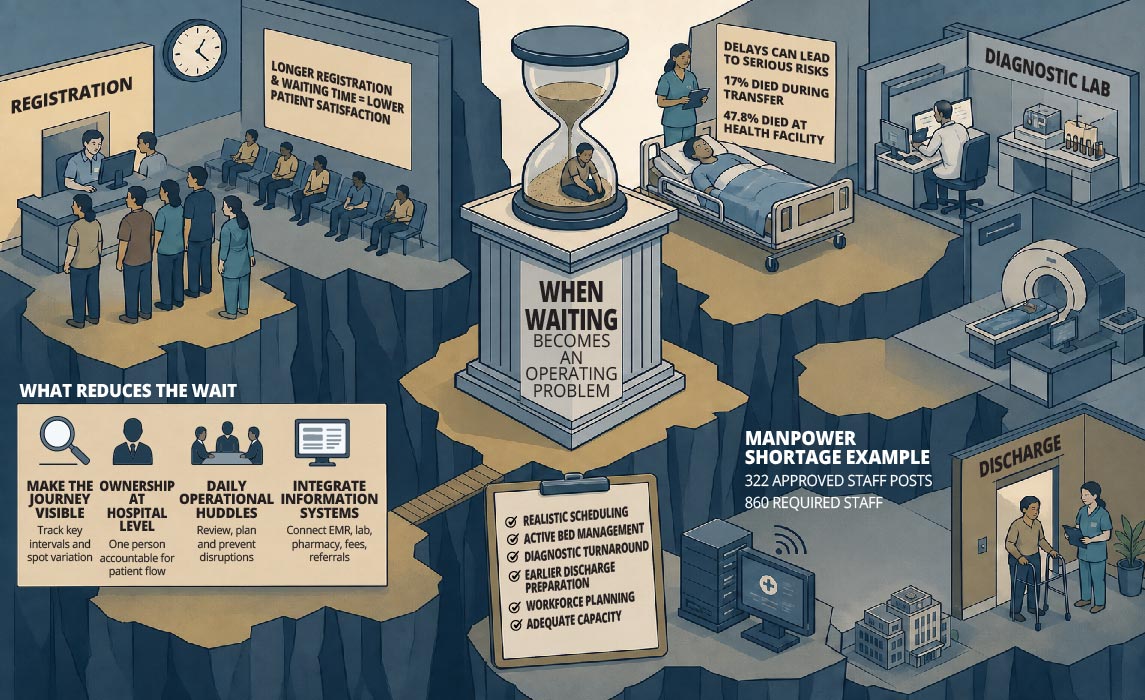
The cost of poor flow is not limited to an uncomfortable afternoon. A 2024 study by Md Zahid Hasan and colleagues, published in JMIR Formative Research, examined 438 users of Bangladesh's government-financed Shasthyo Surokhsha Karmasuchi. It found that satisfaction declined as registration and waiting times increased.
When delays move from inconvenience into clinical risk, the stakes are higher. Bangladesh does not have a reliable national count of deaths caused specifically by hospital waiting. But a 2014 study in BJOG reviewed 571 maternal deaths across four districts and found that 97 women, or 17%, died while being transferred to a health facility, while 273, or 47.8%, died at a health facility. The authors stressed the need for stronger quality of care and a fully functioning referral pathway.
Those figures do not prove that waiting caused the deaths. They do show why referral, treatment and patient flow belong in the same conversation.
For private hospitals, persistent friction can damage trust and reputation. For public facilities, it adds pressure to services already carrying heavy demand. The operational cost is measurable: a physician waiting for a report, a bed blocked by incomplete discharge work or a diagnostic machine sitting idle because the next patient has not reached the department all represent capacity that the hospital cannot fully use.
Bangladesh does not have a reliable national count of deaths caused specifically by hospital waiting. But a 2014 study in BJOG reviewed 571 maternal deaths across four districts and found that 97 women, or 17%, died while being transferred to a health facility, while 273, or 47.8%, died at a health facility.
WHAT ACTUALLY REDUCES THE WAIT
The first step is to make the patient journey visible. Hospitals should track the time from registration to consultation, from test order to result, from admission request to bed and from discharge decision to exit. Averages alone are not enough; managers need to know where variation and avoidable handoffs occur.
The second step is ownership. A department can hit its own target while the hospital misses the patient's target. Someone at the hospital level needs responsibility for flow across departments and the authority to act when one process begins to constrain another.
Short daily operational huddles can help. The Institute for Healthcare Improvement recommends brief huddles to look back at performance and look ahead for problems that could disrupt the day. In a hospital, that can mean reviewing expected discharges, bed availability, unusually heavy clinics, diagnostic backlogs and staffing gaps before they become emergencies.
Then comes integration. In June 2026, Health Minister Sardar Md Sakhawat Husain told Parliament that a comprehensive hospital-automation system was operating in 87 government hospitals, covering electronic medical records, laboratory management, pharmacy tracking, fee collection and referral services. The policy direction is useful because these are exactly the handoffs that often divide a patient's journey into separate departmental processes.
But technology cannot replace capacity. A May 2026 report from Tangail Medical College Hospital described a severe manpower shortage, with 322 approved staff posts against a stated requirement of 860. The hospital also had technical problems affecting MRI services. Digital systems can make a process visible; they cannot make a missing nurse or technician appear.
The most plausible fix is therefore not a single purchase or a single new rule. It is a combination of realistic scheduling, active bed management, measured diagnostic turnaround, earlier discharge preparation, integrated information and workforce planning. Some facilities will need more capacity. Others first need to stop losing the capacity they already have.


