

features
For millions of rural Bangladeshis, accessing healthcare means travelling long distances, navigating understaffed facilities and shouldering costs they can barely afford. The country has made remarkable progress in health, but geography still determines who can receive timely, quality care.

Illustrated By sk. yeahhia
20 September, 2026
ometimes, the distance between a patient and a doctor is measured not in kilometres, but in opportunity. There is a particular kind of exhaustion that belongs only to the rural patient. It is not the exhaustion of illness alone, though that is heavy enough. It is the exhaustion of the journey. The night bus taken before dawn. The money borrowed from a neighbour, counted and recounted in a trembling hand. Somewhere between a nameless village in Barishal and the crowded corridors of a Dhaka hospital, there is a grief that no prescription can cure, the grief of knowing that to be poor and unwell in Bangladesh is, too often, to be forgotten by the very systems built to remember you.
This is not a new story. But it is a story that keeps being told, season after season, in different dialects, across sixty-four districts.
THE LONG ROAD TO A DOCTOR
Bangladesh has earned real praise for its progress. According to WHO data, the country reduced its maternal mortality rate by nearly 79 percent between 2000 and 2023, an achievement written in the survival of mothers who might otherwise not have seen another monsoon. But numbers, like rivers, can conceal what lies beneath their surface.
In Bangladesh, the place where a person is born quietly shapes the kind of healthcare they are able to receive. In Dhaka, a patient may find specialists, diagnostic centres, and emergency services within a small area. Beyond the major cities, the picture becomes something else entirely. A health facility may exist nearby, yet the doctor, the equipment, the medicine, these may still be somewhere very far away.
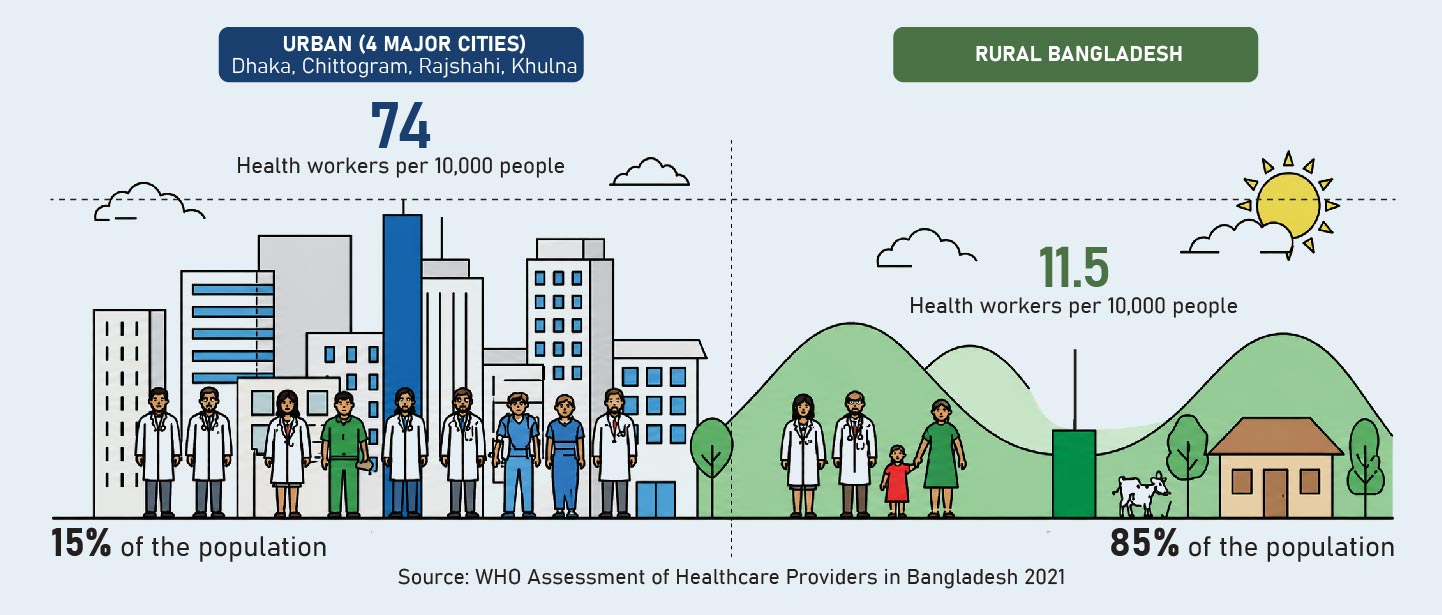
This is not simply a story of too few hospitals. It is a story of geography. The numbers, when placed side by side, are startling. According to the WHO Assessment of Healthcare Providers in Bangladesh 2021, roughly a third of all doctors and nearly a third of nurses in the country serve only 15 percent of the population, those living in four major cities: Dhaka, Chattogram, Rajshahi, and Khulna. Fewer than 20 percent of health workers, meanwhile, serve more than 70 percent of the rural population. In cities, there are roughly 74 recognised health workers per 10,000 people. In rural areas, that figure falls to just 11.5.
A Lancet Regional Health study (2024) examining conditions at upazila health complexes and district hospitals found that about 59 percent of doctor positions across the country sit empty. In Barishal, 73 percent of those positions are vacant. Walk into a rural health complex in Barguna or Dinajpur, and you may find a 50-bed hospital staffed by three doctors tending to hundreds of thousands of people scattered across fields and river channels they will never visit.
HOSPITALS WITHOUT ENOUGH HANDS
Sometimes the body simply cannot wait for the road to improve. The reasons doctors do not stay in rural postings are profoundly human. The same Lancet study documents how medical officers at upazila level report inadequate service rooms, unavailability of surgical equipment, poor housing conditions, shortage of colleagues, lack of laboratory services, and excessive workload. Speaking to The Business Standard, Dr Md Selim Miah, Civil Surgeon of Netrokona District, describes what has become a pattern at his facility: doctors arrive at their posting and within days begin seeking a transfer out. "If someone is posted here, he or she starts lobbying for a transfer within a few days of joining," he says. Left with no alternative, his office relies on outsourced manpower simply to keep the wards running.
A senior professor at Dhaka Medical College and Hospital, speaking to Dhaka Tribune on condition of anonymity, points to the financial arithmetic that makes rural service so difficult to sustain. Working away from one's family in Dhaka means carrying two households on a single salary, while colleagues in the capital supplement their income through private practice that rural communities, with far less spending power, simply cannot offer. "Rural areas do not have as many opportunities for private practice," he explains, "as the people there are not as financially solvent." The reporting dates from 2017, but the structural reality it describes has changed very little.
Junior doctors in these facilities often refer patients to district hospitals for even basic treatment, creating a cascade of overcrowding further up the system. In some cases, patients need immediate care, and since emergency departments in upazila health complexes frequently lack doctors, the wait becomes something no family should have to carry home with them.
WHEN PATIENTS HAVE NOWHERE ELSE TO TURN
And yet, when qualified healthcare is difficult to reach, people naturally turn toward whoever is available nearby. A study published in ScienceDirect (2022) on absenteeism among doctors in the Bangladesh health system documents how informal providers filled the void left by absent formal professionals. As one junior female doctor posted in Sylhet reported in the study: "Medicines are unavailable due to distribution irregularities." An ayurvedic practitioner prescribes allopathic medicines in Bhola. A hospital in Satkhira has remained off-limits to surgery patients for years. In Netrokona, nurses and ward boys run the emergency unit alone. Accessibility, it turns out, is not a luxury added after quality. It is part of quality itself.
There is also a financial wound that the journey inflicts long after the illness has passed. The average hospital admission costs around BDT 55,000. For lower-income families, this is not a medical expense. It is an economic event that can reorganise an entire family's future. The land sold. The daughter's education deferred. The loan that outlives the illness by years. The WHO Universal Health Coverage report (2025) noted that Bangladesh's UHC service coverage index stood at 54 out of 100, while more than 40 percent of the population experienced financial hardship from out-of-pocket health spending. To be born poor and rural in Bangladesh is to begin life on the wrong side of a quiet, invisible geography, a map drawn not in ink but in access.
THE PROMISE AND LIMITS OF TELEMEDICINE
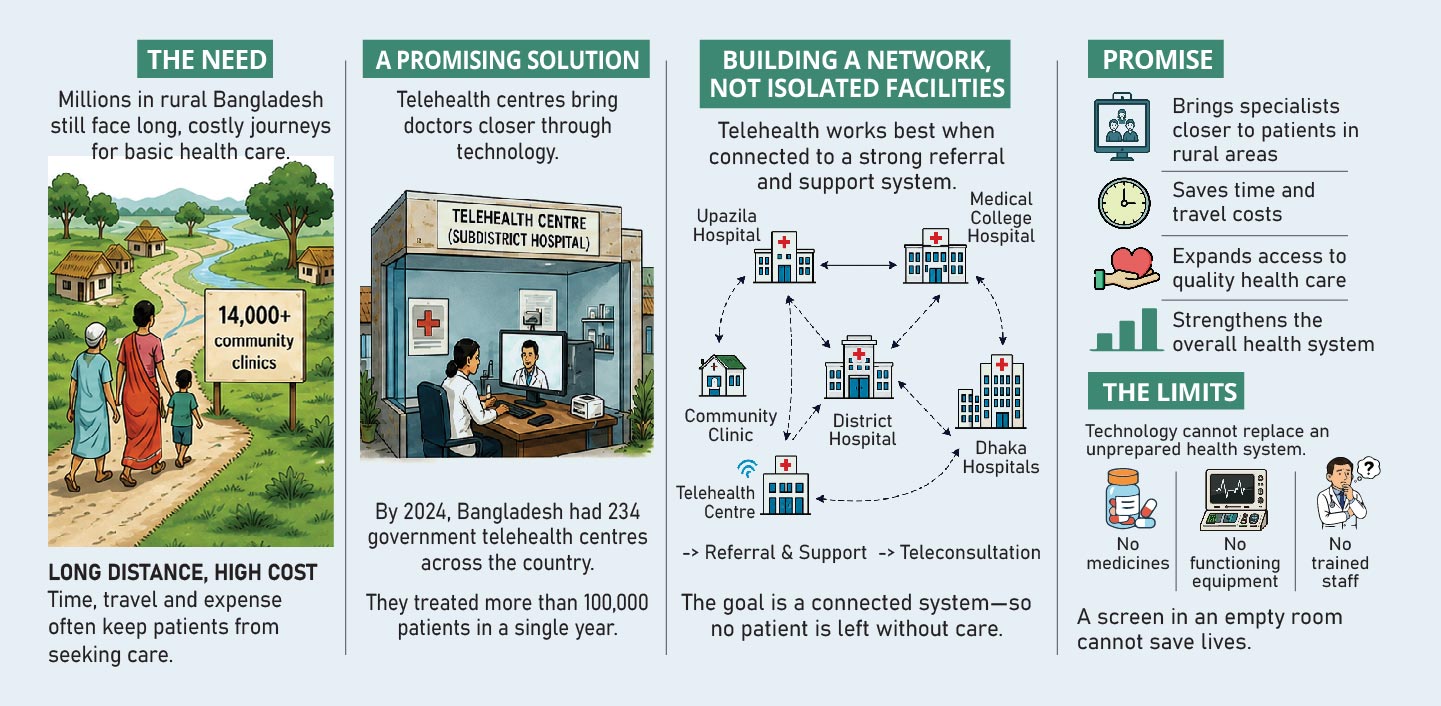
The goal, then, cannot simply be producing more doctors and nurses. Simply multiplying numbers without changing their distribution will leave the same villages empty of care. The challenge is to build a network, not a collection of isolated facilities. There are those who are trying to redraw that map.
By 2024, Bangladesh had 234 government telehealth centres operating across the country, located within subdistrict hospitals, treating more than 100,000 patients in a single year, the country's longest-running telehealth programme according to WHO Bangladesh. In the clinic in Dacope, a 36-year-old administrator named Rahman kept the screens on and the consultations running even when the funding had dried. "I find a deep sense of joy in serving," he said. "Even though I'm not able to provide the same quality of care as before, I can't bear the thought of the centre closing completely." But when USAID halted its funding in early 2025, only about 35 of those 234 centres survived. A candle, lit against the dark, blown out by a wind that came from very far away.
Technology offers real possibility, but it must be understood honestly. A video consultation cannot compensate for a health centre without medicines, functioning equipment, or trained staff. Telemedicine should support the network, not replace it. The solution is not a screen in an empty room. It is a screen connected to a room already prepared to receive the patient who arrives at its door.
Working away from one's family in Dhaka means carrying two households on a single salary, while colleagues in the capital supplement their income through private practice that rural communities, with far less spending power, simply cannot offer.
BRINGING CARE CLOSER TO HOME
Dr Zafrullah Chowdhury, public health specialist and founder of Gonoshasthaya Kendra, told Dhaka Tribune that nine in ten medical cases reaching Dhaka could be handled at the upazila level, if doctors were present and the government treated the matter as its highest priority. The infrastructure, he argues, already exists. What remains missing is the commitment to fill it with people and keep them there.
A viable healthcare network beyond Dhaka would begin with strong primary-care centres, connecting the country's more than 14,000 community clinics reliably to upazila and district hospitals. It would require dependable housing and career pathways for doctors who serve in remote locations. It would require the political will to treat rural life as worthy of the same investment as urban life, not as a charity project, but as a simple belief that a woman in Barguna deserves the same access to a doctor as a woman in Gulshan.
The river still flows only in one direction. The sick still pack their borrowed money and board the night bus toward the city, hoping the hospital will not be too full, hoping the journey was not too late. But somewhere in the upazila hospitals that still have their doctors, in the clinics where Rahman keeps the screen on even when he has not been paid, a different geography is being imagined.
The goal should not be to make every village look like Dhaka. It should be to make sure that living outside Dhaka does not decide how much care a person deserves. Perhaps the truest act of healing is not only to cure the body, but to shorten the distance a person must travel to be seen. And when distance finally stops deciding who receives timely, quality care, geography will stop being a barrier and begin simply to be where people live.


