

features
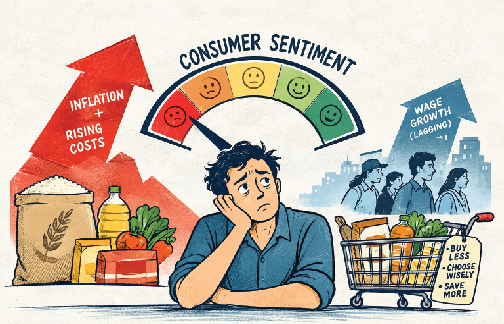
When purchasing power is under pressure, knowing what consumers think — and what they expect next — can be as important as knowing what they are spending today.


Illustrated By sk. yeahhia
17 August, 2026
Despite a gradual rise in nominal wages, inflation in Bangladesh outpaced wage growth for 50 consecutive months from February 2022 to March 2026. At the same time, a growing labour supply continues to place downward pressure on wages in parts of the economy. As a result, the purchasing power of low- and middle-income households — which constitute a substantial share of the consumer market — has been severely constrained. In such conditions, businesses and prospective foreign investors would benefit from an indicator that captures how households perceive their financial circumstances and the wider economy. Knowing whether consumers are becoming more optimistic or pessimistic could help firms make better-informed decisions about production, inventory and investment.
Measuring the National Mood
This is precisely the premise of a Consumer Confidence Index (CCI). Derived from a regular consumer confidence survey, the index measures how people assess current economic and employment conditions, as well as what they expect over the coming months. In broad terms, greater optimism can signal a willingness to spend, while persistent pessimism may indicate that households are preparing to reduce consumption or postpone major purchases.
Bangladesh currently publishes a wide range of economic indicators, including monthly inflation figures, quarterly estimates of gross domestic product and data on imports, credit and retail activity. These measures reveal what has already happened in the economy. What remains absent is a consistent, nationally representative measure of what consumers believe may happen next.
The last widely reported international assessment of consumer confidence in Bangladesh came from Mastercard in 2017. Its survey ranked Bangladesh as the third-most optimistic market in Asia-Pacific, with the country’s index rising by 6.6 points to 89.4 in the first half of the year. Strong expectations regarding employment and regular income contributed significantly to the result, with the respective sub-indices reaching 93.7 and 95.7. The stock-market component recorded the largest increase, rising from 59.9 in the second half of 2016 to 74.9 in early 2017.
That reading is now nearly a decade old. Since then, Bangladesh has experienced a pandemic, prolonged inflation, pressure on foreign-exchange reserves, banking-sector stress and considerable uncertainty in its labour market. An isolated figure from 2017 can no longer offer a meaningful picture of present consumer sentiment. A regularly updated national index is therefore increasingly necessary.

The last widely reported international assessment of consumer confidence in Bangladesh came from Mastercard in 2017. Its survey ranked Bangladesh as the third-most optimistic market in Asia-Pacific, with the country’s index rising by 6.6 points to 89.4 in the first half of the year.
Building a Bangladeshi CCI
Bangladesh could develop its CCI using principles similar to those employed by The Conference Board, the research organisation responsible for the widely followed index in the United States. The process would begin with a monthly survey of a nationally representative sample of households. A sample of approximately 5,000 respondents could provide a reasonable starting point, although the final size should be determined through statistical testing and should adequately represent divisions, income groups, occupations and rural and urban populations.
The survey would ask five central questions. Two would examine respondents’ assessments of current business and employment conditions, forming the Present Situation Index. The remaining three would address expectations for business conditions, employment and total family income six months ahead, forming the Expectations Index.
Respondents would choose among positive, negative and neutral answers for each question. The survey could be conducted during a fixed period every month, with the results released on a predetermined date. A consistent schedule would allow businesses, policymakers and investors to compare changes over time without uncertainty about when new data would become available.
Bangladesh should not, however, simply reproduce the American system without adaptation. The questionnaire would need to use language that is accessible across different levels of education and suited to the realities of both formal and informal employment. It may also need to be administered in Bangla and, where appropriate, regional or simplified spoken forms to minimise misunderstanding.
From Survey Responses to an Index
Once the survey has been completed, each question can be converted into a relative value. This is calculated by dividing the proportion of positive responses by the combined proportion of positive and negative responses. Neutral responses are excluded from this stage of the calculation.
Each relative value must then be compared with a base-period value and multiplied by 100. The Conference Board uses 1985 as its benchmark, meaning that the US index is expressed relative to consumer confidence during that year. Bangladesh would need to establish its own reference period.
Using FY2015–16 as a benchmark may initially appear convenient because it has served as a macroeconomic base year for national statistics. However, a confidence index cannot be constructed retrospectively without comparable consumer-survey responses from that period. A more credible approach would be to conduct the survey over an initial pilot period, potentially 12 months, and use the average result as the benchmark value of 100. This would also allow researchers to test the questionnaire, identify seasonal effects and improve the sampling process before formal publication.
The index values for the two questions on present conditions would be combined to produce the Present Situation Index. The three forward-looking questions would form the Expectations Index. Together, these would create the headline CCI, with present conditions accounting for two-fifths of the measure and expectations for three-fifths.
A single monthly movement should not be interpreted in isolation. Confidence indicators can fluctuate in response to temporary events, political developments or sudden changes in prices. What matters most is the direction and persistence of the trend, particularly when it is supported by changes in spending, employment, credit or business activity.
Why Confidence Matters
A reliable CCI could assist Bangladeshi businesses, policymakers, investors and financial institutions in several ways.
Manufacturers and retailers could use changes in confidence to refine production and inventory decisions. If households expect their incomes or employment prospects to weaken, firms may anticipate lower discretionary spending and avoid accumulating excess stock. Conversely, a sustained improvement in confidence could support expansion, hiring or increased production.
For policymakers, the index would offer a structured measure of public economic sentiment. It could help reveal whether official improvements in inflation, growth or employment are being felt at the household level. A divergence between economic data and consumer confidence would itself be informative: it might suggest that a recovery is uneven, that uncertainty remains high or that households have not yet regained financial security.
The index could also add context to monetary and fiscal decisions. Consumer confidence should not determine policy on its own, but it could complement inflation, employment and credit data when authorities assess the likely direction of household spending.
Foreign investors, meanwhile, often evaluate not only the current size of a market but also the likelihood of future demand. Bangladesh has struggled to attract foreign direct investment commensurate with the scale of its economy. A credible and well-documented measure of consumer sentiment would not eliminate wider concerns about regulation, governance or financial stability, but it could provide investors with a clearer view of domestic demand.
Banks and other lenders could similarly use the index as a macroeconomic signal when assessing consumer and small-business credit. A decline in household expectations may indicate growing repayment risk or weakening demand, while an improvement could support more confident lending. The CCI would supplement — not replace — borrower-level assessments and established risk models.
Institutional credibility may be the most important challenge of all. A 2024 BBS user-satisfaction survey revealed considerable concern about the agency’s data. Approximately one-third of respondents expressed distrust in its inflation statistics, while others raised doubts about the accuracy and timeliness of several major datasets.
The Obstacles to Credibility
Developing the index would nevertheless involve considerable challenges. According to the International Labour Organization, informal employment accounts for approximately 84% of jobs in Bangladesh. In such an economy, questions concerning salary, income and employment security cannot assume that respondents receive regular wages, possess written contracts or work for a single employer. Many may have seasonal, irregular or multiple sources of income.
A household-confidence survey must therefore recognise different forms of livelihood. Questions may need to address the regularity and predictability of earnings rather than rely solely on formal salary brackets. Enumerators would also require sufficient training to record complex employment arrangements accurately.
Digital access presents another difficulty. A survey conducted exclusively online would risk overrepresenting younger, urban and better-educated consumers. Rural residents, older citizens and lower-income households could be systematically excluded, even though their experiences are essential to a national measure. A mixed-mode system combining telephone, online and face-to-face surveys would be more expensive, but it would produce a more representative result.
Bangladesh’s rural and urban economies also differ substantially in their employment structures, consumption patterns and exposure to price changes. The sample should therefore be designed to produce reliable rural and urban estimates, rather than treating geography as a secondary consideration.
Funding will be equally important to the index’s long-term viability. SANEM’s Business Confidence Index, developed in collaboration with The Asia Foundation, demonstrates the value of regularly collecting firm-level sentiment. A nationwide household survey, however, would demand greater financial resources, field capacity and logistical coordination. If funding ended or institutional priorities shifted, the resulting gaps could undermine the value of the entire series. For a confidence index to become analytically useful, it must be published consistently over many years.
Institutional credibility may be the most important challenge of all. A 2024 BBS user-satisfaction survey revealed considerable concern about the agency’s data. Approximately one-third of respondents expressed distrust in its inflation statistics, while others raised doubts about the accuracy and timeliness of several major datasets. These findings do not mean that all BBS data are unreliable, but they demonstrate that public confidence in the publisher can directly affect the usefulness of the information it produces.
An index intended to measure confidence must itself inspire confidence. Transparent sampling, published methodology, independent technical oversight and access to anonymised supporting data would all help establish credibility. BBS could also collaborate with universities, research organisations and independent economists with relevant expertise. Such partnerships would strengthen methodological scrutiny and reduce the perception that the index reflects a preferred institutional or political narrative.
Confidence in the Measure
Bangladesh’s shifting economic landscape has made household sentiment increasingly relevant to business and investment decisions. Existing indicators can show how prices, wages and output have changed, but they cannot fully reveal whether consumers feel secure enough to spend, borrow or make long-term commitments.
A credible Consumer Confidence Index could help fill that gap. Bangladesh possesses the technical capacity to develop one, drawing on internationally established principles while adapting the survey to its own economic realities. The larger challenge lies in building a system capable of representing informal workers, reaching rural households, securing long-term funding and earning public trust.
The objective should not simply be to produce another monthly figure. It should be to establish a dependable record of how households understand the economy and how their expectations change over time. For the index to have genuine value, confidence in the measure will be just as important as the confidence it seeks to measure.


