

Climate Corner
As climate extremes disrupt classrooms across Bangladesh, education emerges not just as a casualty — but as a critical solution for resilience, equity, and long-term climate action.

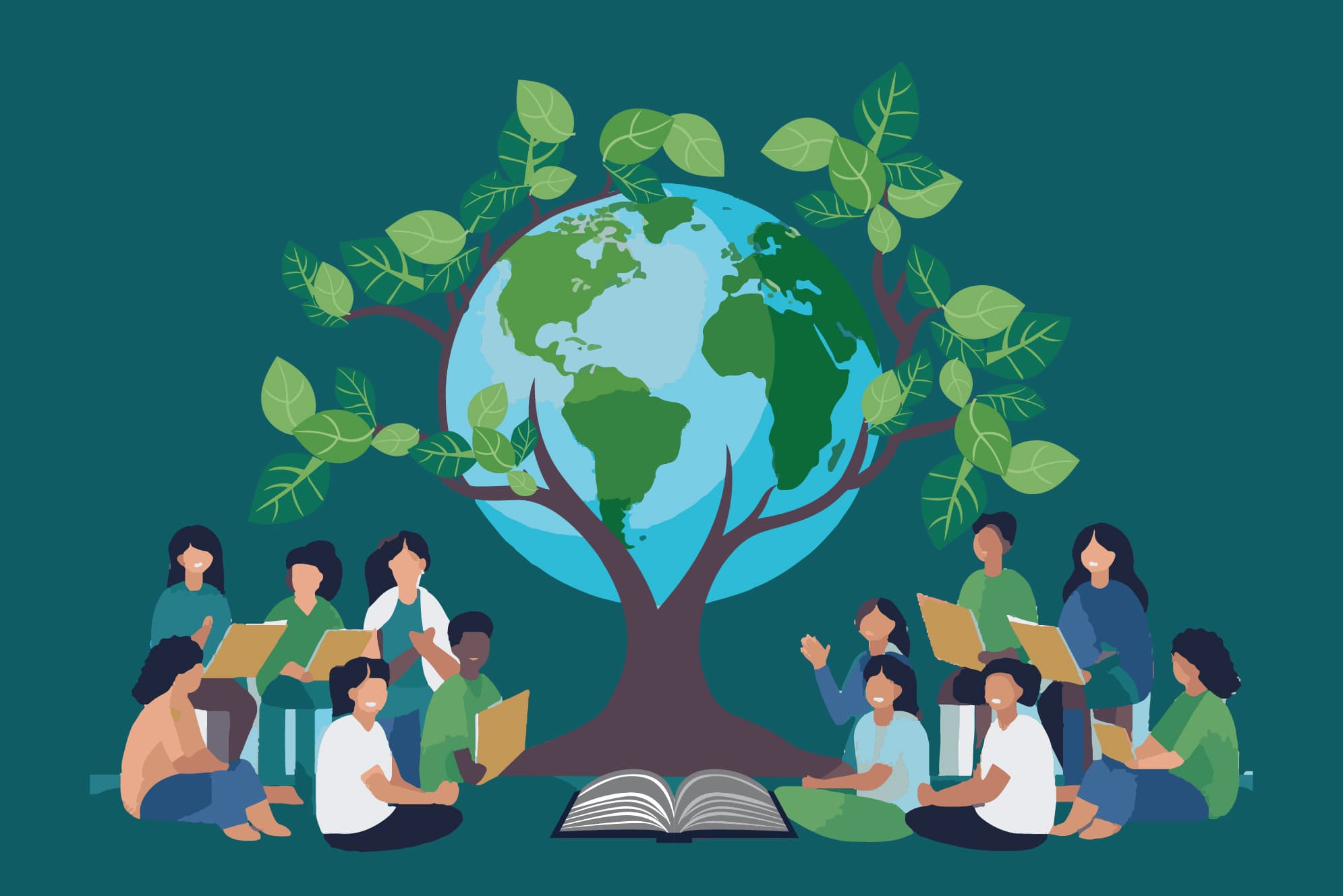
Illustrated By sk. yeahhia
8 February, 2026
Climate change and education are often treated as separate challenges, yet they are deeply interconnected. Quality education strengthens climate resilience, adaptation, and mitigation by improving understanding of climate science, enabling innovation, and fostering public support for sustainable policies. More educated communities are better able to adopt climate-smart practices — such as resilient agriculture — and are more likely to demand climate action.
Education, particularly for girls, delivers outsized climate benefits. Educated women are better equipped to protect families during disasters and tend to have fewer, healthier children, easing long-term pressure on carbon emissions. As climate researchers and UN agencies note, girls’ education ranks among the most effective climate solutions due to its wide social and environmental spillovers. Integrating climate learning into curricula further helps cultivate environmentally conscious citizens and climate-smart lifestyles.
Despite this evidence, education remains undervalued in climate strategies and financing. Yet mounting research shows the climate crisis cannot be solved without addressing the learning crisis. As UNICEF has observed, the two are “two sides of the same problem,” making education a high-impact but still overlooked climate solution.
Climate Disrupts Education
Bangladesh sits on the frontlines of climate change, and its education system is increasingly under strain. Floods, cyclones, heatwaves, river erosion, and salinity regularly damage schools, force closures, and disrupt learning. UNICEF estimates that nearly 35 million children were affected by climate-related disasters in 2024 alone, through infrastructure damage, prolonged school shutdowns, and learning losses.
Extreme heat has become a major disruptor. In April and May 2024, nationwide heatwaves forced schools to close for up to two weeks, exposing children to serious health risks. In several districts, schooling was later interrupted again by Cyclone Remal and subsequent flooding in June. Such repeated disruptions are driving students out of school altogether. The national dropout rate rose sharply to 16.25% in 2024, up from 13.15% in 2023, with climate shocks identified as a key factor.
Rural and coastal communities are the worst affected. Climate-driven displacement has pushed many families into urban slums, where children often leave school for work. UNICEF estimates 1.2 million children in Bangladesh are engaged in labour, many in disaster-prone rural areas or overcrowded cities. Girls face particular risks: climate stress increases early marriage, with studies showing a 50% spike in child marriages during prolonged heatwaves. Keeping girls in school remains one of the strongest protections against this trend.
Even when schools remain open, learning suffers. Overheated classrooms, disease outbreaks, and climate-related trauma reduce concentration and academic performance, especially in poorer schools lacking electricity or cooling. Repeated closures and extreme conditions are eroding educational outcomes and widening inequalities — underscoring that in Bangladesh, climate change is not only an environmental crisis, but an education crisis as well.

Education Overlooked in Finance
Despite mounting evidence that education is central to climate resilience, it remains largely absent from global climate finance. Education receives less than 2% of total climate funding, and in 2021 only around 1.5% of climate-related development aid was directed to the education sector. This is strikingly low given the scale of climate-driven learning disruptions, and reflects a broader policy blind spot rather than a lack of need.
Climate finance is typically channelled toward energy, infrastructure, or agriculture, leaving education ministries with limited access to funding. Few national climate plans explicitly address education, and when schools and learners are missing from climate strategies, they are also missing from investment decisions. As a result, education systems remain highly vulnerable to floods, cyclones, and heatwaves.
Bangladesh illustrates this gap. Climate adaptation efforts have historically focused on disaster management and infrastructure, with limited coordination with education authorities. While recent steps — such as national climate-risk discussions for the education sector and global momentum at COP30 in 2025, including new tools launched under the Greening Education Partnership — signal growing recognition, financing remains minimal. Without a significant shift in priorities, schools will continue to be damaged, learning disrupted, and inequalities deepened.
Closing the climate–education financing gap is urgent. Investing in climate-resilient education offers high returns for adaptation and long-term development, yet remains one of the most overlooked opportunities in global climate action.
Education Powers Climate Action
Education is not only vulnerable to climate change; it is also one of the most powerful tools to address it. Quality education underpins both climate mitigation and adaptation by building skills, shaping behaviour, and strengthening resilience. Educated societies are better equipped to develop clean technologies, improve energy efficiency, and support low-carbon policies. Research shows higher education levels are linked to greater concern about climate risks, while girls’ education in particular reduces fertility rates and long-term emissions growth — an impact highlighted by Project Drawdown as among the most effective climate solutions.
Education’s role in adaptation is even more immediate. Educated communities respond better to disasters, understand early-warning systems, and have greater economic capacity to recover or adapt. In Bangladesh, community education on cyclone preparedness has helped dramatically reduce disaster-related deaths. Each additional year of schooling raises earning potential, giving households more resources to withstand climate shocks.
Bangladesh also demonstrates how education can adapt to climate extremes. Innovative models such as solar-powered floating schools in flood-prone areas ensure learning continues during disasters while doubling as community shelters. These initiatives show how climate adaptation and education can be integrated to protect learning and build resilience.
Ultimately, investing in climate-resilient education delivers broad societal returns. Education has a relatively small carbon footprint but an outsized impact on all other climate responses by building human capacity. In a climate-vulnerable country like Bangladesh, keeping children in school may be one of the most effective long-term climate strategies — preparing future generations to adapt, innovate, and lead a low-carbon future.
Turning Crisis into Opportunity
Bangladesh’s experience shows that quality education is central to effective climate action. Climate shocks have exposed how fragile education systems can deepen vulnerability — but they have also demonstrated how education can build resilience and hope. Climate and education policy can no longer be treated separately. Children already living with the impacts of climate change need education systems that withstand disruption and prepare them for a greener, more resilient future.
Education should be seen as critical climate infrastructure, as essential as seawalls or renewable energy. Redirecting even a small share of climate finance toward education could yield high returns — through climate-resilient schools, innovative models like floating classrooms, and curricula that equip young people to lead climate solutions. Though often overlooked, education underpins all other climate responses by building informed, adaptable communities.
The stories emerging from Bangladesh — from school boats in floodplains to night schools in urban slums — offer a powerful reminder: when people are educated, they are better able to adapt, innovate, and act. By elevating education within climate agendas and investing in it accordingly, Bangladesh and the world can turn a cycle of crisis into one of resilience. Quality education is the key; the opportunity is now.


%20Square%20Ad%20-11.jpg&w=640&q=75)
%20Horizental%20AD-01.jpg&w=3840&q=75)
