

sdg spotlight
Using microalgae to turn carbon dioxide into oxygen, Liquid Trees bring hope for cleaner air in Dhaka’s most crowded spaces.

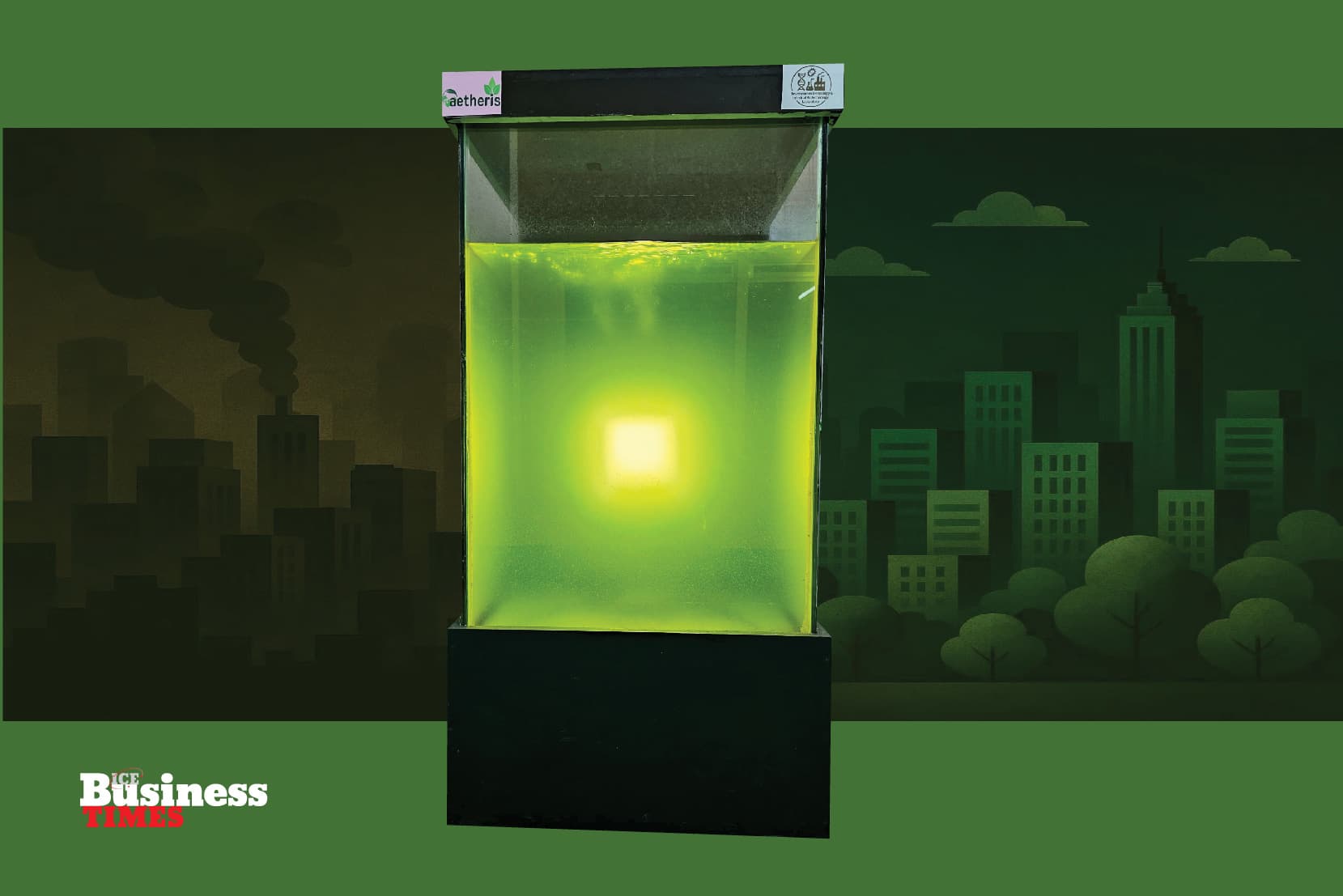
Photograph collected
17 September, 2025
Dhaka’s air is not clean. Since 2018, our air quality has taken a nosedive, and it’s been consistently hazardous. There is only one solution to this: plant more trees. But with no apparent effective enforcement of rules and regulations on forestation or deforestation, citizens often consider the effort of planting trees a futile effort. At the same time, cities like Dhaka that are heavily urbanised simply don’t have enough topsoil to plant trees. It almost feels like giving up is the only option when it comes to purifying Dhaka’s air… Almost!
Researchers at Jahangirnagar University (JU) have come up with an alternative that might give some respite to our lungs. It’s called ‘Liquid Trees’ – a novel idea that saw its first prototype in Belgrade, Serbia, in 2021-2022, where it demonstrated the ability to absorb the equivalent carbon dioxide of two mature trees daily. The JU researchers built on this inspiration to adapt it to Bangladesh’s tropical conditions, which uses local algae, and innovated on it further by specifically designing indoor models - an area previously unexplored globally.
What are Liquid Trees?
A liquid tree is a tank containing water and algae that can ‘breathe in’ carbon dioxide and ‘breathe out’ oxygen, much like a tree, thus purifying the air around it. The research team at Bioresources Technology and Industrial Biotechnology Lab of the BGE department of Jahangirnagar University describe it as an innovative biotech solution designed to combat carbon dioxide pollution in both indoor and outdoor environments.
While calling it an air purifier is perhaps the easiest way to explain it to the layman, unlike conventional approaches, the Liquid Tree harnesses the power of microalgae to capture carbon dioxide and release oxygen through photosynthesis. This process mimics the natural function of trees, but in a controlled and highly efficient system.
Liquid Trees are transparent photobioreactors, a controlled cultivation system that uses light to grow photosynthetic organisms, in this case, microalgae. When exposed to sunlight or artificial light, the microalgae perform photosynthesis, a plant’s process of using sunlight, water, and carbon dioxide to create its own food. Through photosynthesis, the carbon dioxide is used up, and oxygen is released as a natural byproduct.
Liquid Trees are designed for autonomous, low-maintenance operation, making them suitable for dense, urban areas and enclosed indoor spaces.
The Indoor Liquid Tree has been developed specifically to address the growing concern of carbon dioxide accumulation in enclosed environments. These are more compact bioreactors than the outdoor units and are ideal for classrooms, conference halls, meeting rooms, and offices.
Types of Liquid Trees
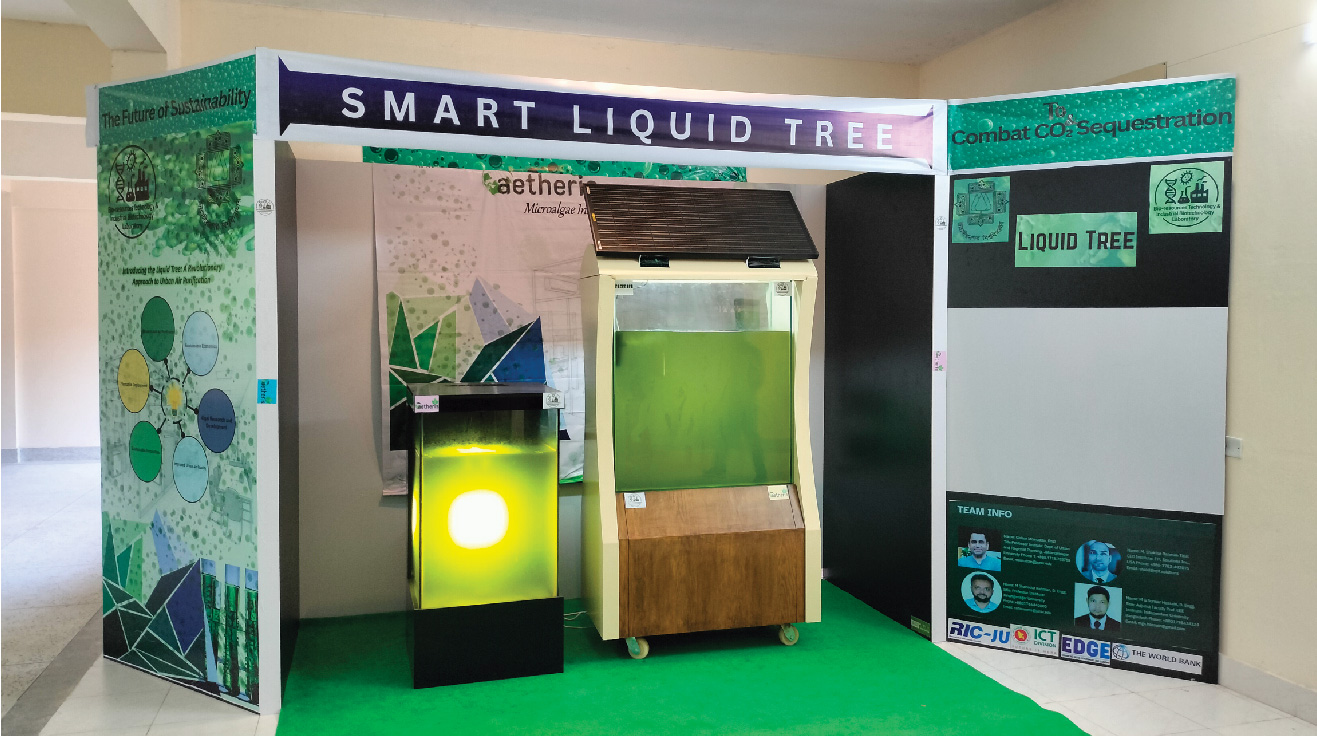
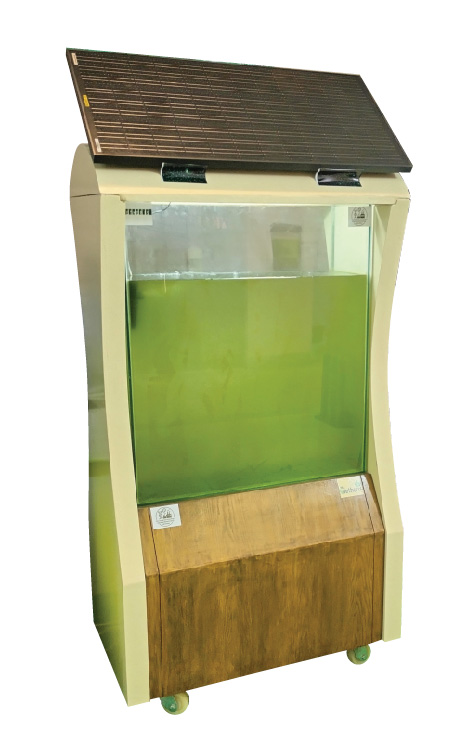
The JU research team has designed two models: Outdoor Liquid Tree and Indoor Liquid Tree. The Outdoor Liquid Tree is engineered for space-constrained urban footprints such as sidewalks, road dividers, rooftops, parking areas, and industrial zones. These units capture carbon dioxide from vehicle emissions and industrial activity while providing localised oxygenation in polluted neighbourhoods. Outdoor Liquid Trees utilise sunlight for their photosynthesis process.
The Indoor Liquid Tree has been developed specifically to address the growing concern of carbon dioxide accumulation in enclosed environments. These are more compact bioreactors than the outdoor units and are ideal for classrooms, conference halls, meeting rooms, and offices. By actively absorbing carbon dioxide exhaled by occupants and releasing oxygen, Indoor Liquid Trees ensure healthier air quality, improved focus, and enhanced productivity. Indoor Liquid Trees utilise artificial light for their photosynthesis process.
Efficiency and Advantages of Liquid Trees
In good working conditions, a single Liquid Tree bioreactor can achieve the same level of carbon dioxide capture and oxygen release with excellent efficiency compared to natural trees. The advantage over natural trees is in their deployment. Natural trees take years to grow and mature, but since Liquid Trees are fabricated, they can be deployed within weeks.
The Liquid Tree system also comes with additional features. For instance, the microalgal biomass produced can be repurposed as organic fertiliser or biofuel once they have served its purpose. Additionally, Liquid Trees are small and compact, meaning their footprint allows for installation in dense, urban centres. Indoor models, particularly, can function 24/7 with artificial lighting support. Finally, there is an educational and awareness value as its design, functionality, and uniqueness attract public interest and inspire discourse on sustainable innovation.
Challenges and Opportunities of Liquid Trees
Liquid Trees, like all pioneering technologies, will have to overcome the challenge of high initial investment and high maintenance costs. The technology is new, and requires consistent light and water supply, and routine maintenance. A second challenge lies in the number of Liquid Trees needed to achieve a significant impact. The JU research team has not yet specified a number, but for city-wide impact, the scope and scale of the deployment would have to be quite high. A third challenge lies in public understanding of Liquid Trees, where some may mistakenly believe that Liquid Trees are here to replace natural trees. In reality, Liquid Trees are supposed to work in tandem with natural trees, to be used in places where it is not feasible to plant a tree.
These challenges can be overcome with further investment, research, and scaling up operations, and the opportunities that will be presented along the way are highly lucrative. Liquid Trees offer grounds for significant scientific advancement in optimising native algal strains for Bangladesh’s climate. If economies of scale can be achieved, the lifecycle of the matter inside Liquid Trees can be extended by utilising byproducts such as organic fertiliser and bioenergy. Furthermore, Liquid Trees can be integrated with urban design, in rooftops, building facades, and public spaces can host Liquid Trees. A huge opportunity that can be brought about by Liquid Trees is in its economic potential. The development and deployment of Liquid Trees is poised to create new jobs in biotechnology, green manufacturing, and maintenance.
The Scope of Liquid Trees in Bangladesh
For a country like Bangladesh, where rapid urbanisation has strained both environmental and public health systems, the Liquid Tree is more than just a symbolic innovation. It is a practical solution for mitigating carbon dioxide pollution in environments where traditional greenery may not thrive. It aligns with the nation’s national agenda for climate resilience, sustainable urban planning, and green technology development.
Additional research funding and further investments in indoor Liquid Tree models is where we have the most opportunity. By pioneering this sector, Bangladesh can take global leadership in addressing the often-ignored crisis of indoor carbon dioxide accumulation. This innovation not only protects public health but also enhances learning environments, workplaces, and community well-being.
Call to Action
The research team behind the innovative Liquid Tree consists of Dr. Golam Moinuddin, Professor, Department of Urban and Regional Planning, Jahangirnagar University, Dr. Mohammad Shahedur Rahman, Professor, Bioresources Technology and Industrial Biotechnology Lab, Biotechnology and Genetic Engineering, Jahangirnagar University, Dr. M G Sorwar Hossain, Professor, EEE Department, BRAC University, and M Shakilur Rahman, EPL Solutions, USA. They share this call to action for further collaboration in the development of Liquid Trees:
“The Liquid Tree is not a replacement for natural greenery but a complementary solution. Trees, parks, and forests remain irreplaceable for biodiversity and ecological balance. However, in space-cramped urban areas and sealed indoor environments, Liquid Trees provide a scalable, rapid-deployment alternative for ensuring breathable, healthier air.
We call upon policymakers, urban planners, academic institutions, and industries to support the deployment and further research of Liquid Trees in Bangladesh. With collective effort, this biotechnology can evolve from a promising prototype into a transformative tool for sustainable living.”
The Liquid Tree is developed entirely using indigenous microalgae strains, with full support from Jahangirnagar University’s Bioresource Technology & Industrial Biotechnology Lab, Research & Innovation Centre (RIC-JU), and the EDGE Project funded by the Government of Bangladesh.


%20Square%20Ad%20-11.jpg&w=640&q=75)
%20Horizental%20AD-01.jpg&w=3840&q=75)
