

in focus
For Bangladesh, 2026 could become a hinge year if strengthening governance, productive capacity, and human capital translates into the everyday reliability its economy depends on.


Illustrated By sk. yeahhia
1 January, 2026
Bangladesh is entering 2026 to address sectoral disruptions and institutional strain, while aiming for accelerated reform, with systems still in the process of recalibration. The decisions made this year will determine whether decisions at both the government and industrial levels can translate into durable institutions, predictable rules, and sustained productivity gains.
The task over the past year, throughout 2025, has been to stabilise and maintain the economy's functioning through uncertainty. The challenge that follows is different: converting those pathways into institutions that can hold — quietly, consistently, and without interruption.
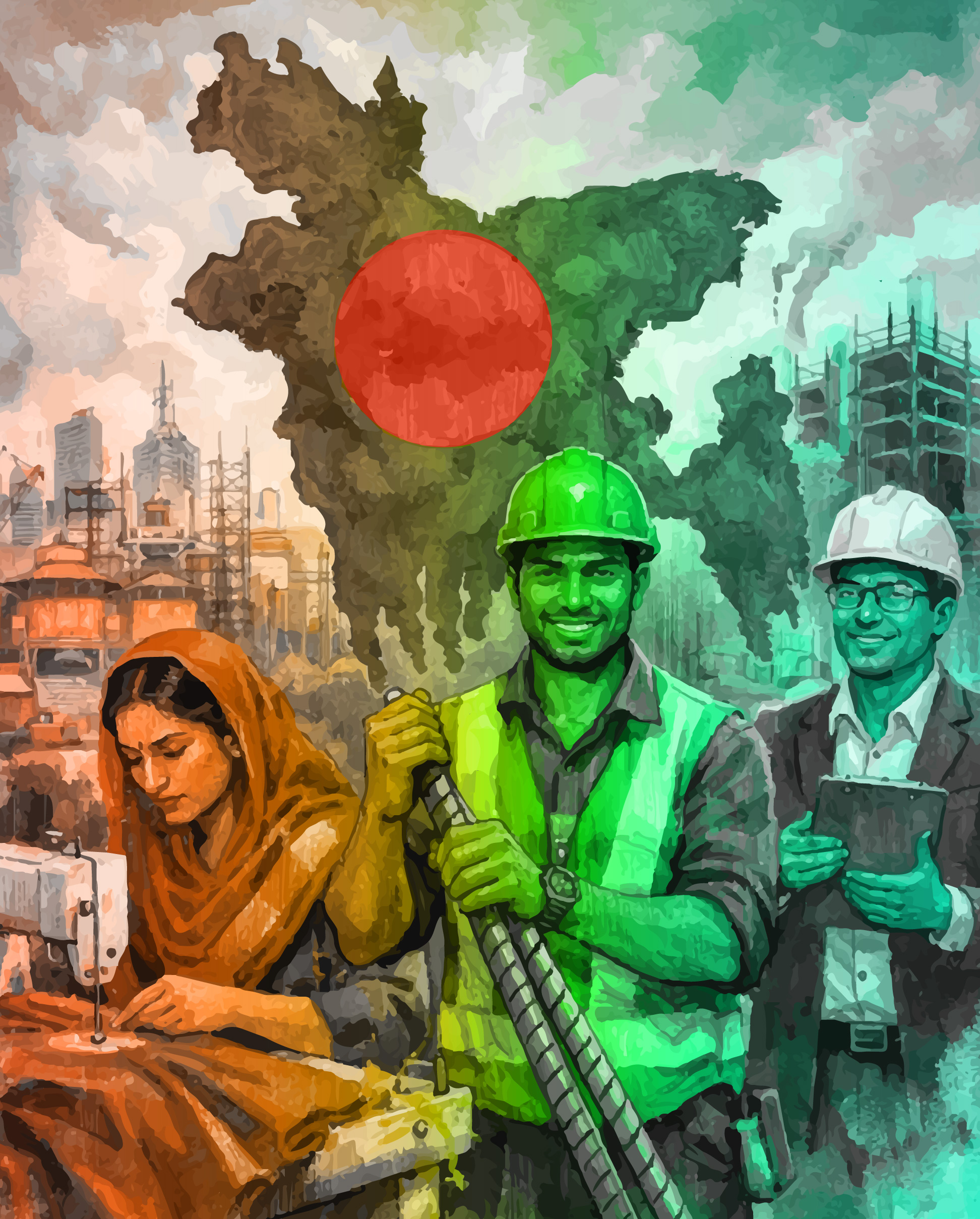
This is where renewing, rebuilding, and restrengthening the middle stops being an abstract idea and begins to show up in daily life. The “middle” is the backbone of Bangladesh’s economy and society — the broad base of people, small and medium-sized business owners, workers, and ordinary citizens whose productivity, engagement, and confidence keep the country functioning and growing. We must achieve this not by speeches or slogans, but by ensuring that rules are enforced evenly, ports move goods, banks lend responsibly, and public services function without favour or friction.
Over the past year, work has unfolded — often quietly — across these pressure points. Some interventions have stabilised the system. Others have exposed how fragile it remains. Together, they form an unfinished architecture that 2026 will test.
Strengthening Governance and Confidence
Cards on the table — Bangladesh has a trust issue. Institutions are often seen as inconsistent, enforcement uneven, and economic governance unpredictable. Restoring confidence — the belief that the state could function according to rules rather than discretion — remains a central challenge.
In 2025, one of the most consequential shifts was our acknowledgement that reform must be an institutional process rather than a promise to tackle an insurmountable problem. Consequently, our vision for reform was across all sectors — policing, the judiciary, public administration, labour, health, and media, to name a few. The aim is to reduce uncertainty by signalling that change was structured rather than open-ended. Economic governance provided more tangible tests. Separating tax policy from tax administration was a long-overdue modernisation aimed at reducing discretion and improving compliance. While resistance and strikes disrupted imports and exports, the intent was to enhance confidence. In the financial sector, some much-needed steps have been taken to restore trust in the financial system, primarily those that signalled the beginning of the end of automatic impunity.
In 2026, rebuilding confidence will mean converting transitional frameworks into routine governance: enforcing law consistently, completing revenue reform without paralysing the system, and moving from symbolic oversight to real resolution.
Strengthening Productive Capacity in Business and Trade
Strengthening productive capacity over the past year was less about announcing growth targets and more about keeping Bangladesh’s trade machinery running during strain. The most tangible interventions focused on trade facilitation, export support, and reducing friction in the systems exporters rely on every day.
One of the most consequential moves came within the customs and bonded warehouse regime. Export-oriented industries depend on bonded facilities to import raw materials duty-free, and delays here directly raise costs. During this period, the National Board of Revenue accelerated bond automation and made automated utilisation permission mandatory. This was a transparency and efficiency measure aimed at faster processing and reduced misuse. For exporters, predictability in bond approvals translated into lower inventory costs and fewer shipment delays.
Export incentives were another stabilising tool. Facing global demand uncertainty and domestic disruption, cash incentives were extended for 43 export sectors, with varying rates designed to support diversification beyond garments, acting as a bridge to maintain competitiveness. However, longer-term reforms remain incomplete.
Procedural bottlenecks were also addressed. Removing quotas on free-of-charge imports for 100% export-oriented firms was a technical change, but one that directly affects production planning and flexibility.
Investment confidence, an indirect but critical driver of productive capacity, was addressed through institutional reform. The approval of the Commercial Court Ordinance 2025 was intended to speed up resolutions of commercial disputes. For businesses, quicker dispute settlements lower risk premiums and encourage longer-term investment, particularly as Bangladesh approaches LDC graduation.
Trade diplomacy also featured prominently. Some progress has been made towards a Japan–Bangladesh Economic Partnership Agreement, potentially offering duty-free access for thousands of products — a significant opportunity to strengthen the trade portfolio at a critical moment.
Failures, however, were equally visible. Strikes by NBR officials slowed or halted customs operations at Chattogram port, creating backlogs and missed sailings. Even after work resumed, delays damaged reliability — a core component of productivity. For exporters, manufacturers, logistics operators, and small businesses, reliability is not an abstract ideal. It determines whether shipments leave on time, whether working capital cycles shorten, and whether investment decisions feel rational rather than risky. Workers feel it too — in stable hours, safer workplaces, and predictable wages. In that sense, strengthening productive capacity is not only about trade numbers; it is about restoring confidence across the private economy that effort, compliance, and planning will be rewarded.
In 2026, the task is therefore clear. Bond automation, targeted export incentives, commercial court implementation, and trade agreements must continue. But how reforms are delivered matters as much as what is delivered — phasing implementation, ensuring labour peace at ports and customs, and building logistics resilience so reform does not interrupt trade. Productive capacity grows when systems become boringly reliable. In 2026, reliability itself must become policy.
Human Capital, Resilience, and Work Culture
Beyond trade and administration, some of the most consequential work unfolded in education, healthcare, climate resilience, and work culture — the social foundations of productivity.
In education, the most visible intervention was the large-scale recruitment of primary school teachers. After years of stagnation, 10,219 assistant teacher positions were opened, with nationwide examinations scheduled for January 2026. While recruitment alone did not transform quality, it addressed prolonged staffing gaps and injected new capacity into classrooms.
Healthcare reform followed a similar path. A Health Sector Reform Commission submitted its report in May 2025, outlining system-wide proposals on governance, access, and service delivery. Though recommendations are not yet legislated, the process signalled a shift from ad hoc measures toward structured reform thinking.
In work culture, the formation of a Labour Reform Commission reopened long-stalled debates on worker safety, compensation, and dignity. Its recommendations — including safer workplaces and stronger legal protections — matter not only for rights but for productivity and buyer confidence, particularly in export sectors.
Implementation gaps remain. Teacher recruitment has not resolved training, deployment, or retention challenges. Health reforms remain consultative. Climate measures are still pilot-oriented. These gaps define the work ahead: convert plans into funded programmes, embed resilience into infrastructure, and enforce labour standards consistently.

2026 as a Hinge Year
What Bangladesh can reasonably hope for in 2026 is not a sudden transformation but steady normalisation. If reform momentum is sustained without disruption, if institutions prioritise consistency over spectacle, and if systems begin to work more predictably, confidence — once restored — can compound.
2026 is poised to become a hinge year for Bangladesh — effective institutions, disciplined economic management, and predictable rules will determine whether Bangladesh can improve its business climate, attract investment, and strengthen its trade portfolio at a time of intense global competition.
The middle has been held together. What comes next will determine how well we strengthen our core.


%20Square%20Ad%20-11.jpg&w=640&q=75)
%20Horizental%20AD-01.jpg&w=3840&q=75)
