

Climate Corner
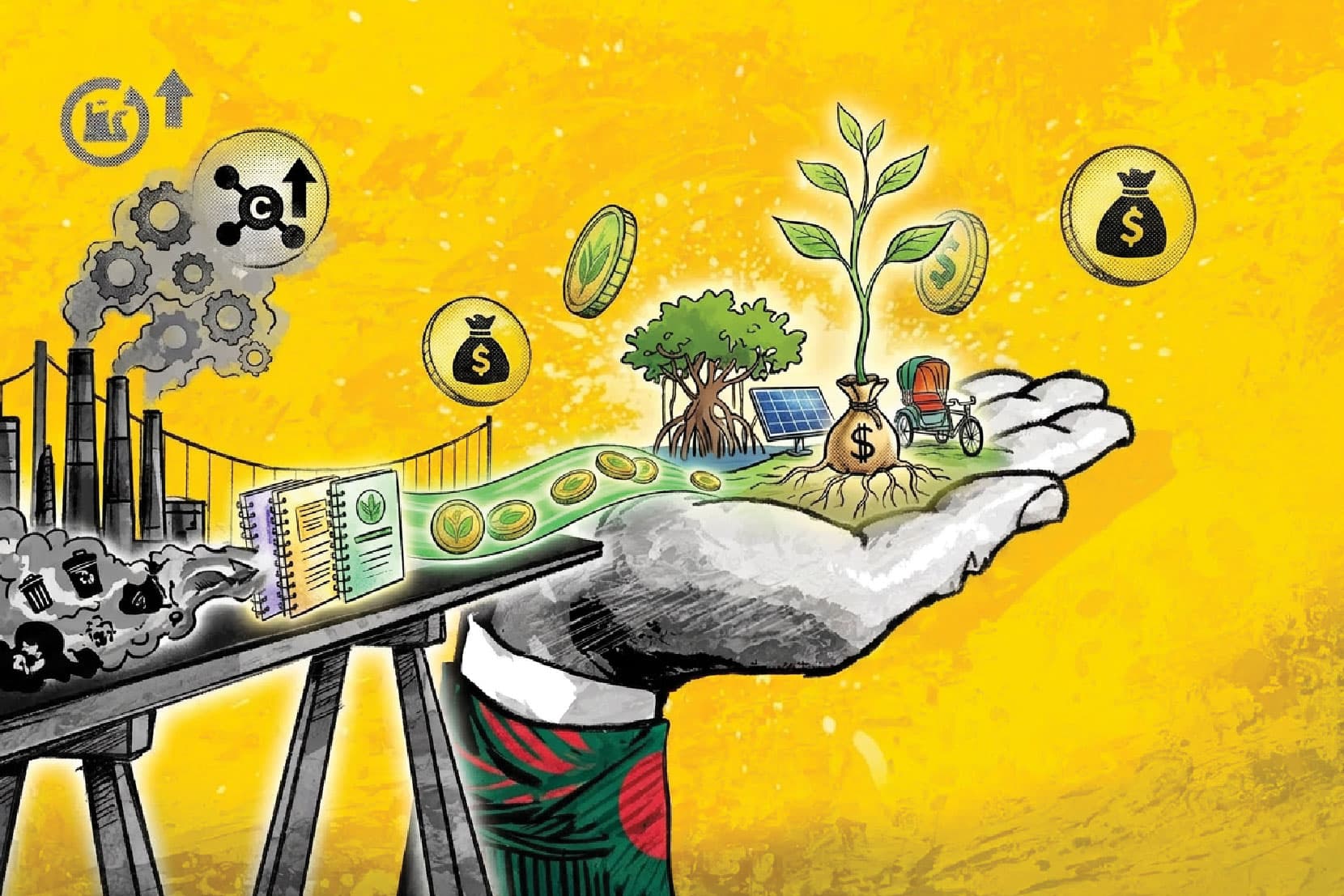
Bangladesh is aiming to unlock a powerful new engine for economic growth by rolling out its nascent carbon economy framework, a move that holds the potential to convert environmental compliance into tradable wealth and attract global investment.

Illustrated By sk. yeahhia
10 April, 2026
Bangladesh has begun laying the groundwork for entry into the global carbon economy, with the rollout of the Bangladesh Carbon Registry and the 2026 Positive List for carbon trading. This move signals a shift in how the country approaches climate action as it transforms from a compliance burden into an economic opportunity. The urgency of this transition becomes clear when looking at Bangladesh’s emissions trajectory. The country emitted roughly 241 million tonnes of CO₂ equivalent in 2024, a dramatic rise from just 3 million tonnes in 1970. This increase reflects industrialisation, urbanisation, and growing energy demand. Yet Bangladesh still accounts for only about 0.3% of global emissions, placing it among the lowest emitters on a per-country basis. This dual reality of rising domestic emissions alongside low global responsibility makes carbon trading particularly relevant. It offers a pathway for Bangladesh to sustain economic growth while attracting climate finance from higher-emitting countries.
Entering the carbon market landscape
At its core, carbon trading transforms emission reductions into tradable assets. When a company reduces greenhouse gas emissions below a defined baseline, it can generate carbon credits and sell them in international markets. Globally, this has already evolved into a multi-billion-dollar industry, and Bangladesh is now positioning itself to participate. Experts estimate the country’s carbon credit market could grow at an annual rate of around 5.5% between 2025 and 2031, driven by sectors such as energy, transport, and manufacturing.
The 2026 Positive List is central to this emerging framework. In line with its Article 6 commitments under the Paris Agreement, Bangladesh is gradually integrating into global carbon trading markets. By identifying eligible sectors such as renewable energy, electric mobility, brick kiln modernisation, and forestry, it provides clarity for investors and businesses. These sectors are key engines of economic growth as well as the biggest drivers of emissions which makes them ideal candidates for carbon monetisation.
Under earlier mechanisms like the Clean Development Mechanism (CDM), Bangladesh generated only 1.26 million tonnes of carbon credits — a measly 0.53% of the global total. The new registry and trading framework aim to correct this by creating a structured, transparent marketplace. There are promising signs already — Bangladesh has secured a $16.76 million emission reduction purchase agreement linked to solar energy projects, including over 3.3 million solar home systems that have generated verified emission reductions. These early transactions demonstrate how climate action can directly translate into financial inflows.
Shapers of the emerging economy
While large industries stand to benefit, the emerging carbon economy extends far beyond factories and power plants. It is increasingly being shaped by a diverse ecosystem of actors working across different levels. At the grassroots level, local organisations are generating the foundation of this market: measurable emission reductions. Groups such as Bondhu Foundation and Sustainable Agriculture Foundation Bangladesh work directly with communities to implement projects for mangrove restoration, agroforestry, and climate-smart agriculture, and these initiatives go beyond environmental conservation. By quantifying carbon sequestration and emission reductions, they are converting everyday rural practices into verifiable and tradable climate assets. In doing so, they are effectively turning landscapes into sources of climate finance. Alongside, organisations such as Arannayk Foundation and Mati Organic are playing a pioneering role in translating policy into practice. Through feasibility studies and pilot projects, they are exploring how sectors often overlooked in traditional decarbonisation, such as community forestry and regenerative agriculture, can be integrated into carbon markets. Their work demonstrates how carbon finance can extend into areas where mitigation and livelihood benefits intersect.
However, generating carbon assets is only the first step. Bridging the gap between local initiatives and global markets requires technical expertise and credibility. This role is increasingly being filled by project developers such as Varaha and the Syngenta Foundation for Sustainable Agriculture. These entities design methodologies, ensure compliance with international standards, and manage the complex processes of measurement, reporting, and verification (MRV). Without this layer of validation, locally generated credits would struggle to gain acceptance in international markets. In essence, these intermediaries transform grassroots climate action into certified, bankable assets. Financial and institutional actors form the third pillar of this emerging ecosystem. Organisations such as Palli Karma-Sahayak Foundation, along with commercial banks, are beginning to treat carbon credits as a viable asset class. By aggregating small-scale projects, providing upfront financing, and facilitating market access, they help address one of the biggest barriers in carbon markets: scale. Their involvement illustrates the growing confidence in the fact that carbon finance can be integrated into Bangladesh’s broader financial system.
Without this layer of validation, locally generated credits would struggle to gain acceptance in international markets. In essence, these intermediaries transform grassroots climate action into certified, bankable assets.
Positioned to attract international investment
Moreover, this evolving ecosystem is also attracting international interest. Global corporations such as Japan’s Mitsui & Co., and Sumitomo Corporation are actively seeking high-quality carbon offsets to meet their climate commitments. Mitsui aims to deploy an Alternate Wetting and Drying system across 250,000 hectares of farmland to reduce water use, increase crop yields by 10%, and lower methane emissions. Meanwhile, Sumitomo is targeting methane leakage in gas pipelines. For such buyers, Bangladesh presents an attractive frontier, offering relatively low project costs, significant mitigation potential, and strong co-benefits in terms of livelihoods and ecosystem restoration. If these linkages mature, they could unlock new income streams for rural communities. Farmers, forest-dependent households, and local cooperatives could receive payments tied directly to environmental outcomes. In this way, carbon markets have the potential to embed climate finance within grassroots development.
Past experience shows that carbon markets can falter without strong governance, so there will be many challenges for this growing economy. Ensuring transparency, accurate measurement, and the prevention of double counting will be essential to maintaining credibility. There is also a broader concern around equity. While carbon trading can attract investment, it must not distract from the fundamental goal of reducing emissions at scale. Policymakers will need to strike a careful balance between enabling market mechanisms and enforcing meaningful climate action. Bangladesh’s entry into the carbon economy is still in its early stages, but efforts to shape it into a coordinated system in which local initiatives, technical intermediaries, and financial institutions work together to transform emissions reductions into economic value.


%20Square%20Ad%20-11.jpg&w=640&q=75)
%20Horizental%20AD-01.jpg&w=3840&q=75)
