

Climate Corner
As awareness of sustainability grows, Bangladesh faces a harder question: who should bear the cost of making consumption more responsible when greener choices remain more expensive and less accessible?

Illustrated By sk. yeahhia
16 August, 2026
We scroll through Instagram and Facebook and see videos about climate change, plastic pollution, fast fashion, unethical labour and the environmental cost of the things we buy. We learn where our clothes come from, how much plastic we use and how much waste we produce. We become more aware. And then we go shopping.
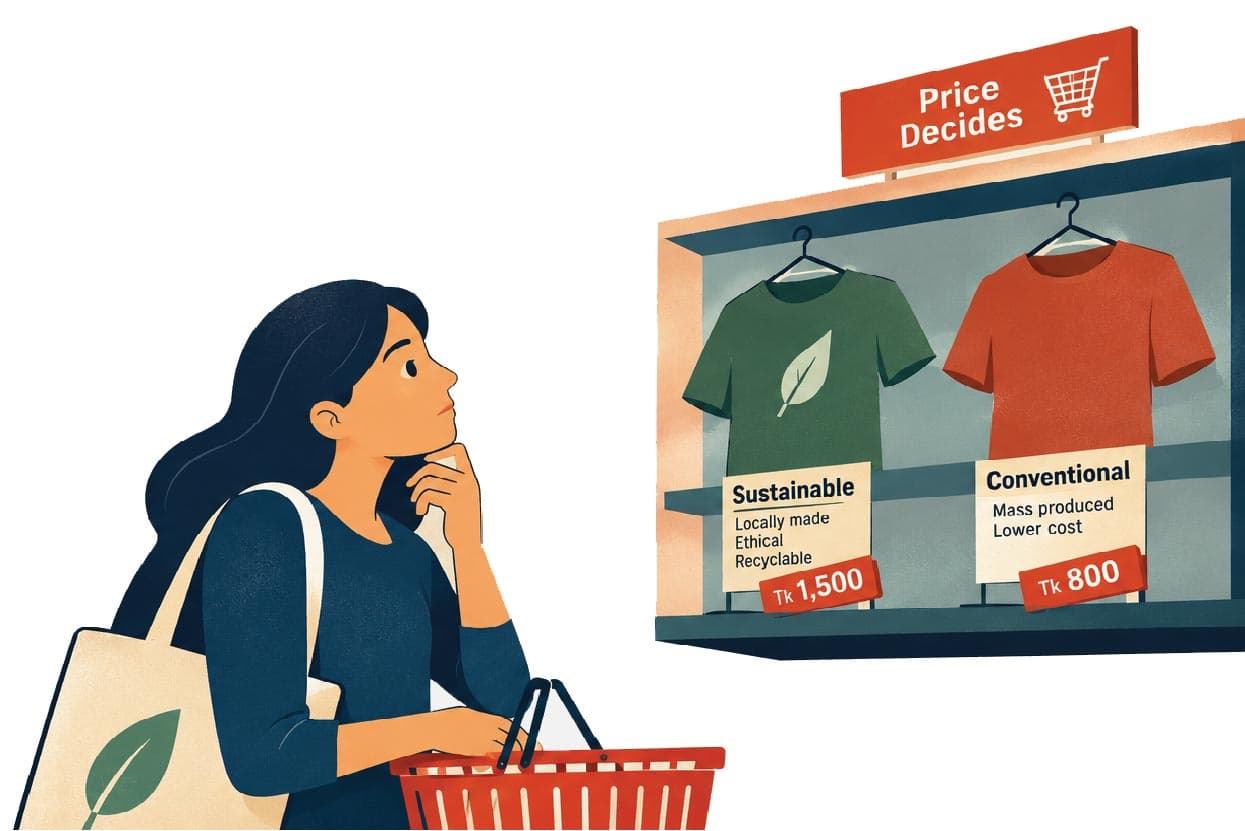
We see the sustainable product sitting beside the conventional one. The sustainable one is locally produced, ethically sourced, recyclable, biodegradable or made from recycled materials. And it is more expensive. So we buy the other one.
This is often described as the intention-action gap, the difference between what consumers say they care about and what they actually do when they have to make a purchase. But perhaps we are asking the wrong question. Instead of asking why consumers do not act according to what they believe, perhaps we should ask: what happens when the sustainable choice is simply harder to afford?
The Cost of Caring
The internet has made sustainability easier to understand, but the market has not necessarily made it easier to practise. Many Bangladeshi consumers may be familiar with the value of eco-friendly clothing, yet awareness alone does not determine what they buy. Cost, quality and availability continue to shape purchasing decisions, often making conventional products the more practical choice.
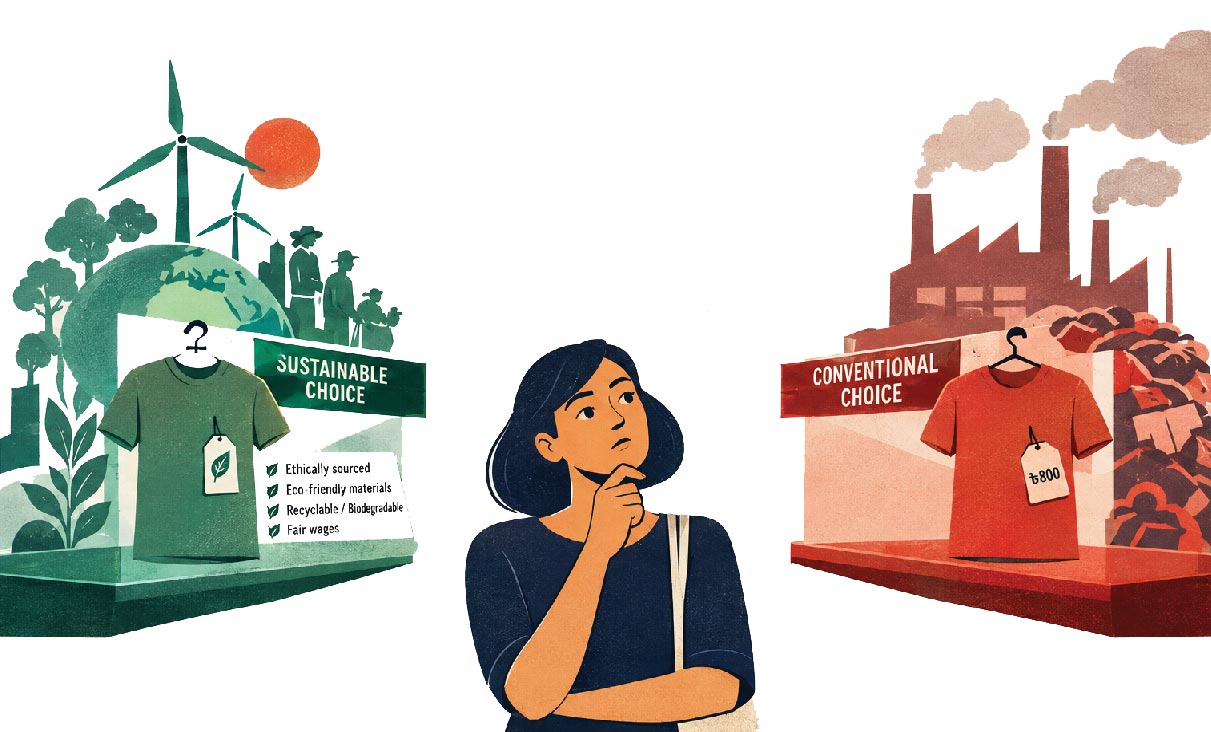
This makes sense. Imagine two shirts. One is produced cheaply and sold everywhere. The other uses more sustainable materials, perhaps pays workers better, uses cleaner production methods and creates less environmental damage. If the first costs BDT 800 and the second costs BDT 1,500, the decision is no longer simply about whether you care about the environment. It is also about whether you can afford to care through your consumption. And that is where sustainability becomes complicated.
Imagine two shirts. One is produced cheaply and sold everywhere. The other uses more sustainable materials, perhaps pays workers better, uses cleaner production methods and creates less environmental damage. If the first costs BDT 800 and the second costs BDT 1,500, the decision is no longer simply about whether you care about the environment.
Why Doing Better Costs More
There is a common assumption that sustainable businesses simply charge more because sustainability has become a marketing trend. Sometimes that may be true. But there is also a basic economic explanation. Producing responsibly costs money.
If a company pays fairer wages, improves working conditions, uses better materials and adopts cleaner production methods, its costs naturally increase. Conventional products may seem cheaper because their environmental and social costs, whether in the form of pollution, waste or poor labour conditions, are often not reflected in their price.
The sustainable producer, meanwhile, may be trying to account for some of these costs. That does not automatically make the sustainable product overpriced. Sometimes it simply means the conventional product is cheaper because someone else is paying part of its real cost.
The Scale Trap
But then comes another problem: demand. Sustainable businesses need customers. If only a small group of consumers are willing or able to buy sustainable products, producers cannot always manufacture at the same scale as businesses selling conventional alternatives. And scale matters.
A factory producing 10,000 units can spread machinery, transportation, design, research and other fixed costs across many more products than a small producer making 500. The larger producer can negotiate better prices with suppliers, distribute products more efficiently and recover its investment across a larger number of sales. The smaller sustainable producer cannot always do that.
The result is a frustrating cycle. Low demand means smaller production. Smaller production means higher unit costs. Higher costs mean higher prices. Higher prices discourage consumers. And lower demand keeps the producer small. It is not simply that sustainable products are expensive. Sometimes, we have not yet built a market large enough to make them cheaper.
Bangladesh's experience with alternatives to polythene provides a useful example. When demand for jute, paper and other alternatives surged ahead of the government's plastic-bag restrictions, manufacturers reported that these alternatives were still more expensive than conventional plastic. They also said that costs could fall if production increased with adequate support.
Governments can provide incentives for cleaner production, support small sustainable producers and invest in technologies that reduce production costs. Better information and credible sustainability labels can also make it easier for consumers to know whether the premium they are paying actually represents a more sustainable product.
Who Should Pay the Premium?
But there is another question we do not ask often enough. Who should actually pay for sustainability? Should the consumer pay the entire premium? Should a small business absorb the cost of cleaner production? Should workers accept lower wages so that sustainable products remain affordable?
Obviously, the last option cannot be the answer. Sustainability cannot mean protecting the environment by making the people producing sustainable goods poorer. A product cannot truly be called sustainable if the environment is protected while the people producing it remain economically vulnerable.
This becomes particularly important for Bangladesh, where the fashion industry is deeply connected to employment and livelihoods. If we want ethical and sustainable fashion, we have to think about the worker producing the garment as much as the material used to make it. Sustainability has to include both: people and the planet.
Making Behaviour Change Possible
A recent example is Aarong’s decision to charge for paper shopping bags and encourage customers to bring reusable ones, while offering BDT 15 cashback. While the move faced criticism over shifting the cost of sustainability to consumers, Aarong later reported a reduction of 46.79 lakh paper bags, with proceeds directed towards environmental initiatives.
The Aarong example raises an important question. If sustainability requires consumers to change their habits, how much inconvenience or additional cost can reasonably be placed on them? A BDT 15 charge may seem insignificant to one consumer and unnecessary to another. But perhaps the larger lesson is that sustainable consumption is about designing incentives that make changing behaviour possible and meaningful.
There are already other examples in Bangladesh of businesses trying to make this transition easier by creating more environmentally friendly shopping experiences and explicitly linking their models to Sustainable Development Goal 12: responsible consumption and production.
There are also Bangladeshi businesses working with jute, recycled materials, upcycling, handmade products and local artisans. These alternatives matter because sustainable consumption does not necessarily have to mean importing an expensive foreign lifestyle.
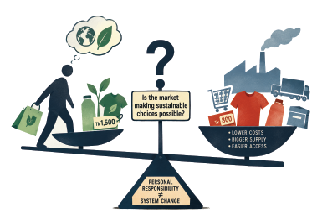
Because the real paradox is not simply that consumers know what is right and still choose differently. The paradox is that we keep asking people to make environmentally responsible choices while making environmentally damaging choices cheaper, easier and more accessible.
Consumption Beyond the Checkout
And perhaps most importantly, we need to ask questions. Where did this product come from? How long will it last? Can I reuse it? Can I repair it? Do I actually need it? Conscious consumption does not have to mean buying the most expensive sustainable product available. Sometimes the most sustainable purchase is the one you do not make.
At the same time, businesses need to make sustainable products more affordable and available. Governments can provide incentives for cleaner production, support small sustainable producers and invest in technologies that reduce production costs. Better information and credible sustainability labels can also make it easier for consumers to know whether the premium they are paying actually represents a more sustainable product.
From Premium to Standard
Consumers can create demand, but they cannot build the market alone. Sustainable consumption should not be treated only as a matter of personal responsibility when sustainable choices remain more expensive and less accessible. The real question is not why consumers do not choose sustainably, but whether the market allows them to.
Because the real paradox is not simply that consumers know what is right and still choose differently. The paradox is that we keep asking people to make environmentally responsible choices while making environmentally damaging choices cheaper, easier and more accessible.
Conscious consumption should not be a luxury available only to those who can afford it. At some point, sustainability has to stop being a premium product and become the standard. The goal should not be to create perfect consumers. It should be to create a market where making the better choice does not require being the richer consumer.


