

Climate Corner
Carbon markets can reward Nepal for protecting its forests, but they cannot replace a destroyed bridge or rebuild a damaged hydropower plant. The gap points to a larger problem in global climate finance.

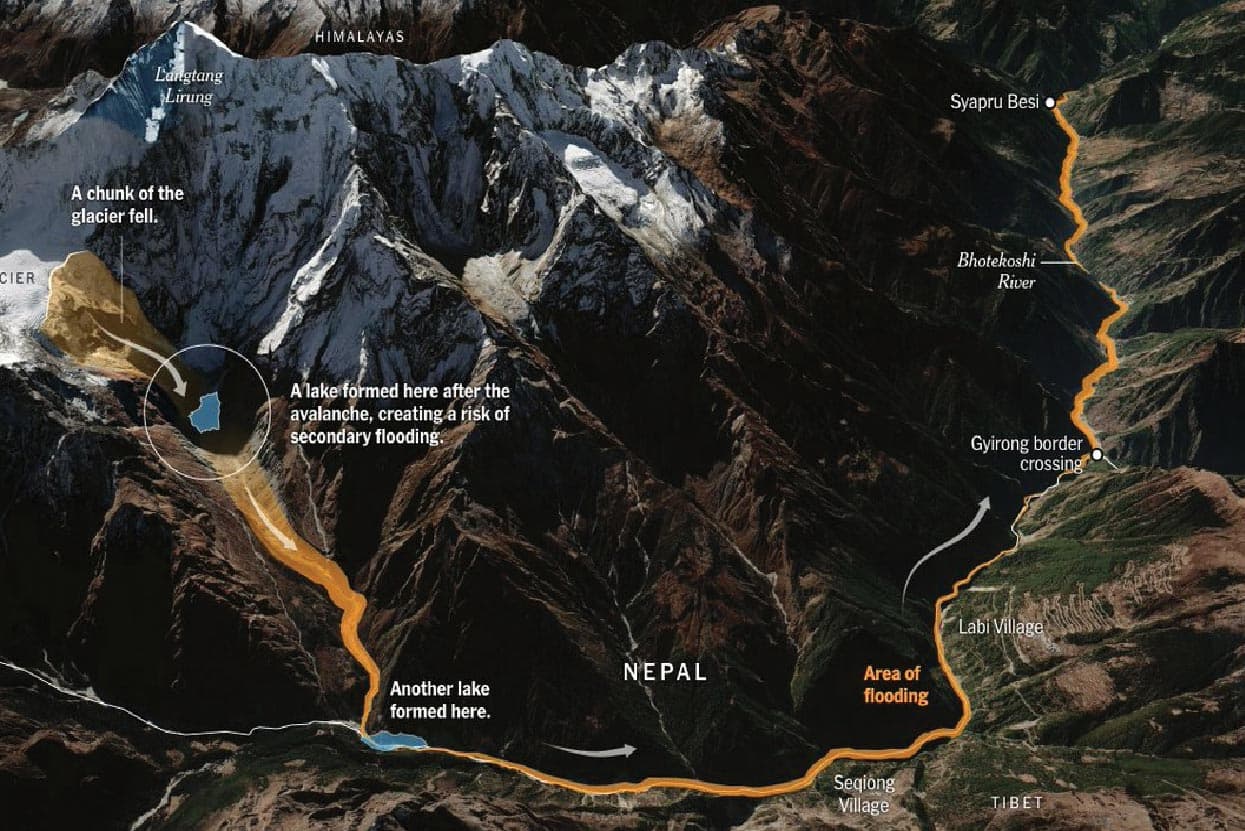
Photograph collected
21 August, 2026
On 26 August 2026, a disaster in the high Himalayas quickly developed into an economic and financial shock. A glacier-related collapse near the Nepal–China border triggered devastating floods and debris flows, damaging roads, bridges, settlements and hydropower infrastructure. What initially appeared to be a disaster in a remote mountain region soon exposed vulnerabilities in foreign investment, electricity generation, trade, supply chains and public finances.
Nepal's preliminary estimate puts the cost of rebuilding damaged infrastructure at USD 4-5 billion, nearly 10% of the country's economy. More than 12% of its electricity-generating capacity has reportedly been affected. Several hydropower projects involving foreign investors and international development finance have also suffered serious damage.
The scale of the consequences raises a larger question. How can a single climate-related event disrupt years of investment and development in a country that contributes only a tiny share of global greenhouse-gas emissions?
The answer lies in understanding climate change not only as an environmental problem, but as an economic and financial one.
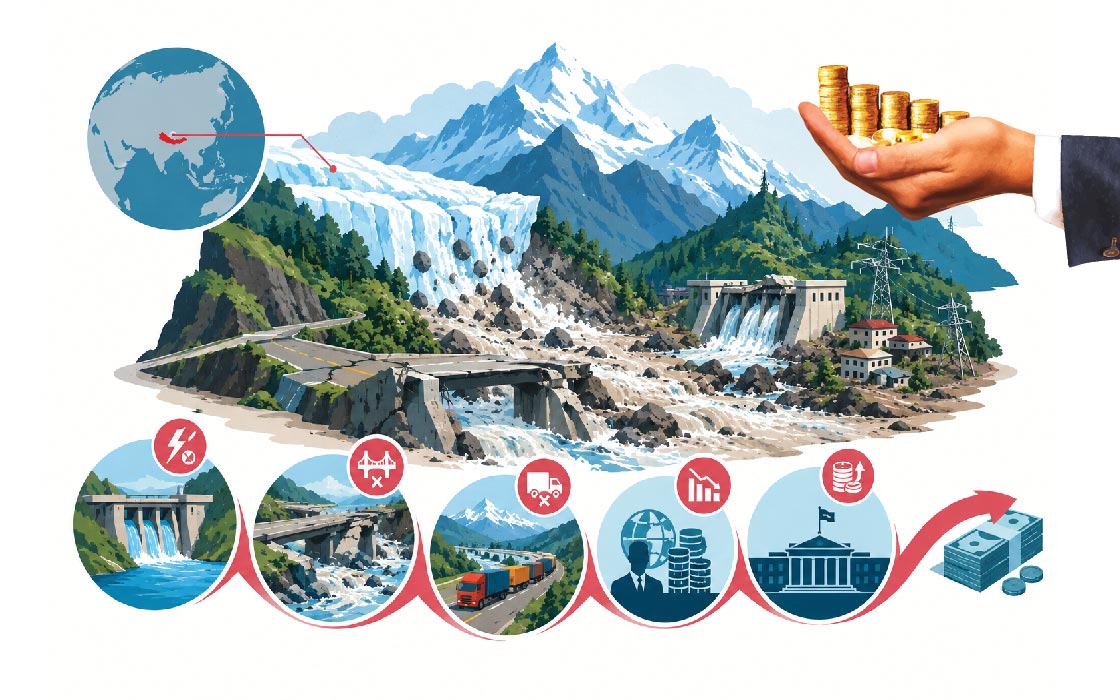
From a Mountain Disaster to an Economic Shock
A flood does not only destroy physical infrastructure. It can also disrupt the economic activity that infrastructure makes possible.
Consider hydropower for Nepal. Hydropower is a major development opportunity and a potential source of electricity revenue and exports. A hydropower plant embodies years of investment, construction expenditure, debt financing, employment and expected future revenues. When the project is damaged, those expected economic returns are disrupted as well.
The current disaster illustrates this risk. Several hydropower sites have been damaged, including the 216-megawatt Upper Trishuli-1 project, backed by South Korean investors and the World Bank's International Finance Corporation.
The economic chain is therefore much longer than the flood itself:
Climate hazard g infrastructure damage g investment losses g lower electricity production g lower revenue g fiscal pressure g higher reconstruction costs.
The same transmission mechanism applies to roads, bridges and border infrastructure. Nepal is landlocked and depends heavily on transport corridors to connect its economy with neighbouring countries. Damage to a major route connecting Nepal and China can delay imports and exports, increase transportation costs and disrupt businesses. A destroyed bridge is therefore not simply a construction expense. It can also represent lost trade, lost income and lost investment. A disaster lasting hours can produce economic effects lasting years.
Climate Risk Is Becoming Investment Risk
This is one of the most important economic lessons from the disaster. Infrastructure investment depends on expectations about future returns and the risks that could undermine them. Climate change is altering both sides of that calculation. A hydropower project may be designed to operate for decades, but rising exposure to extreme floods, landslides and glacier-related hazards can alter its expected returns over that entire investment horizon.
Investors may demand stronger insurance, additional safeguards or higher returns to compensate for greater risk. Lenders may also reassess whether a project can generate enough revenue to repay its debt.
In economic terms, climate change can increase the risk premium attached to investment.
This can create a damaging cycle:
Extreme events g asset destruction g weaker economic activity g fiscal deterioration g higher perceived risk g more expensive borrowing g slower reconstruction.
The damage therefore does not end when the floodwater disappears. Climate risk can remain embedded in the financial system.

The scale of the consequences raises a larger question. How can a single climate-related event disrupt years of investment and development in a country that contributes only a tiny share of global greenhouse-gas emissions?
The Inequality of Climate Vulnerability
Nepal's situation exposes a fundamental imbalance in the global climate system. Nepal contributes barely around 0.1% of global greenhouse-gas emissions, yet it is highly vulnerable to climate-related hazards. Its own climate commitments describe its contribution to global emissions as negligible.
This creates an uncomfortable contrast. Countries and industries that historically produced large quantities of greenhouse gases benefited from decades of carbon-intensive economic growth. Countries such as Nepal, meanwhile, can face severe economic consequences from climate change despite having contributed relatively little to global emissions. This is not just a moral argument, but an economic one.
When a country with limited fiscal capacity must suddenly spend billions rebuilding infrastructure, those resources have an opportunity cost. Resources diverted to repairing a destroyed road cannot simultaneously be used to build a new school. Similarly, resources devoted to rebuilding a hydropower plant mean that resources will be unavailable for healthcare, education and other development priorities. Climate disasters can therefore slow development even when the disaster itself lasts only a few hours.
When Climate Damage Reaches the Government Balance Sheet
The problem becomes even more serious when it reaches the government budget. After a major disaster, governments often face rising expenditure at the same time that economic activity and public revenues are weakening. They may need to repair infrastructure, provide emergency assistance, support affected businesses and restore trade routes. At the same time, damaged economic activity can reduce tax revenues. The result can be a larger fiscal deficit and greater demand for borrowing. For a developing country, this creates difficult choices: increase borrowing, cut other expenditure or delay reconstruction. This is how climate disasters can become sovereign financial risks.
A country may end up borrowing to rebuild assets that were themselves supposed to generate future growth and government revenue. If repeated disasters create repeated borrowing needs, climate change can gradually reduce fiscal space.
Over time, this can create a climate-development trap:
Disaster g reconstruction debt g weaker fiscal space g slower development → greater vulnerability to the next disaster.
This is where climate finance becomes critical.
Where Do Carbon Credits Fit?
One of the most discussed instruments in climate finance is the carbon credit.
A carbon credit generally represents one tonne of greenhouse-gas emissions that has been reduced, avoided or removed, subject to the rules and verification standards of the relevant carbon market or programme.
For Nepal, this is particularly relevant because of its forests. Protecting forests can preserve carbon stocks while also supporting biodiversity, watersheds and rural livelihoods. Nepal has already begun receiving financial benefits from forest-carbon programmes.
In 2025, Nepal received USD 9.4 million from the World Bank's Forest Carbon Partnership Facility for reducing approximately 1.88 million tonnes of carbon dioxide through its REDD+ programme. Nepal has also signed an agreement with the LEAF Coalition that could potentially bring up to USD 55 million through the purchase of high-integrity forest carbon credits.
These developments matter. They illustrate how verified emissions reductions can become a source of economic value for a country whose contribution to global emissions is very small. But there is a crucial limitation.
This distinction has become particularly relevant in Nepal's response to the disaster. The country's recent call for greater international responsibility, specifically from India, China and USA, for climate-related losses highlights the gap between being rewarded for reducing emissions and receiving financial support when climate impacts cause physical and economic damage.
Carbon markets and disaster finance serve fundamentally different purposes. Carbon credits reward emissions reductions or removals, while adaptation and loss-and-damage finance address the physical and economic consequences of climate change. A carbon payment can create valuable revenue for forest protection and resilience, but it cannot directly replace a destroyed bridge, restore a damaged hydropower plant or cover a multibillion-dollar reconstruction programme.
Carbon credits should not be treated as a substitute for disaster-risk financing or loss-and-damage support. The difference becomes clear when we consider the scale. Nepal's USD 9.4 million forest-carbon payment and potential USD 55 million LEAF agreement are significant sources of climate finance. Yet the estimated reconstruction requirement from the current disaster is USD 4-5 billion.
The figures are not directly comparable because the programmes serve different purposes. But the contrast reveals a fundamental gap. The international system can pay Nepal for the carbon it keeps out of the atmosphere. It does not automatically pay Nepal for infrastructure destroyed by climate-related hazards.
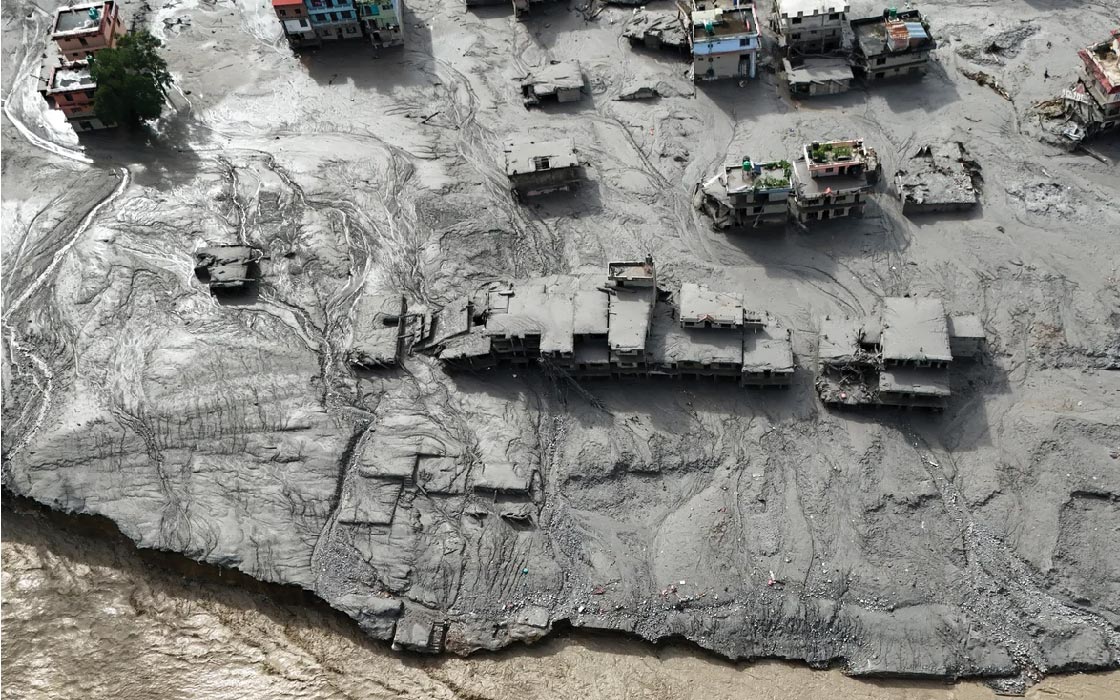
The Warning from the Himalayas
The Nepal–China disaster should not be viewed only as a tragedy in a remote mountain region. It is a warning about the future economics of climate change.
Infrastructure built today is expected to operate for decades. But its financial returns depend on the physical environment remaining sufficiently stable. As climate risks increase, that assumption becomes less obvious.
The question is therefore no longer only how much carbon a country emits. It is also how much financial risk that country inherits from a changing climate. Nepal's contribution to global emissions is tiny. Its exposure to climate risk is not.
Carbon credits can help Nepal earn from protecting the world's carbon sinks. They can create incentives for conservation and provide valuable climate finance. But they cannot, on their own, pay for the economic losses created when climate hazards destroy the physical foundations of development.
The larger lesson is simple, a global economy that prices carbon must also learn to price vulnerability.
If the international community benefits from emissions reductions generated by countries such as Nepal, climate-finance mechanisms should also provide greater support for resilience against climate risks those countries have contributed relatively little to creating.
The future of climate finance should therefore not be about choosing between carbon markets and loss-and-damage finance. It should be about building a system in which mitigation is rewarded, resilience is financed and unavoidable loss is not left entirely on the balance sheet of the vulnerable.


