

Climate Corner
Renewables are a vital safeguard for energy security during global crises. So why aren’t we jumping on board already?

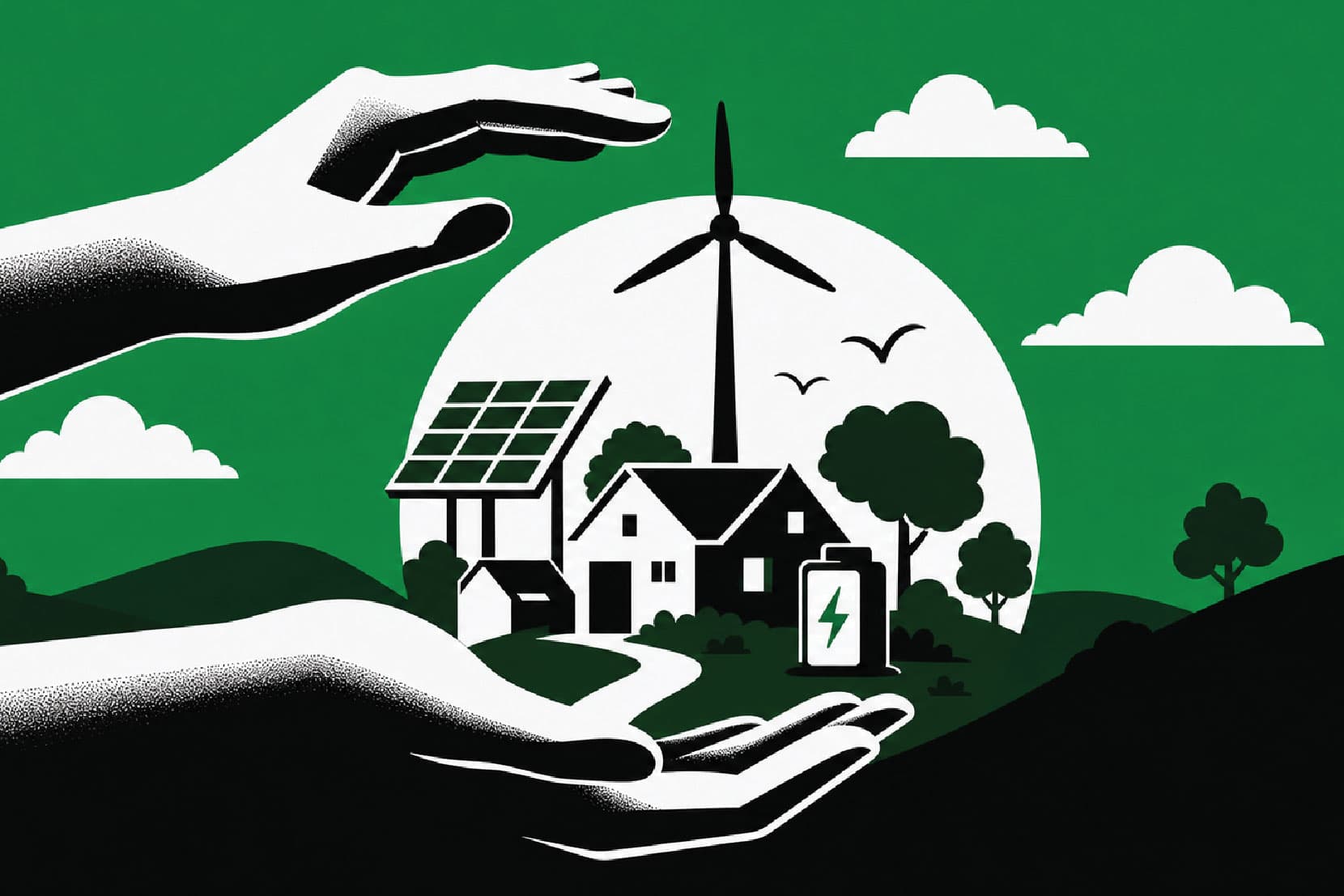
Illustrated By sk. yeahhia
23 May, 2026
The conversation around renewable energy tends to be confined to its role in combating climate change, but transitioning from fossil fuels to renewable sources of energy presents countries with another huge advantage — the opportunity to wean themselves off of expensive fossil fuel imports that expose domestic economies to blowbacks from international crises.
In 2022, inflation in Bangladesh shot up following an escalation of hostilities between Russia and Ukraine, its foreign reserves coming under severe strain as it paid five times more for Liquefied Natural Gas (LNG) imports than it did in 2021. Today, four years later, another distant war, this time in Southwest Asia, has Bangladeshi commuters waiting hours at petrol pumps to be turned away; universities closing early for Eid; and the government issuing directives for shopping malls not to use excessive lighting, to say nothing of the looming threat of loadsheddings and widespread economic upheaval.
Though Iran has assured safe passage to fuel shipments heading to Bangladesh through the Strait of Hormuz, which was closed to traffic following the war’s onset on February 28, major fossil fuel producers based in the Gulf Arab states have declared force majeure, meaning they cannot fulfill their contractual agreements to buyers due to unforeseeable and unavoidable catastrophic events. These are concerning developments for Bangladesh, which imported 109 LNG cargoes worth USD 3.88 billion in 2025, 40 of them from QaterEnergy, 21 from Oman’s OQ Trading, and 28 from the spot market through various energy supplying companies, many of which are based in Gulf states.

As of January 2026, natural gas makes up 38.6% of Bangladesh’s energy mix. If LNG exporters cannot fulfill their contractual agreements, Bangladesh’s economy will grind to a halt and costs of living will skyrocket.
Renewable energy is far less prone to geopolitical and economic disruption. The equipment to generate it may have to be imported, but the energy generation itself occurs using natural resources that are available in abundance, namely sunlight, rapidly flowing water, and strong winds. Despite the strong rationale, renewables only make up 5.24% of Bangladesh’s energy mix as of January 2026.
There are modest plans to grow renewable capacity. Per the Renewable Energy Policy 2025, Bangladesh will generate 20% of its electricity from renewable sources by 2030, and 30% by 2041. The Third Nationally Determined Contributions (NDC 3.0) submitted to the UNFCCC in 2025 articulates plans to retrofit 50% of existing government buildings, institutions, schools, and hospitals to be powered by rooftop solar PV systems by 2035, and requires all new government buildings, institutions, schools, and hospitals to be solar-powered.
The NDC 3.0 further aims to switch out 25% of buses in the Dhaka city area with Electric Vehicles (EVs) by 2035. Success on this front might lessen transport disruptions during future global crises. Bangladesh can follow in the steps of Thailand’s Bangkok E-bus Programme, which replaces fossil fuel-fired buses with e-buses on a number of busy bus lines. The programme generates carbon credits, whose revenues cover the cost of buying and maintaining the e-buses.
The government of Bangladesh is also keen to promote the solarisation of diesel irrigation pumps currently being used in agriculture. Roughly 1.22 million diesel pumps and more than 430,000 electric pumps are used to irrigate farmlands in Bangladesh. Replacing them with energy efficient solar irrigation pumps would cut consumption of approximately 1 million tons of imported diesel fuel annually, gradually making Bangladesh’s agriculture sector less vulnerable to global shocks.
As of January 2026, natural gas makes up 38.6% of Bangladesh’s energy mix. If LNG exporters cannot fulfill their contractual agreements, Bangladesh’s economy will grind to a halt and costs of living will skyrocket.
The conversion of municipal waste, of which Bangladesh has plenty, to energy would further alleviate dependence on imported fuel. Modern landfill gas capture and processing technology can not only produce electricity, but also reduce methane emissions—a major contributor to global warming. A 42.5 MW waste-to-energy plant is currently under construction at Dhaka’s Aminbazar landfill. Though environmentalists have voiced their scepticism about the pollutants it will emit, the technology being used is said to comply with EU pollutant emissions standards.
Mass uptake of renewables is presently hindered by the perception that they are more expensive. In truth, while initial costs are higher, the International Energy Agency (IEA) has found that new renewable facilities have been delivering power at a lower lifetime cost than the cheapest fossil-fuel alternative for several years running.
The government of Bangladesh can take a number of initiatives to lower initial costs, like offer tax exemptions on imported solar PV equipment, or incentivise local manufacturers to produce it for both domestic and export markets. Financing can be sourced from institutions like the Green Environment Fund or multilateral development banks like the World Bank and Asian Development Bank. The government can also support carbon market activities that generate revenue from corporate and foreign buyers.
The successful rollout of renewables will require meticulous quality assurance of equipment, and a sizeable cohort of trained technicians to install, operate and maintain them. Political resolve will, of course, be paramount. What’s most important right now is to set the ball rolling. The knowledge that comes with experience is bound to help overcome the current reluctance to transition to renewables. Experience may embolden Bangladesh to aim for a larger share of renewables in its energy than presently planned, safeguarding itself from global crises that much more.
*
Anjum Noor Choudhury is a Climate Policy Research Consultant for Asian Development Bank HQ and the author of The Divining Thread (Harper Collins India). For a full list of her published works, please visit www.anjumchoudhury.com.


%20Square%20Ad%20-11.jpg&w=640&q=75)
%20Horizental%20AD-01.jpg&w=3840&q=75)
