

Tech
AI is fueling massive productivity gains in Bangladesh's industries, but the nation must quickly decide how to safeguard workers from the coming automation wave.

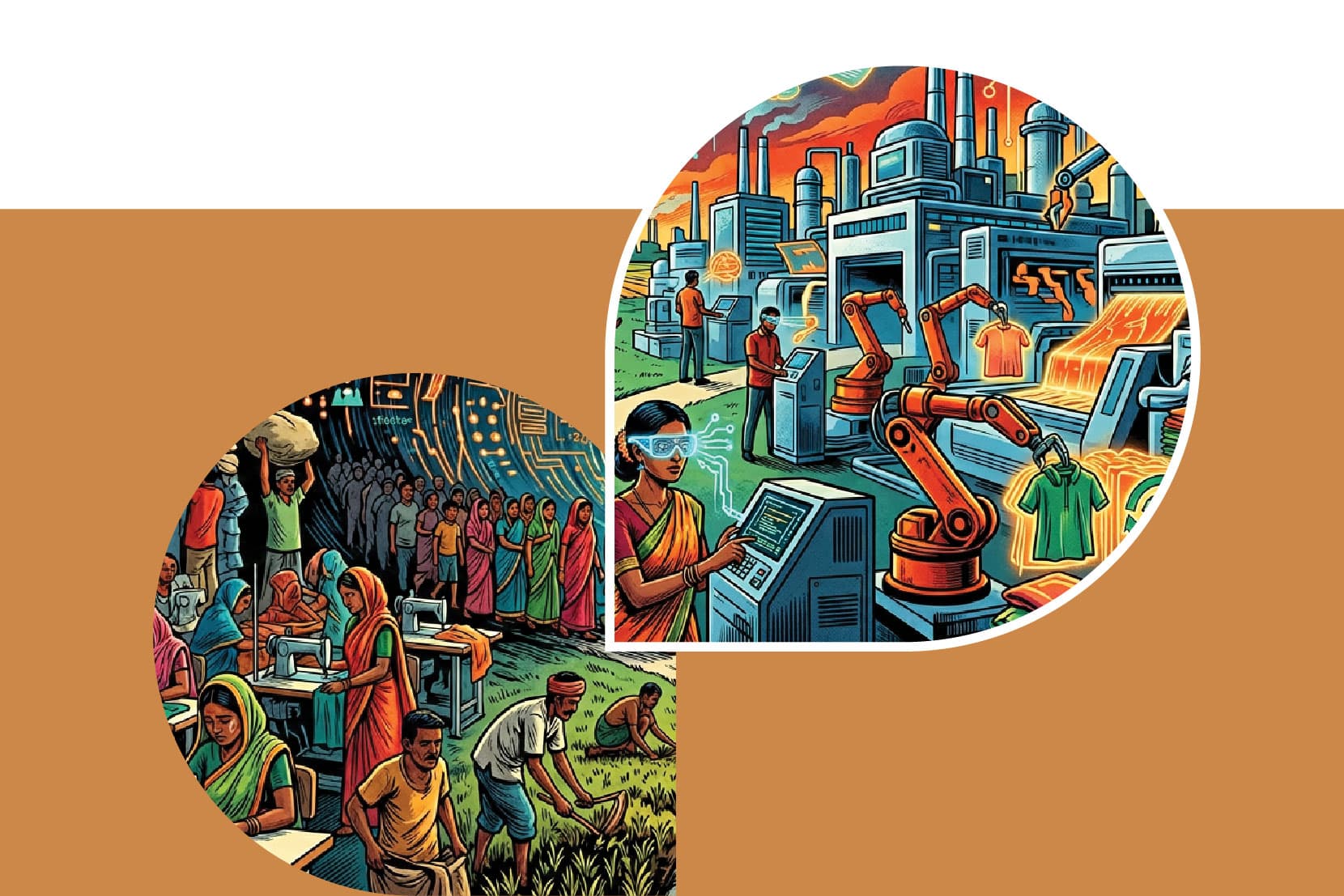
Illustrated By sk. yeahhia
20 April, 2026
For years, "AI adoption" meant deploying a customer service chatbot and calling it transformation. In 2026, that era is decisively over. What industry analysts are calling the year of "recalibrated AI" marks a fundamental change that Artificial intelligence has officially moved past the hype cycle in industrial and enterprise environments. The global economy now generates over 120 zettabytes of data annually, a figure projected to double before the end of the decade. The question is no longer whether AI can process this data, but who is putting it to work, where, and with what real-world consequence.
Bangladesh, whose economy relies on a manual labor force finds itself at a crossroads in this story. The country is not arriving at AI late but with urgency, with structural advantage, and with a great deal at stake.
The New AI Ecosystem in the Nation
Firms like Intelligent Machines Limited, BJIT Group, Vivasoft, and Socian AI are no longer niche tech consultancies but they are connecting Bangladesh's industrial giants to the algorithms that can reshape them.
Intelligent Machines (IM) is arguably the most instructive example of what purposeful AI deployment looks like in a developing market context. Rather than selling generic automation, IM develops sector-specific AI products with measurable industrial outcomes. IM’s precision marketing product, Fordo, helped Unilever Bangladesh achieve a 260% stretch on its campaign targets in 2021. Their speech recognition product Shobdo delivered a 253% improvement in brand campaign execution accuracy for BAT Bangladesh. Most remarkably, their retail AI products Nimonton and Biponon helped bKash achieve a 76% productivity gain and a 15% monthly onboarding growth rate. These are not just numbers. These are production-scale results, earned in a market with real friction.
Conglomerates in Recalibration: Akij, Bashundhara, Beximco
Bangladesh's largest conglomerates have sprawling, multi-sector entities where supply chain inefficiency can cost millions and HR complexity across tens of thousands of workers creates enormous administrative drag. AI is beginning to change both.
Akij Group, with interests spanning textiles, ceramics, food processing, and more, has been among the most notable examples of automation-driven recalibration. Akij's push toward automation reduced factory staff by 12% while achieving a 27% increase in output.This makes Akij more competitive in a global market where margins are thin and buyer expectations are rising. Akij iBOS, a software subsidiary within the Akij family, is developing smart business solutions specifically designed to digitize and streamline conglomerate operations. Beximco has moved toward state-of-the-art machinery capable of tripling output with fewer errors and less waste. DBL Group, similarly, has adopted automation across its production lines. According to industry reports, over 350 Bangladeshi factories have already initiated automation projects, with nearly 20% achieving partial automation across production lines. The primary driver from the buyer side
is unambiguous: global fashion brands increasingly demand faster turnaround, higher compliance standards, and verifiable traceability. Automation and AI-assisted supply chain management can deliver that easily.
AI Benefits in Readymade Sector:
Bangladesh has more than four million workers in the readymade garments (RMG) sector which also provides more than 80 percent of the earnings in the country in the form of exports. It is also a sector that is under a great pressure owing to the soaring wages, demands by international consumers to receive faster turnaround and stronger ESGs and climate stress which threatens both supply-chains and factory-workers.
It is here that AI is making its most tangible industrial contribution in Bangladesh at the moment. Fakir Eco Knitwears, located in a LEED Gold-certified Narayanganj factory, uses AI cutting machines to recycle 95% of fabric scraps into new yarns within a circular production model, which is less expensive and will also comply with the future Ecodesign regulations of the EU. A neighboring large knit composite plant also experienced a 15-18% reduction of water usage in the dyeing department when sensor data was combined with process control software.
The ThreadBridge is an AI company that works in the RMG field proposing a real-time quality-detecting system with smart glasses and a mobile app that detects the defects in the garments in real-time. The system does not replace floor workers
but uses them in more productive, data-driven, quality assurance jobs. It is a system that is driven by factory floor reality: garment workers (with most being from poor tech backgrounds) are able to learn to use it within a short span of time.
Digital devices like JaNets by JUKI, IoT sensors that connect individual sewing machines to central performance dashboards have registered a 12% productivity improvement in the lines of a knitwear factory in Dhaka after adoption in 2025. Another sensor product that has a productivity gain of up to 10% and no additional labor is Nidle.
The analytics supply chain intelligence aspect of AI is enabling manufacturers to predict disruptions before they take place. AI systems can also propose alternative suppliers on the fly, without impacting production schedule, in case there is a delay in deliveries of raw material. The models of demand forecasting help the factories avoid over-production, stock management and accord to the philosophy of just-in-time manufacturing, which the RMG sector of Bangladesh has always been struggling to master.
Digital Product Passport (DPP) project, a joint venture of DigiProd Pass Ltd., Digital Architect Ltd., and BGMEA, is piloting the idea of tamper-proof real-time traceability of the raw materials to final garments. This puts Bangladesh in a good position in the next round of the Ecodesign regulation proposal by the EU, a move that would be decisive in accessing export markets in the coming years.
Is AI integration just for the sake of hype, or are they looking at the big picture?
Bangladesh is experiencing actual and practical developments on the industrial AI front - more than its digital literacy rates indicate it can. The entrepreneurial spirit of the AI agency ecosystem of Dhaka is real. Productivity increases in the RMG and agri-tech can be documented and the conglomerates are on the go.
However, there is a distinction between recalibrating AI to grow and recalibrating AI to grow inclusively. The zettabyte economy will create massive value - and Bangladesh has a justifiable claim to a large portion of it. The danger is that this value directly flows to the capital owners and export markets while the four million women on the factory floor face the consequences of AI efficiency. This would not only be unethical but economically suicidal in a nation where the social stability rests on mass employment.
Bangladesh might not be entirely ready, yet the zettabyte economy is coming. Buying decisions will not be the most critical decisions that Bangladesh will have to make in the next five years. The questions it should concern itself with are who will be trained to use AI, how will workers be safeguarded when it displaces jobs, and how the data which proliferates in the country, its farms, factories and financial systems, will be managed with the public interest in mind.


%20Square%20Ad%20-11.jpg&w=640&q=75)
%20Horizental%20AD-01.jpg&w=3840&q=75)
